THE PROBLEM OF LOST SATELLITES: Satellites are often lost during extreme geomagnetic storms. The reason: Models of Earth's upper atmosphere fail during some storms, introducing errors in estimates of satellite drag. A new study published in Space Weather solves the problem using a clever trick. Instead of modeling the atmosphere, researchers from MIT analyzed decades of satellite orbits to learn how spacecraft respond to space weather. When a storm hits, those historical patterns reveal what satellites are likely to do next. Read the original research.
LUNAR ECLIPSE REVEALS HOT SPOTS ON THE MOON: Of the millions of people who witnessed yesterday's total eclipse of the Moon, amateur astronomer "Wah" in Canada saw a lunar disk like no other. "I used a thermal camera to observe the eclipse," he explains. "The difference was amazing!"
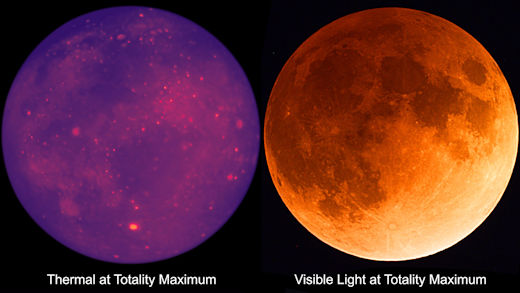
Wah's rare photo reveals a landscape dotted with hot spots glowing like stars strewn across the lunar terrain. There are 37 hot spots in total, headlined by craters Tycho, Plato, and Aristarchus.
This has been done only a handful of times in the Space Age, usually by large research telescopes. The earliest thermal eclipse observations came from infrared telescopes in the 1960s, before spacecraft explored the Moon. One classic experiment observed the Dec. 19, 1964, total lunar eclipse, producing thermal maps showing more than a thousand hot spots corresponding to rocky craters.
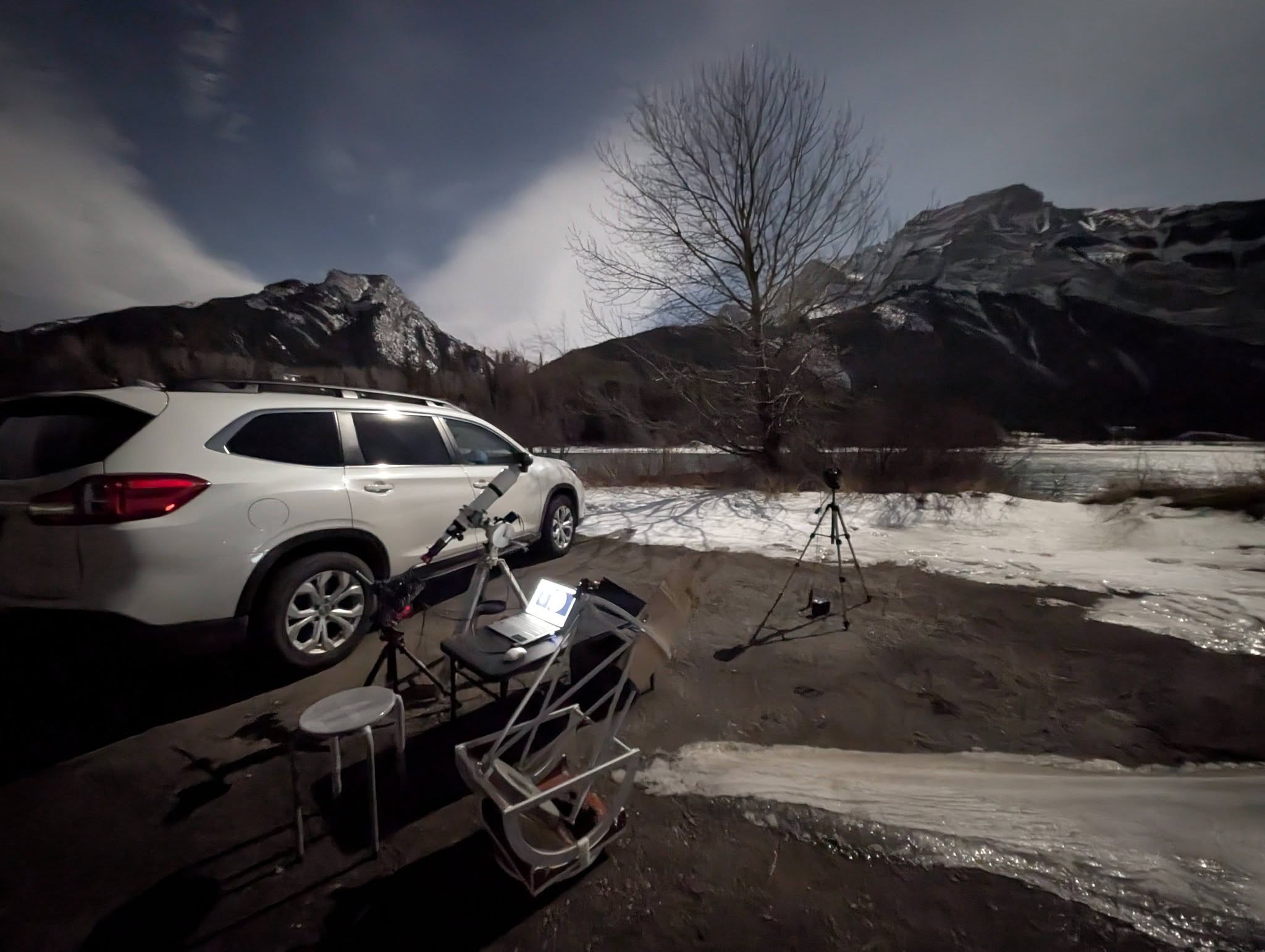 Wah's image was recorded at a wavelength of about 12 microns, where the Moon shines by its own heat rather than reflected sunlight. "My setup (pictured right) included a 640x512 thermal camera and a 12-inch Newtonian telescope," he says.
Normally, the surface of the full Moon is sizzling hot after two weeks of unremitting sunlight. But when Earth's shadow falls across the Moon during an eclipse, the sunlight switches off. Some parts of the lunar surface cool faster than others. Fine moondust loses heat rapidly, while young blocky craters hang on to their warmth, creating prominent hot spots.
Photos like this are not just novelties. When properly calibrated, they can measure the thermal inertia of lunar regolith and map different kinds of rock types in potential landing zones. With NASA aiming to return to the Moon, this kind of information could be as golden as a total eclipse.
more images from Wah: #1, #2, #3, #4.
Realtime Eclipse Photo Gallery
Free: Spaceweather.com Newsletter
THE RAINBOW ROSE FROM SPACE: This is no ordinary rose. It shimmers with all the colors of the rainbow, and it has been to the edge of space:
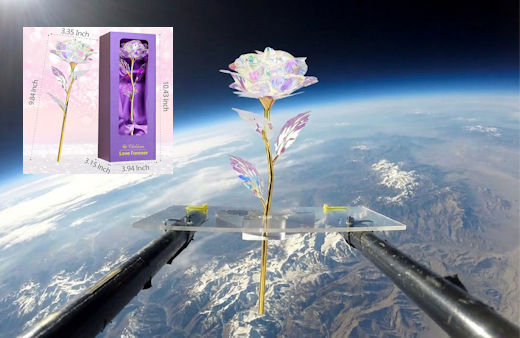
You can have it for $127.95. The rainbow rose flew through the stratosphere on Jan. 24th carried by an Earth to Sky Calculus cosmic ray research balloon. The artificial bloom comes with a greeting card showing the rose in flight, and telling the story of its journey to the top of Earth's atmosphere. It makes a great birthday, anniversary, or (coming soon!) Mother's Day gift.
Far Out Gifts: Earth to Sky Store
All sales support hands-on STEM education
Realtime Aurora Photo Gallery
Free: Spaceweather.com Newsletter
Realtime Space Weather Photo Gallery
Free: Spaceweather.com Newsletter