ALMOST NO CHANCE OF FLARES TODAY: There are six sunspot groups on the solar disk, yet none of them has an unstable magnetic field likely to explode. NOAA forecasters say there is no more than a 1% chance of X-flares on March10th. Solar flare alerts: SMS Text
EQUINOX AURORAS: During weeks around equinoxes, something happens that took scientists decades to understand: The magnetic field of Earth can link to the magnetic field of the sun. It's called the "Russell-McPherron effect," and it is responsible for these unexpected auroras over New York last night:
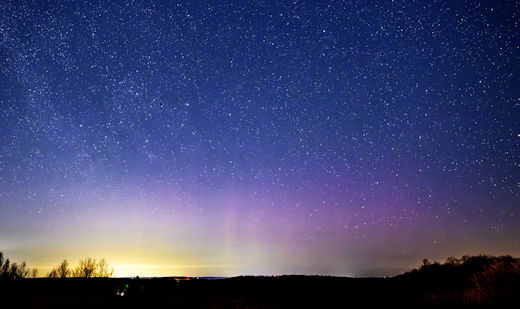
"The equinox enhancement is working," says photographer Jessica Fridrich of Binghamton, NY. "During other times of the year, storms in the Kp=3 range are normally not within what I can capture from here at 42N. This substorm, which occurred at 22:45 pm EDST was an overachiever."
Auroras love equinoxes! Stay tuned for more as the equinox approaches on March 20th. Aurora alerts: SMS Text
Realtime Aurora Photo Gallery
Free: Spaceweather.com Newsletter
THE SUN'S SHAG CARPETING: The sun is made of seething-hot hydrogen and helium.Yet if you take a close look, it resembles something completely different from the 1970s: a shag carpet. Thierry Legault photographed the texture on March 9th from Paris, France:
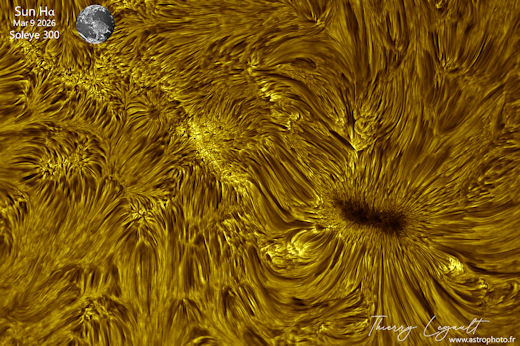
The technical name for the shaggy threads is "chromospheric fibrils." They are tendrils of plasma organized by magnetic fields in the sun's lower atmosphere (or "chromosphere").
Just like shag fibers, fibrils are extremely crowded. Thousands can occupy a region only a few thousand kilometers wide. Bunches of fibrils tend to "lean" the same way, giving the surface a visible texture--much like brushing shag carpet in one direction.
The only place these fibrils become really organized is near sunspots. There's one in Legault's image (AR4384). "It is shaped like an Earth-sized peanut," he says. Around that sunspot, fibrils become radial, plunging into the sunspot's dark core. The concentration of fibrils inside the sunspot could provide the magnetic energy needed for a solar flare. It's all in the weave....
more images: from Richard Schrantz of Nicholasville, Kentucky
Realtime Space Weather Photo Gallery
Free: Spaceweather.com Newsletter
THE BLUE MOON PENDANT: There's Blue Moon coming in May. You can have the Blue Moon Pendant now. The students of Earth to Sky Calculus flew it to the edge of space on Oct 11, 20925, onboard a cosmic ray research balloon:
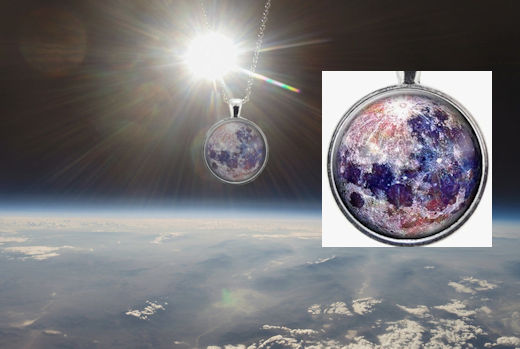
It's yours for $99.95. The colors of the pendent depict subtle but real colors on the Moon. Blue denotes areas rich in titanium, while orange is titanium poor. Titanium-rich zones are particularly interesting because lunar titanium is bound to oxygen--a key ingredient for life support in lunar greenhouses and spacesuits. The "Mineral Moon" shown on the pendant is a scientifically accurate map of these elements.
The pendant comes with a greeting card showing the Blue Moon in flight, and telling the story of its journey to the top of Earth's atmosphere. It makes a great birthday, anniversary, or (coming soon!) Mother's Day gift.
Far Out Gifts: Earth to Sky Store
All sales support hands-on STEM education
Realtime Aurora Photo Gallery
Free: Spaceweather.com Newsletter