PHOTOS WANTED--CALIFORNIA STARLINK LAUNCH: This morning just before 7 am PDT, a Falcon 9 rocket launched from Vandenberg Space Force Base carrying 25 Starlink satellites. Did you see it? Please submit photos here.
FRIDAY THE 13TH GEOMAGNETIC STORM: A corotating interaction region (CIR) hit Earth's magnetic field on March 13th, sparking a minor G1-class geomagnetic storm with auroras across northern-tier US states. Jessica Fridrich photographed the display from Binghamton, NY:


"These auroras appeared at ~00:30 EDT," says Fridrich. "It looks like we will have some nice conditions tonight and possibly tomorrow as we are just getting into a CIR. I encourage those living perhaps as far south as 38N to give it a shot."
CIRs are transition zones between fast- and slow-moving streams of solar wind. Often, they contain enhanced magnetic fields that connect to Earth's magnetic field, causing the kind of light show Fridrich witnessed.
Minor (G1) to moderate (G2) geomagnetic storms are possible on March 13-14 as a result of the CIR. Aurora alerts: SMS Text

Realtime Aurora Photo Gallery
Free: Spaceweather.com Newsletter
WHAT'S HAPPENING INSIDE THESE SUNSPOTS? If you stare at a sunspot long enough, you may start to see things you cannot explain. Here are two examples:
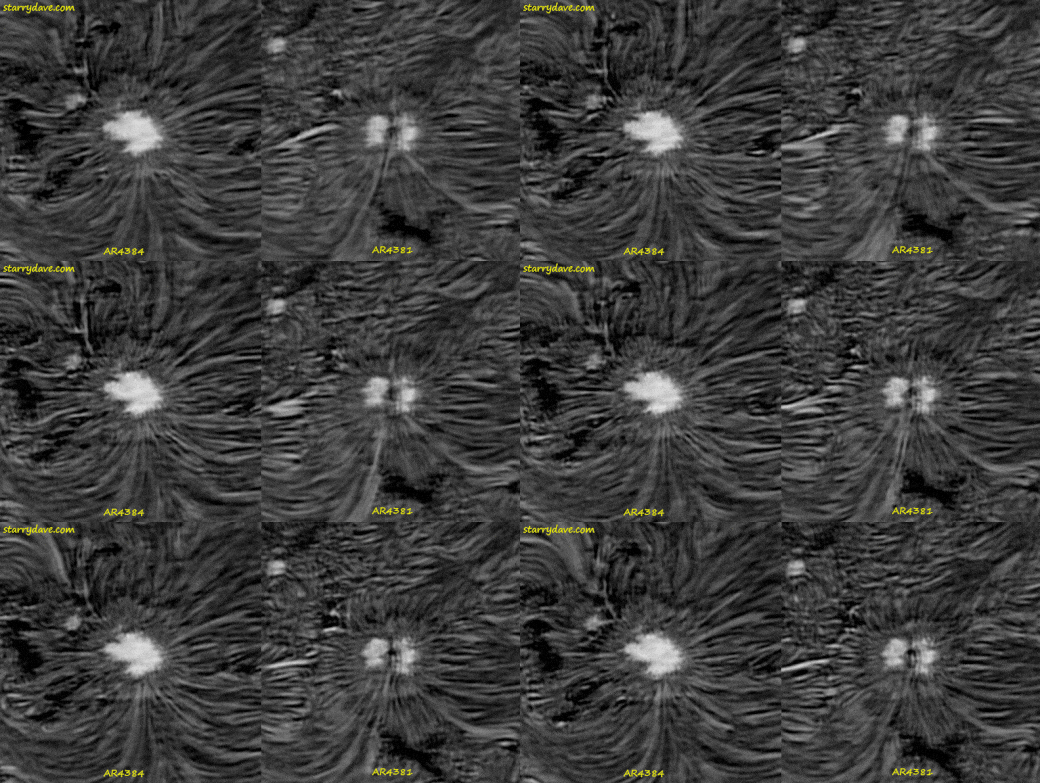
David Wilson of Inverness, Scotland, made these movies last week. "They are 'umbral flashers'," he says. "I inverted the video to better show the phenomenon."
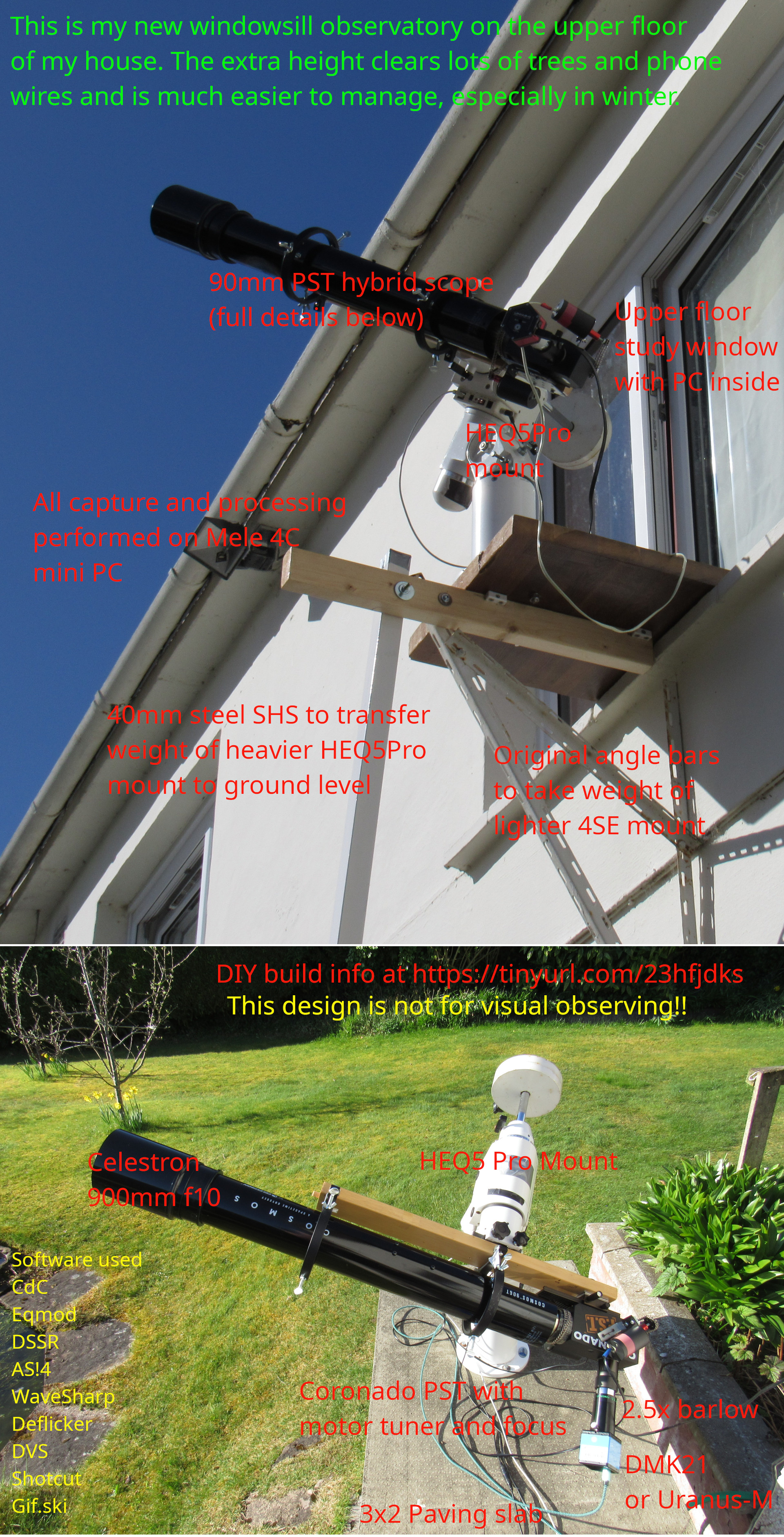
Umbral flashes are ripples that emerge from the cores of some sunspots. You can see them most clearly in the sunspot on the left (AR4378). It looks like stones dropped in a pond of solar fire, producing rapid-fire concentric rings.
Researchers are not sure why this happens. One theory holds that gas from the sun's atmosphere falls into the umbra. When it reaches the "floor" of the sunspot, the gas rebounds, forming luminous shockwaves that ripple outwards from the center.

The sunspot on the right (AR4381) illustrates this idea beautifully with a clear plume of material falling into the sunspot. Yet a third sunspot not shown above has the clearest ripples of all--with no obvious infall. Thus, the mystery persists.
Realtime Space Weather Photo Gallery
Free: Spaceweather.com Newsletter
"I NEED MY SPACE" SNOOPY CUP: Coffee tastes better in a cup that's been to space. On July 16th, the students of Earth to Sky Calculus launched this Snoopy cup to the stratosphere onboard a cosmic ray research balloon. Here it is floating more than 105,315 feet above Earth's surface:
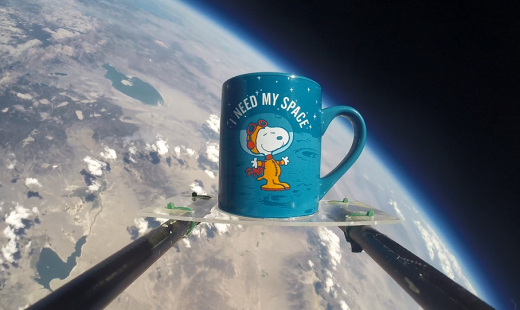
You can have it for $119.95. It's Peanuts for a cup from space! The students are selling Snoopy cups to support their cosmic ray monitoring program. Each one comes with a greeting card showing the cup in flight and telling the story of its trip to the stratosphere and back again.
Every item in the Earth to Sky Store has been to the edge of space--floating above 99.7% of Earth's atmosphere, experiencing space-like blasts of cosmic rays, extreme cold, and a wild ride parachuting back to Earth. Even Amazon doesn't carry items this far out. And, best of all, all sales support student science projects and STEM education.
Far Out Gifts: Earth to Sky Store
All sales support hands-on STEM education
Realtime Aurora Photo Gallery
Free: Spaceweather.com Newsletter