TEN THOUSAND STARLINKS: Today, SpacX's internet megaconstellation crossed a milestone. There are now 10,000 Starlinks in Earth orbit. The successful launch of Starlink 10-48 from Cape Canaveral added 29 satellites, raising the total to an estimated 10,003. When Starlink launched its first batch of 60 satellites in May 2019, there were roughly 2,000 active satellites in Earth orbit total (across all operators and countries). The explosive growth of Starlink since then has utterly transformed the orbital environment.
PI DAY GEOMAGNETIC STORM: 3.14 means auroras! A geomagnetic storm broke out on March 14th (Pi Day) when the solar wind speed near Earth topped 700 km/s (1.6 million mph). Todd Salat celebrated the display with a "pi in the face" selfie on the banks of the Knik River in Alaska:
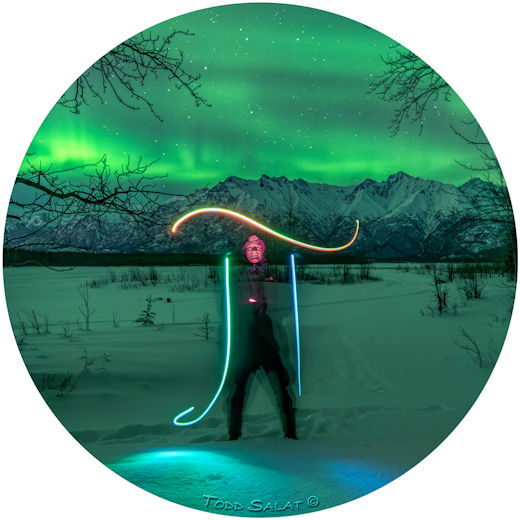
"For the past two nights, I watched auroras carve patterns of light across the sky," says Salat. "On Pi Eve (3•13), I stayed warm by light writing π. Then today, Pi Day (3•14), the aurora show went hog wild!"
In the United States, auroras were photographed as far south as the West Elk Mountains of Colorado--a surprisingly widespread display considering that the underlying geomagnetic storm was nominally minor (only G1-G2).
Pi itself may be partly responsible. The constant is deeply embedded in the mathematics of a seminal 1973 paper by Russell and McPherron, which describes why the weeks around equinoxes are prime time for auroras. At this time of year, the magnetic field of Earth can link to the magnetic field of the sun, providing a superhighway for solar wind to enter our planet's magnetosphere. Springtime auroras are the result.
Stay tuned for more auroras as the northern vernal equinox approaches on March 20th--and Happy Pi Day! Aurora alerts: SMS Text
more images: from Otto Mehes 30,000 feet above Alaska and British Columbia; from Alan C Tough of Elgin, Moray, Scotland; from Sam Lawler near Arthur's Pass, New Zealand; from Carl Bracken of Lansing, Iowa; from J.Sperr of Blue Lagoon, Iceland; from Aaron Watson of West Elk Mountains, Colorado; from Martin Guth of Hermantown, Minnesota; from Björgvin Kristinsson of Hafravatn, Iceland;
Realtime Aurora Photo Gallery
Free: Spaceweather.com Newsletter
THE NORTHERN LIGHTS PENDANT: Are you looking for a far-out gift? Consider the Northern Lights Pendant. It has been to the edge of space and back again onboard an Earth to Sky Calculus cosmic ray balloon:
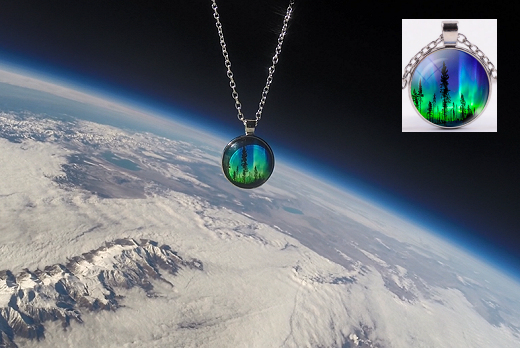
You can have it for $129.95. The pendant comes with a greeting card showing the necklace in flight and telling the story of its journey to the edge of space. It makes an out-of-this-world birthday or anniversary gift!
Every item in the Earth to Sky Store has been to the edge of space--floating above 99.7% of Earth's atmosphere, experiencing space-like blasts of cosmic rays, extreme cold, and a wild ride parachuting back to Earth. Even Amazon doesn't carry items this far out. And, best of all, all sales support student science projects and STEM education.
Far Out Gifts: Earth to Sky Store
All sales support hands-on STEM education
Realtime Space Weather Photo Gallery
Free: Spaceweather.com Newsletter