A BREAK IN THE STORMS: Since the vernal equinox, Earth's magnetic field has been active and stormy--a result of CME impacts amplified by the Russell-McPherron effect. The next two days should be relatively quiet until another CME passes close to Earth on March 26th. High-latitude sky watchers might see more auroras on Thursday night. Aurora alerts: SMS Text
THE MYSTERY OF OHIO AND TEXAS FIREBALLS: Is Earth under siege? If you've been reading headlines about space rocks falling over Ohio and Texas, you might be wondering what's going on. According to NASA, it's nothing unusual, yet still a little mysterious.
"Spring is fireball season," says Bill Cooke of the NASA Meteoroid Environment Office. "For reasons we don't fully understand, the rate of very bright meteors climbs 10% to 30% during weeks around the vernal equinox."
Above: The Ohio fireball over Kennerdell, PA. Credit: Jeff Campbell
The Ohio and Texas meteors landed squarely in the middle of the season. Onlookers saw the Ohio fireball on March 17th only 3 days before the equinox. The Texas fireball appeared one day after the equinox on March 21st. Both were visible in broad daylight, with sonic booms and meteorites. One fragment reportedly punched through the roof of a home in suburban Houston.
"Meteorite falls--fragments that actually hit the ground--are more common in spring as well," says Cooke.
Although researchers have known about the spring surge for 30+ years, no one is sure what causes it. There seems to be an intrinsic variation in the meteoroid population along Earth's orbit, with a roughly February-to-June peak in large, fireball-producing debris. The source of the extra debris is unknown.
Although the spring surge is real, it may not be required to explain these recent fireballs. Three decades of data from US government sensors shows that an Ohio-class fireball hits Earth roughly once a month, but almost all of them go unnoticed because they occur over oceans or remote regions. The Ohio and Texas fireballs are roughly consistent with these statistics.
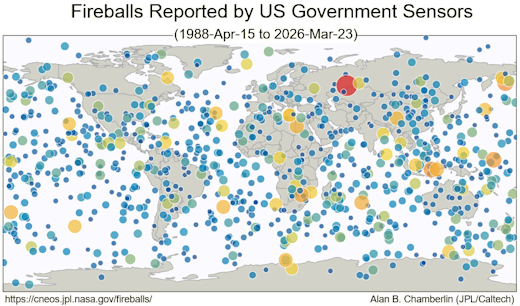
Finally, we note that the Texas and Ohio fireballs did not come from the same place despite arriving during the same "spring surge."
"The two fireballs had completely different orbits," says Cooke. "Plus, the meteorites they produced are quite different. Ohio finds are probably eucrites, whereas the recovered Texas meteorite appears to be an ordinary chondrite."
So, nothing unusual--but still a little mysterious. Keep looking up.
Realtime Space Weather Photo Gallery
Free: Spaceweather.com Newsletter
A GIFT FOR TOLKIEN FANS -- THE ONE RING OVER HOBBITON: Need a far out gift for a Tolkien fan? Consider the One Ring over Hobbiton. During a rare South Pacific balloon flight, the students of Earth to Sky Calculus flew this ring to the stratosphere directly over the movie set for Peter Jackson's Lord of the RIngs:
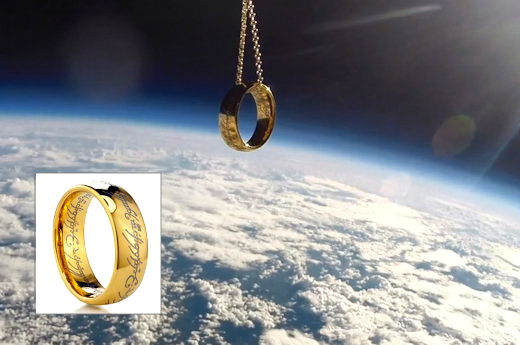
You can have it for $199.95. On the southern winter solstice, it reached an altitude of 108,345 feet, flying alongide a suite of cosmic radiation sensors that the students use to monitor atmospheric radiation. The ring is made of gold-plated tungsten and inscribed with the authentic Mordor script of the One Ring.
Your purchase comes with a greeting card showing the ring in flight and telling the story of its journey to the edge of space and back again.
Far Out Gifts: Earth to Sky Store
All sales support hands-on STEM education
Realtime Space Weather Photo Gallery
Free: Spaceweather.com Newsletter
Realtime Aurora Photo Gallery
Free: Spaceweather.com Newsletter