TEN SUNSPOT GROUPS: Suddenly, the solar disk is peppered with sunspots. Including three new dark cores emerging over the eastern limb, there are at least 10 sunspot groups on the Earthside of the sun. This naturally increases the odds of geoeffective flares. Solar flare alerts: SMS Text
HAPPY 30TH, COMET HYAKUTAKE: One of the biggest surprises in modern astronomy happened 30 years ago. On Jan. 30, 1996, Japanese amateur astronomer Yuji Hyakutake spotted a faint fuzzball through binoculars. Within weeks, "Comet Hyakutake" became a worldwide sensation as it passed just 0.1 AU from Earth.
Alan Dyer was one of many who photographed it on March 25, 1996--the night of closest approach:
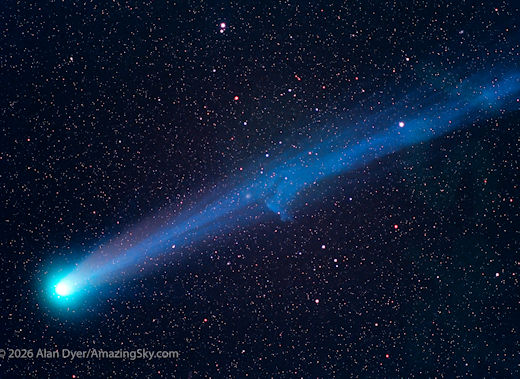
"I reprocessed this image on March 25, 2026, to mark the 30th anniversary," says Dyer. "The comet's tail was at its greatest length and showed a strong 'disconnection event' caused by solar activity."
Hyakutake’s electric-blue ion tail stretched across as much as 90 degrees of sky, rippling with solar wind disturbances. For many observers, it was the first time a comet looked truly alive and dynamic. Nightly changes were visible to ordinary people simply looking up from their own backyards.
Comet Hyakutake arrived without much warning, peaked quickly, and faded almost as fast. Thirty years later, veterans still speak of it in reverent tones.
The next Great Comet could appear with as little notice. The Oort cloud contains an enormous reservoir of fresh comets, and a steady trickle of them enters the inner solar system each year. It only takes one big one to suddenly turn a faint fuzzball into a sky-spanning spectacle.
Happy 30th, Comet Hyakutake!
more images: from Doug C. Zubenel of Carroll County, Missouri; from Mariano Ribas of Buenos Aires, Argentina; from Ron Burk of Maine
Realtime Space Weather Photo Gallery
Free: Spaceweather.com Newsletter
FAITHFUL HEARTS IRON SCULPTURE: Astronomers have long known that the element iron (Fe) is created in supernova explosions. Keep that in mind when you consider the Faithful Hearts iron sculpture. On Nov. 13, 2025, it flew to the edge of space onboard a cosmic ray research balloon:
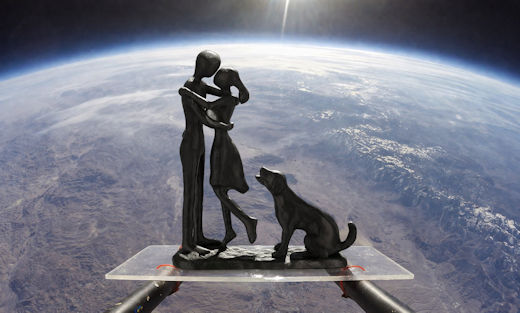
You can have it for $159.95. Handmade from the "stuff" of exploding stars, this iron sculpture celebrates a love that is powerful and enduring. It comes with a keepsake card showing the sculpture at the top of Earth’s atmosphere, and telling the story of its flight to space and back again.
Far Out Gifts: Earth to Sky Store
All sales support hands-on STEM education
Realtime Space Weather Photo Gallery
Free: Spaceweather.com Newsletter
Realtime Aurora Photo Gallery
Free: Spaceweather.com Newsletter