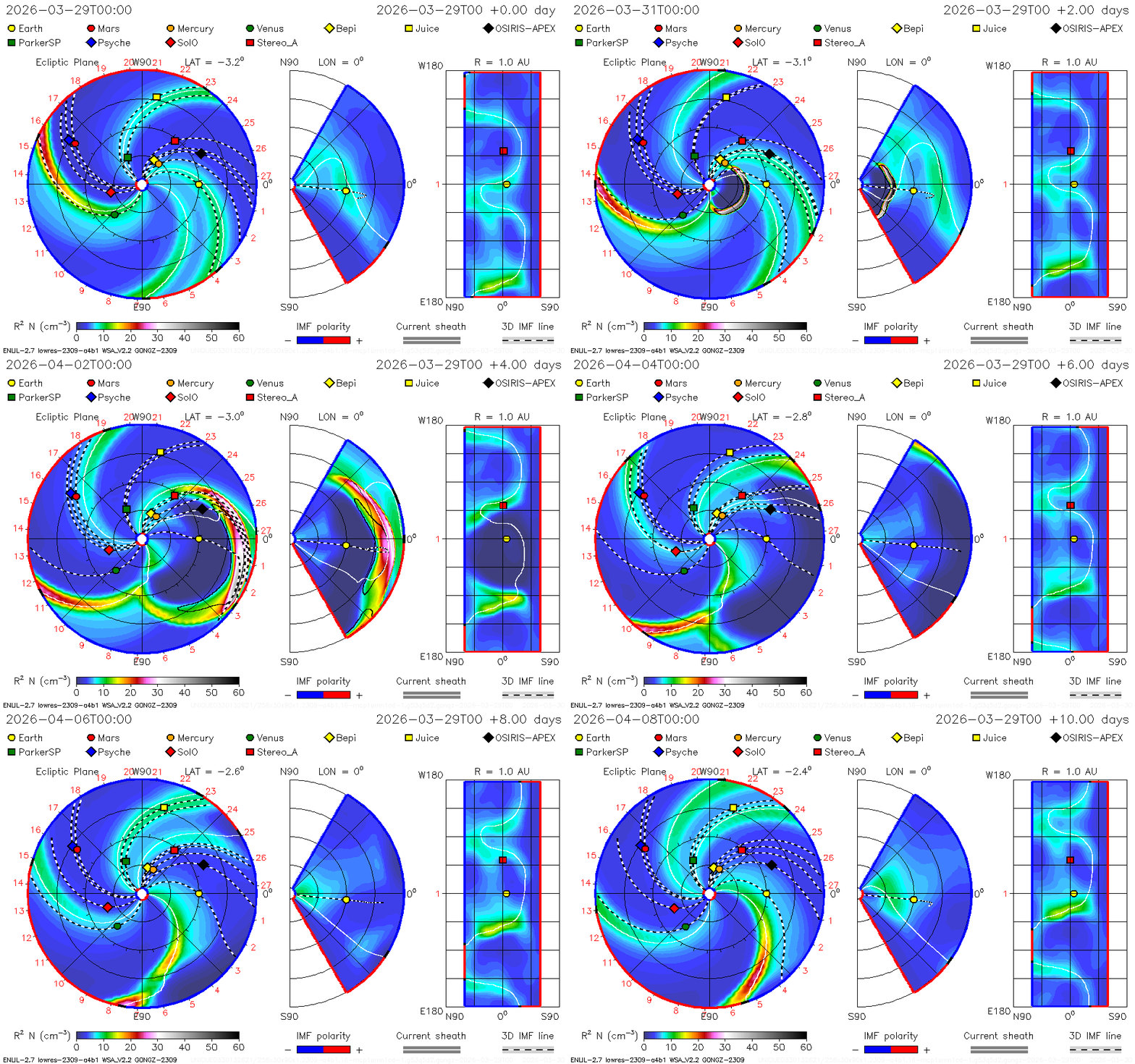
ARTEMIS II AND THE SOLAR STORM: If all goes according to plan, NASA will launch the giant Artemis II rocket on April 1st, propelling astronauts to the Moon for the first time since the Apollo era. Because of today's solar flare, a CME will reach Earth just before liftoff. This is not necessarily a problem for Artemis, though. The incoming solar storm does not appear to be rich in energetic particles. Moreover, it will likely be a glancing blow, not a direct hit. This storm is almost certainly not a show-stopper. Additional X-flares from sunspot 4405, however, could make mission planners re-think their schedule. Solar flare alerts: SMS Text
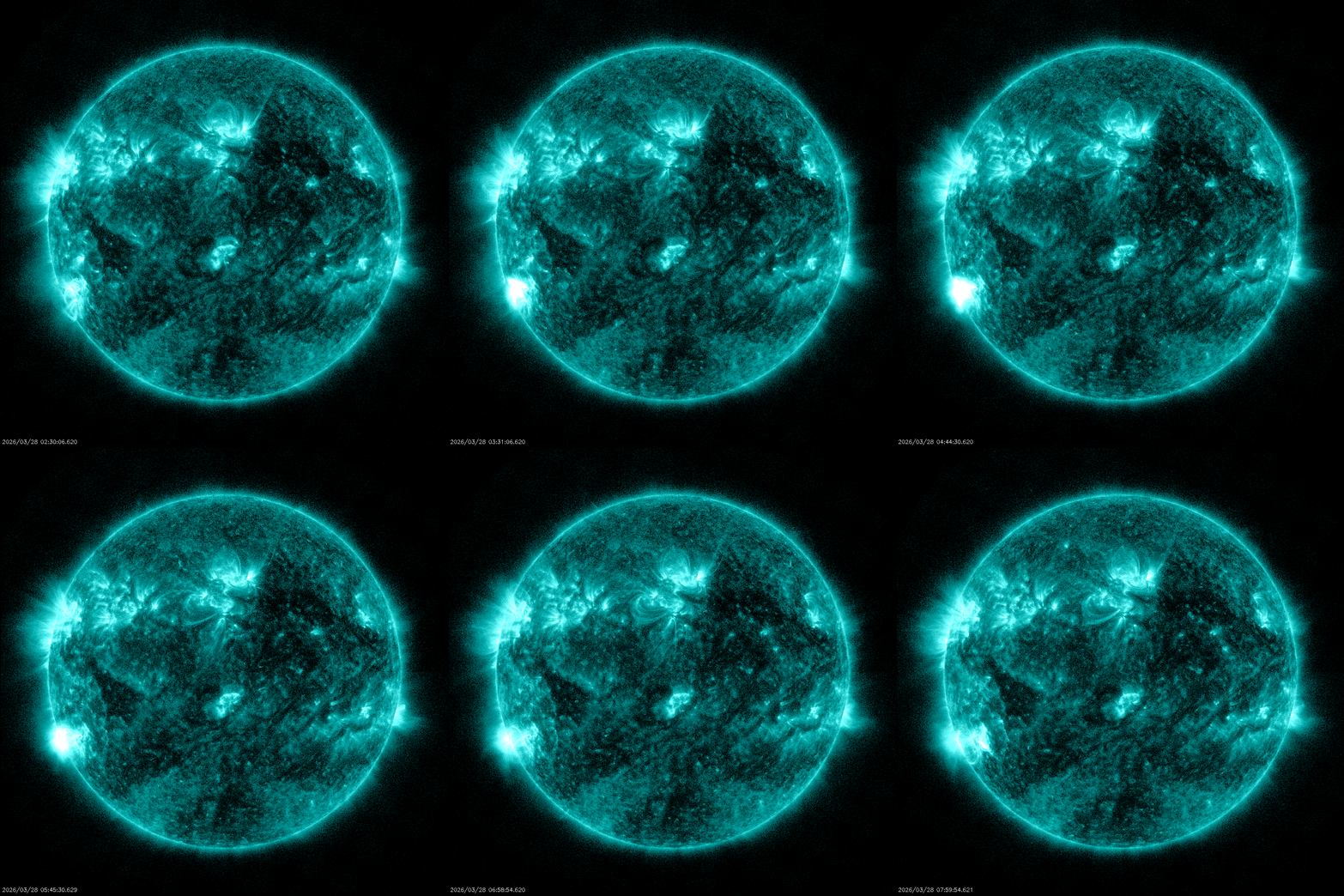
X-CLASS SOLAR FLARE AND CME: Growing sunspot 4405 erupted again on March 30th, producing an X1.5-class solar flare. NASA's Solar Dynamics Observatory captured the hours-long explosion:
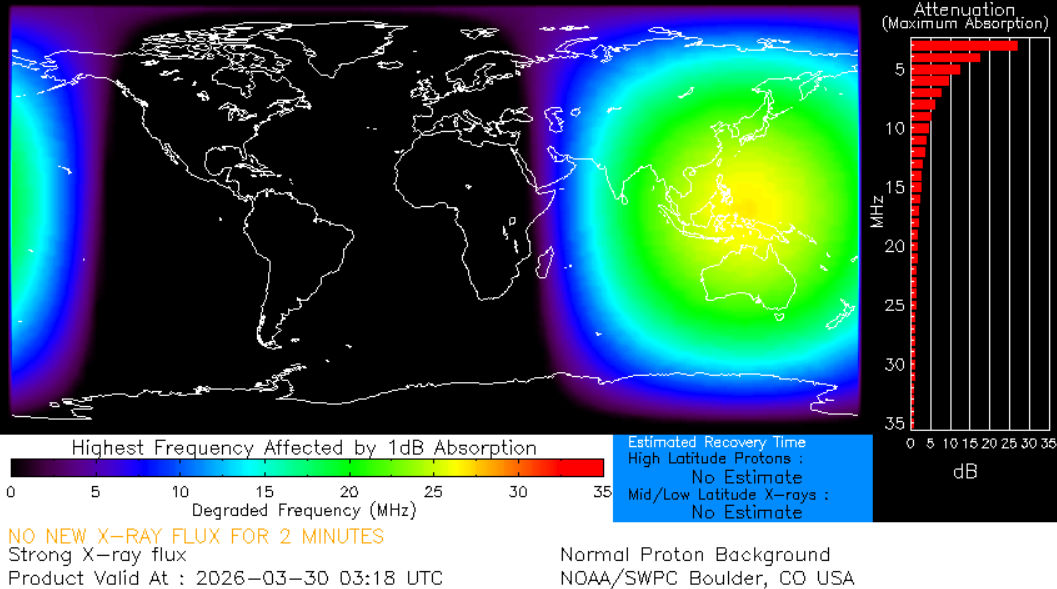
Extreme ultraviolet radiation from the flare ionized the air above southeast Asia and Australia, causing a shortwave radio blackout in those locations. Ham radio operators may have noticed loss of signal at all frequencies below30 MHz.
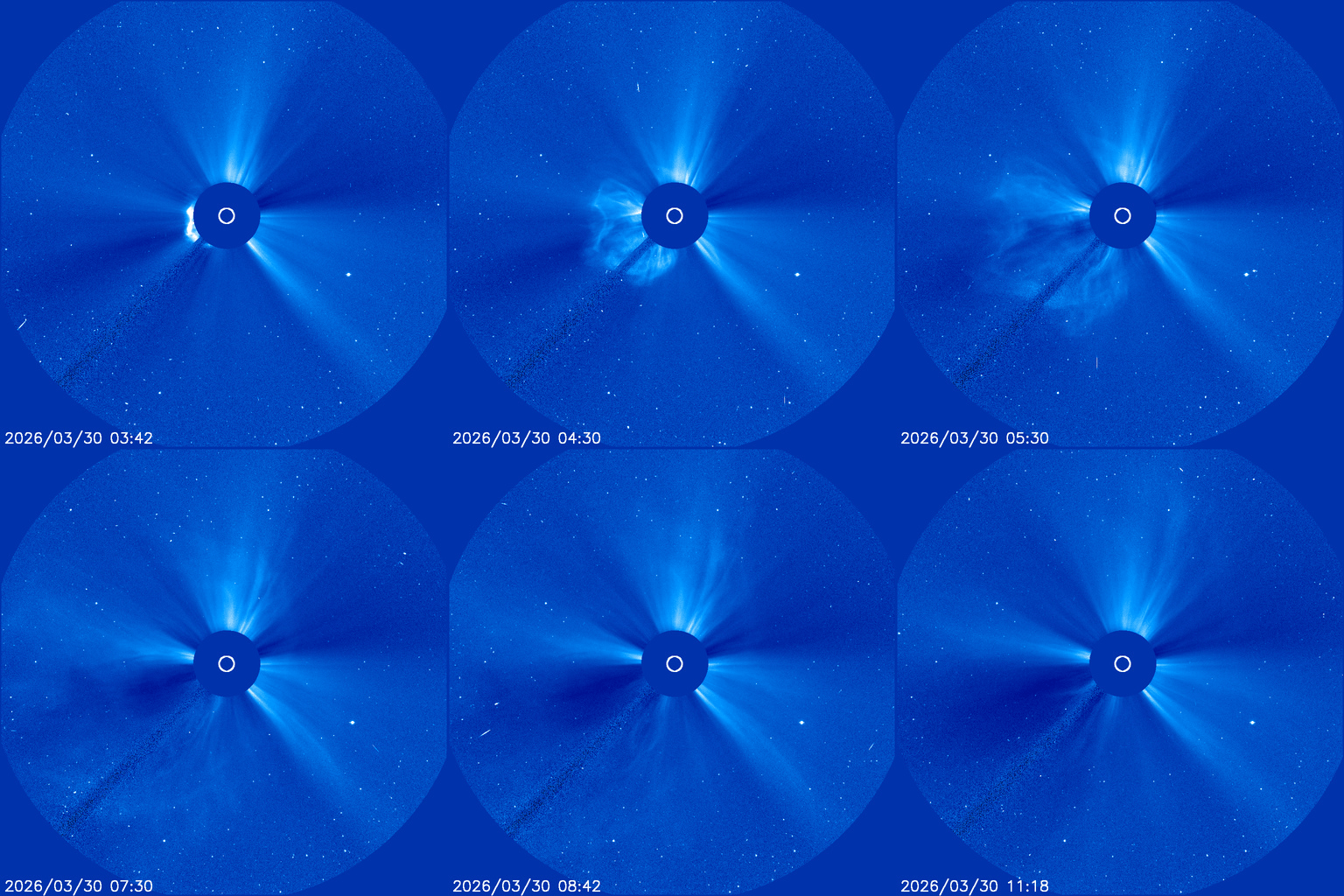
Of greater interest is the CME. The explosion hurled a fast and massive CME into space, and it has an Earth-directed component. NOAA and NASA models disagree slightly. The NOAA model predicts a glancng blow while the NASA model suggests a more direct hit. Either way, G2 to G3-class geomagnetic storms are possible on March 31-April 1st. CME impact alerts: SMS Text


Realtime Space Weather Photo Gallery
Free: Spaceweather.com Newsletter
FAITHFUL HEARTS IRON SCULPTURE: Astronomers have long known that the element iron (Fe) is created in supernova explosions. Keep that in mind when you consider the Faithful Hearts Iron Sculpture. On Nov. 13, 2025, it flew to the edge of space onboard a cosmic ray research balloon:

You can have it for $159.95. Handmade from the "stuff" of exploding stars, this iron sculpture celebrates a love that is powerful and enduring. It comes with a keepsake card showing the sculpture at the top of Earth’s atmosphere, and telling the story of its flight to the edge of space and back again.
Far Out Gifts: Earth to Sky Store
All sales support hands-on STEM education
SUNGRAZING COMET UPDATE: Sungrazing Comet MAPS (C/2026 A1) is getting very close to the sun. On April 4th it will skim just 160,000 km (0.23 solar radii) above the sun's surface--a true death dive. The event will be invisible from Earth, but space-based coronagraphs will be able to see what happens:
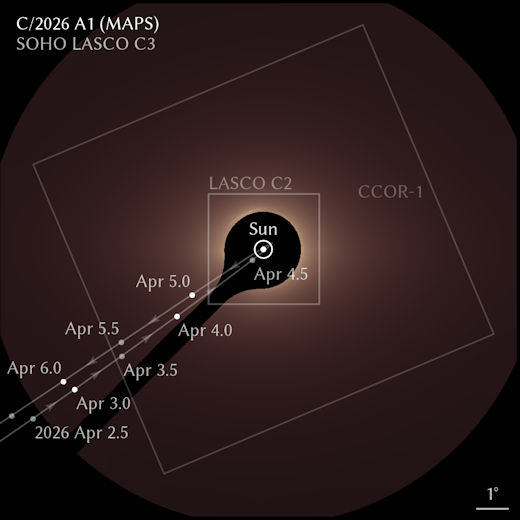
Astronomer Qicheng Zhang of Lowell Observatory in Flagstaff, Arizona, created this diagram. "It shows the trajectory of of Comet MAPS through the SOHO/LASCO and GOES-19/CCOR-1 fields of view," says Zhang. "The comet approaches the sun from the lower left and will also depart to the lower left, if it survives perihelion (closest approach to the sun)."
"Even if the comet's nucleus fully disintegrates right now, the remnant will still rapidly brighten in the final hours as intense solar heating turns the dust into a trail of glowing gas," he continues. "In that case, a peak brightness around magnitude −2 would occur about ten hours before perihelion (Apr 4 ~04 UT)."
In 2011, Comet Lovejoy (C/2011 W3) skimmed the sun at about the same distance and survived. It became a spectacular sight for weeks. Could the same thing happen to Comet MAPS?
"I'm pessimistic," says Zhang. "Images from the James Webb Space Telescope suggest that the nucleus of Comet MAPS is only ~0.4 km in diameter, which is on the lower side of estimates for Comet Lovejoy. Whether any of the comet still exists after April 4th remains to be seen."
Stay tuned!
Realtime Comet Photo Gallery
Free: Spaceweather.com Newsletter
Realtime Space Weather Photo Gallery
Free: Spaceweather.com Newsletter
Realtime Aurora Photo Gallery
Free: Spaceweather.com Newsletter