Just released: The Full Lunar Flyby Photo Gallery (Thanks, NASA!)
A METEOR SHOWER ON THE MOON (UPDATED): The crew of Artemis II were giddy (their words!) on the evening of April 6th when they witnessed explosions on the lunar surface. Meteoroids were hitting the Moon. "We saw at least five," reported mission commander Reid Wiseman. In mission control, scientists were overheard shouting in delight.
The lunar meteors appeared in middle of a solar eclipse. About 90 minutes after the crew made their closest approach to the farside of the Moon, the sun disappeared behind the lunar disk. They witnessed the first solar eclipse ever seen by humans from behind the Moon.
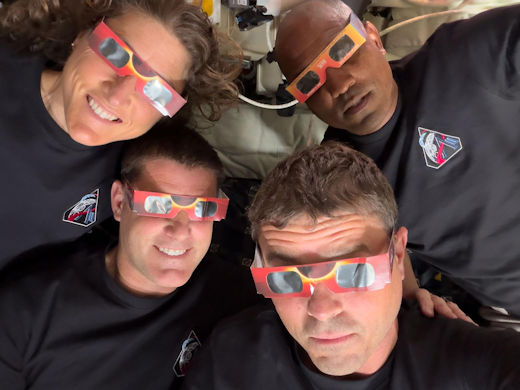
The Artemis II crew – Christina Koch (top left), Jeremy Hansen (bottom left), Reid Wiseman (bottom right), and Victor Glover (top right).
During the hour-long eclipse, the sun's corona was visible "at least 10 solar diameters [beyond the lunar limb]," according to Canadian astronaut Jeremy Hansen. This allowed mission specialist Christina Koch to photograph mountains and other topography silhouetted by the sun's atmosphere along a wide arc of the Moon's edge.
The meteors were a complete surprise. "We're seeing them near the Moon's equator," reported Wiseman during the live webcast. Later, his crewmate Victor Glover spotted one near the Moon's South Pole. All of them appeared as bright flashes of light on the lunar surface.
Lunar meteors are different than Earth meteors. Here on Earth, meteoroids burn up in the atmosphere. On the airless Moon, they slam directly into the surface. NASA has been monitoring these impacts since 2006, logging about 20 per year on average. The crew of Artemis II saw 5 or 6 in about 30 minutes.
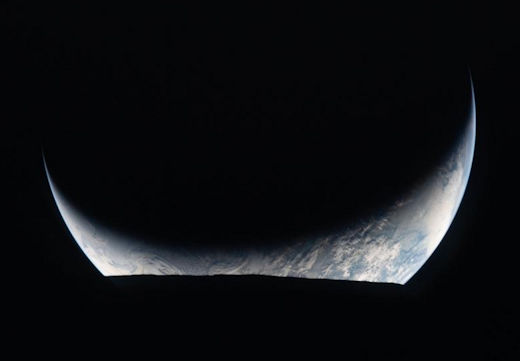
Earth rising over the edge of the Moon on April 6, 2026
The Moon was mostly but not completely dark during the meteor shower. The soft blue-tinged glow of Earth itself was cast across the lunar terrain. "The Earthshine is unreal," reported Glover. "Humans have not evolved to see what we are seeing. It's hard to describe"
The crew downloaded their photos to Earth overnight, and some of them were discussed during NASA's April 7th press conference. No photos of meteor strikes were shared, possibly because there is none. Sometimes the human eye is the best detector. The science team is still sorting through 50 GB of images. Stay tuned!
Realtime Space Weather Photo Gallery
Free: Spaceweather.com Newsletter
"BEST MOM EVER" TEA CUP FROM SPACE: Mother's Day is coming soon. Here's a gift she'll use every day: The Best Mom Ever Tea Cup. Last October it flew to the edge of space onboard an Earth to Sky Calculus cosmic ray research balloon:
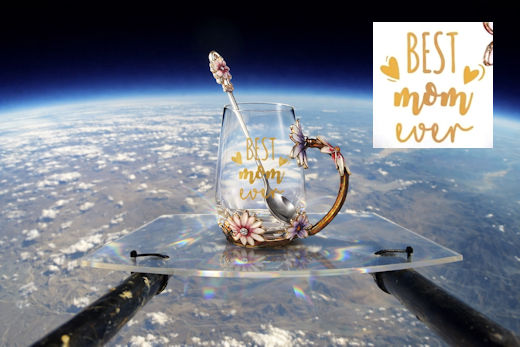
You can have it for $134.95. The crystal glass cup is decorated with 3D pink and purple daisies, and comes with a matching teaspoon. Also included is a greeting card showing the cup in flight and telling the story of its journey to the stratosphere. See also: The High Tea Cup.
Earth to Sky Mother's Day gifts have flown above 99.7% of Earth's atmosphere, experiencing space-like blasts of cosmic rays, extreme cold, and a wild ride parachuting back to Earth after the balloon explodes. Even Amazon doesn't carry items this far out. And, best of all, all sales support student science projects and STEM education.
Far Out Gifts: Earth to Sky Store
All sales support hands-on STEM education
Realtime Comet Photo Gallery
Free: Spaceweather.com Newsletter
Realtime Aurora Photo Gallery
Free: Spaceweather.com Newsletter