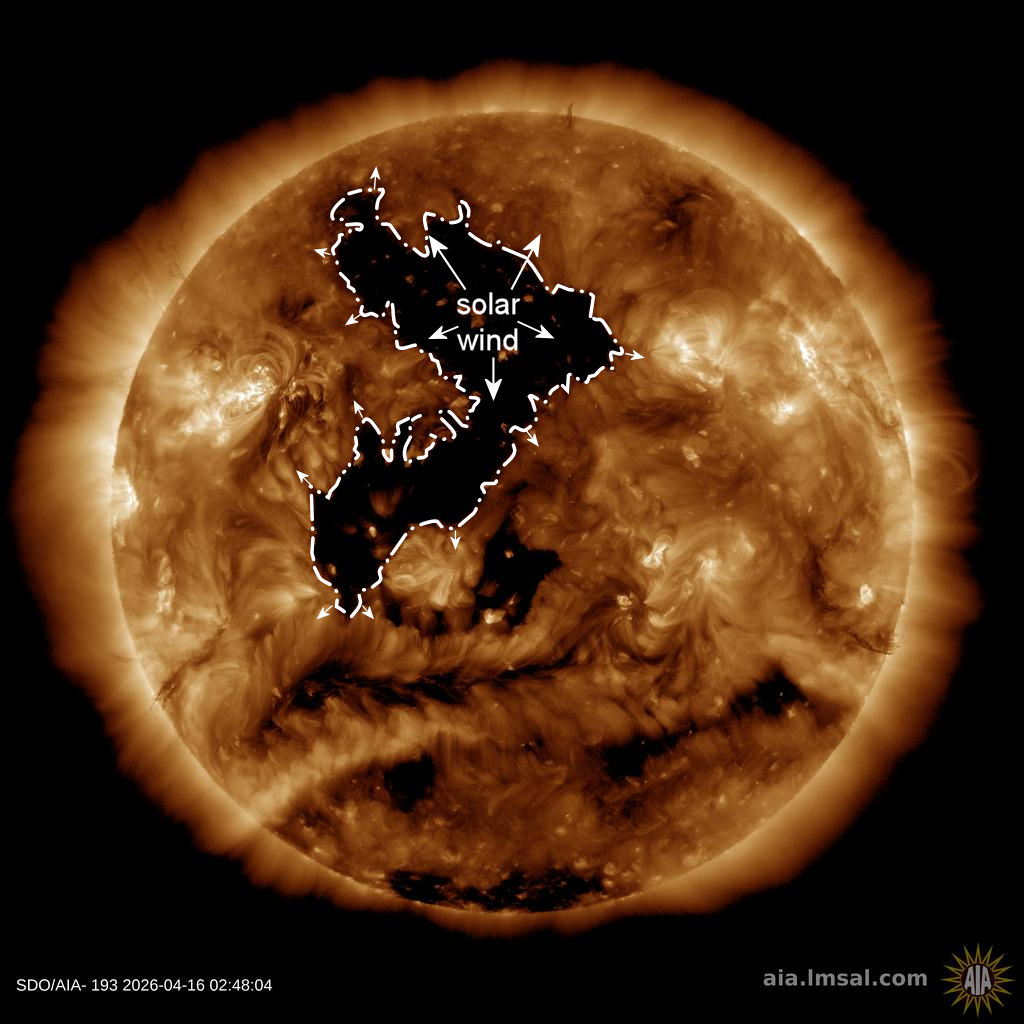
A HOLE IN THE SUN'S ATMOSPHERE: A large hole has opened in the sun's atmosphere, and it is directly facing Earth. High-speed solar wind flowing from this coronal hole should arrive on April 18th, potentially sparking G2-class geomagnetc storms. The New Moon will provide dark skies and a nice canvas for long-exposure photography of auroras. Free: Spaceweather.com Newsletter

STARLINK DECLARES WAR ON COMETS: Earlier this year, the number of Starlink satellites in Earth orbit surpassed 10,000. You can see the evidence in the sky:
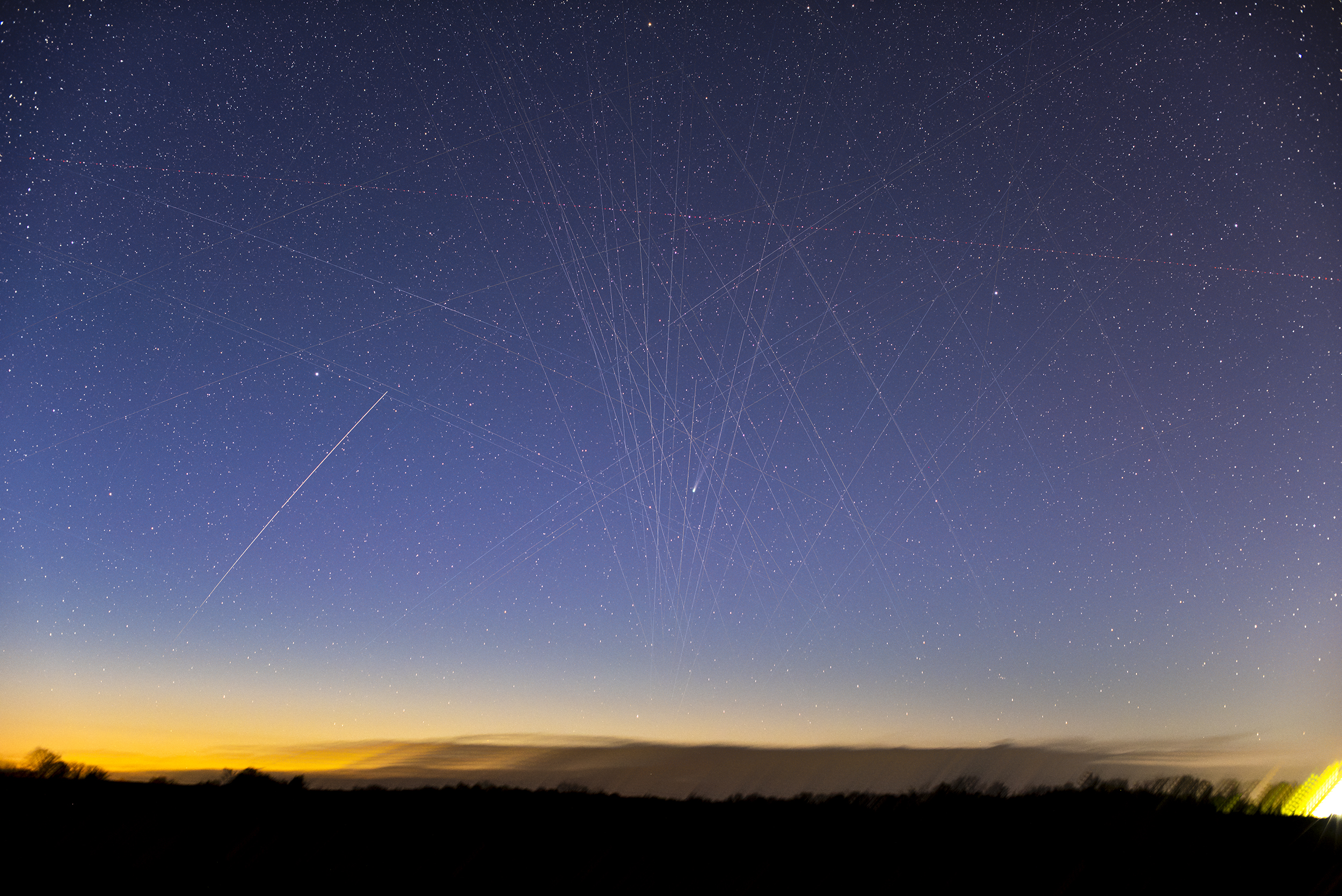
Dan Bush took this picture before sunrise on April 16th from Albany, Missouri. It's supposed to be a picture of Comet PanSTARRS (C/2025 R3), but it contains far more satellites than comets--more than 35 Starlinks in the full-frame photo.
"The 'Starlink Zone of Maximum Reflection' appeared right in front of the comet," says Bush. "Stacking 30-second exposures helped alleviate the satellites, but they're still there."
Bush's photo is no fluke. In the past year, the number of comet photos criss-crossed by satellites submitted to our gallery has jumped more than 10-fold. The actual counts are certainly greater. Many astrophotographers use software to remove the streaks (e.g., StarXTerminator and Cosmic Clarity), then submit the scrubbed photos without mentioning that they were photobombed.
Sometimes, Starlink is the point: "Like any good astrophotographer, I was out in the pre-twilight hours of April 15th photographing Comet PanSTARRS," says David Blanchard of Mormon Lake, Arizona. This is what he saw:
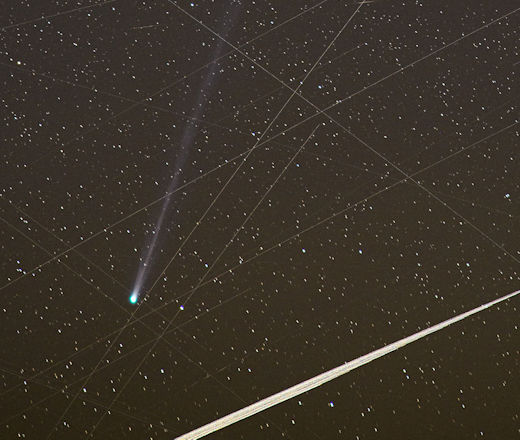
"Having Starlink satellites move across the image is expected these days -- but I was not expecting this!" he says. "Some of the Starlinks were as bright as Venus." (They had launched only 6 1/2 hours earlier and were still in extra-bright low orbits.)
Comet PanSTARRS is especially vulnerable to photobombing. It hugs the morning horizon in a patch of twilight sky where Starlinks are outside of Earth's shadow. There, the satellites do a great job reflecting high-altitude sunlight into telescopes.
The Space Weather Photo Gallery is 10+ years older than the Starlink program, and it contains phenomena of all types--from Auroras to Zodiacal Lights. We find that comet photos are disproportionately susceptible to interference. Comets tend to be close to the sun, where Starlinks are brightest, and the field of view + exposure time of a typical comet photo is perfect for catching satellites.
Ultimately, SpaceX plans for 42,000 satellites. Note to the Editor: Next year, re-title this piece "The Good Old Days."
more images: from Mary Beth Kiczenski of Moab, UT; from Mike Olason of Tucson, Arizona; from Larry Stevens of Portal, AZ; from Horst Peter Franzen of Flugplatz Senheld, Vulkaneifel, Germany
Realtime Space Weather Photo Gallery
Free: Spaceweather.com Newsletter
MOTHER'S LOVE IRON SCULPTURE: Mother's Day is coming soon. Here's a gift she'll never forget: The Mother's Love Iron Sculpture. On Nov. 13, 2025, the students of Earth to Sky Calculus launched it to the stratosphere onboard a cosmic ray research balloon:
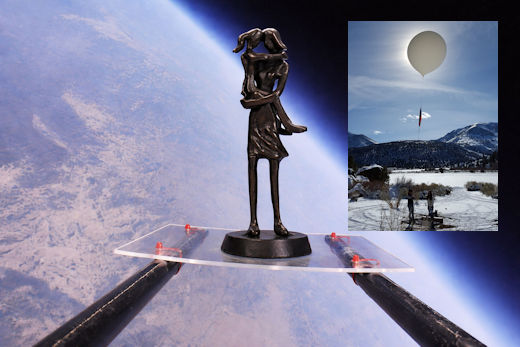
You can have it for $159.95. Handmade from iron, the sculpture depicts a young mother holding her child in a loving embrace. The gift-boxed figurine includes a unique keepsake card showing the sculpture at the top of Earth’s atmosphere. Inside, the card tells the story of the flight and certifies that this gift has been to the edge of space--and back again.
Far Out Gifts: Earth to Sky Store
All sales support hands-on STEM education
Realtime Comet Photo Gallery
Free: Spaceweather.com Newsletter
Realtime Aurora Photo Gallery
Free: Spaceweather.com Newsletter