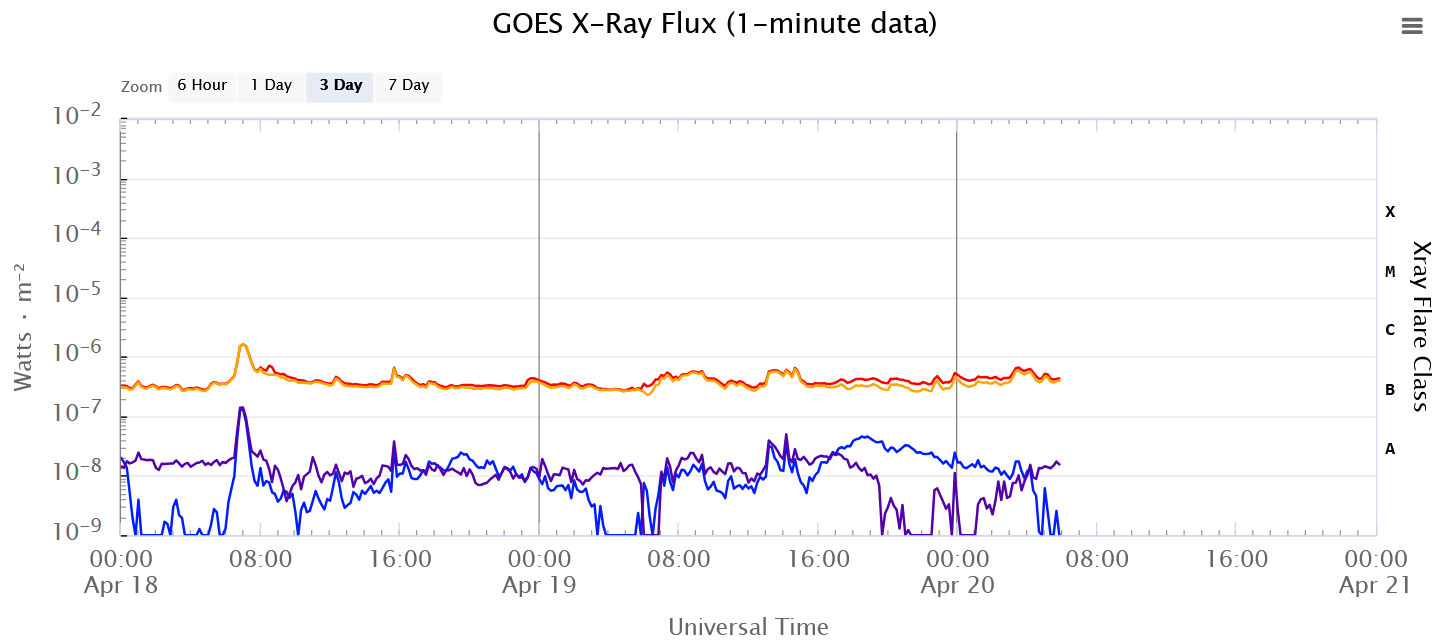
THE SUN IS FLATLINING AGAIN: The sun's X-ray output has reached low levels as the sunspot number plummets. The GOES solar flare monitor resembles a flatlined EKG. Also, the Thermosphere Climate Index (TCI) has reached its lowest level since 2023, indicating sharply reduced heating of Earth's upper atmosphere. Free: Spaceweather.com Newsletter
WHERE IS COMET PANSTARRS? Short answer: Making its closest approach to the sun--a.k.a. "perihelion." Petr Horálek of Brozany, Czech Republic, photographed the comet barely outside the sun's glare at dawn on April 18th:
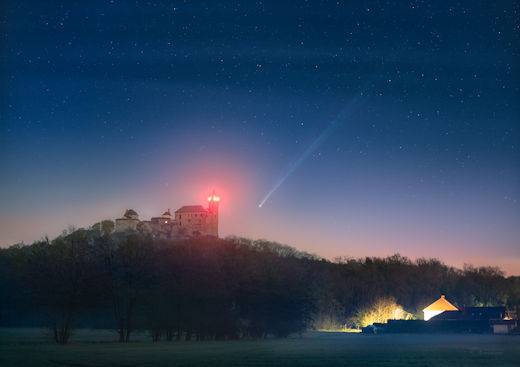
"This morning was the last chance to capture Comet PanSTARRS (C/2025 R3) from mid-Europe," says Horálek. "The Kunetic Castle was in the foreground, and I took the picture from a precisely calculated spot where the comet appeared beside the castle’s tower. I only had about 15 minutes before dawn made the sky too bright for imaging."
After perihelion, the comet will pass almost directly between Earth and the sun, making it extremely difficult to observe from the ground. Spacecraft will be able to see it, though. On April 23rd, the comet will enter the field of view of SOHO coronagraphs where it is expected to put on a good show. Stay tuned!
Realtime Comet Photo Gallery
Free: Spaceweather.com Newsletter
STARLINK IS NOT ALONE: Lately, we've been covering the growing problem of Starlink interference in astronomy photos. Pictures of comets often contain dozens of streaks. But Starlink is not alone, as shown in this picture taken by amateur astronomer Rainer Baule of Siegen, Germany:
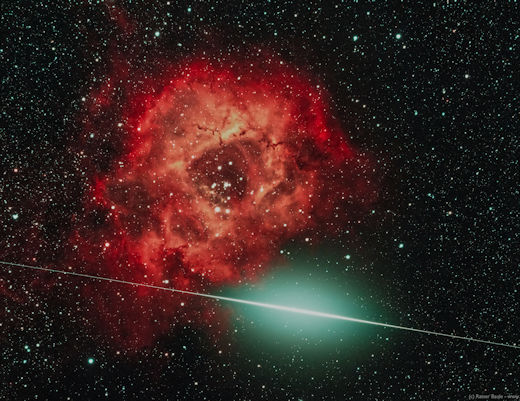
"The image shows the Rosette Nebula (NGC 2237) in the constellation Monoceros with a prominent satellite flare crossing the field of view," says Baule. "The object was the US military satellite FIA Radar 4, which flies in an orbit of 1,107 km height. The maximum brightness was close to Venus with -4.5."
Although the Starlink program has attracted attention for launching more than 10,000 satellites, they're not the only ones orbiting Earth. The population of other satellites has been growing, too. Satellites not named "Starlink" now total almost 5,000, bringing the grand total of all satellites to ~15,000.
Who is second to Starlink? The biggest runner-up is OneWeb (operated by Eutelsat), with 656 satellites. Amazon Leo (formerly Project Kuiper) comes in third with 233 satellites. Guowang, Starshield, and Thousand Sails are still trying to join the conversation with starter swarms of 100 to 200. All of these growing constellations aim for thousands of satellites in the future.
Ten years ago there were only about 1,400 active satellites--TOTAL. The current near-Earth environment is 10 times as busy and growing more crowded every day. What could go wrong?
Realtime Space Weather Photo Gallery
Free: Spaceweather.com Newsletter
"ALWAYS AND FOREVER" SPACE PENDANT: Are you looking for a far out gift? Consider the 'Always and Forever' Space Pendent. The students of Earth to Sky Calculus launched it to the top of Earth's atmosphere onboard a cosmic ray research balloon:
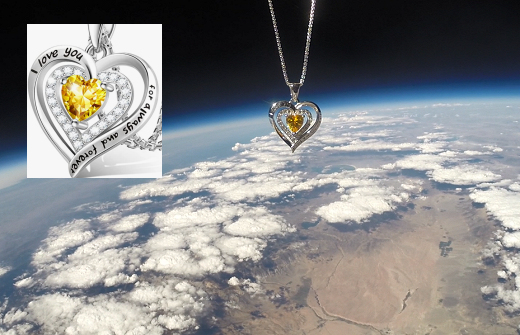
It's yours for $279.95. Engraved with the words "I love you always and forever," this sterling silver pendant features a heart-shaped citrine crystal surrounded by a ring of glittering 5A cubic zirconia nuggets. It comes with a greeting card showing the jewelry in flight and telling the story of its journey to space.
The students of Earth to Sky Calculus are selling space pendants to support their high-altitude balloon program. Each pendant has flown above 99.7% of Earth's atmosphere, experiencing space-like blasts of cosmic rays, extreme cold, and a wild ride parachuting back to Earth after the balloon explodes. All sales support student science projects and STEM education.
Far Out Gifts: Earth to Sky Store
All sales support hands-on STEM education
Realtime Aurora Photo Gallery
Free: Spaceweather.com Newsletter