THE LYRID METEOR SHOWER PEAKS TONIGHT: The annual Lyrid meteor shower peaks tonight, April 21-22, when Earth passes through a stream of debris from Comet Thatcher (C/1861 G1). This shower typically produces about 15 naked-eye meteors per hour. A fun way to experience the Lyrids is listening to their radio reflections. Tune in here.
'TIS THE SEASON FOR BLUE AURORAS: Blue auroras are very rare. Even veteran aurora chasers with years of Arctic experience have seldom seen them. Yet there is a time of year when they become easier to find--and that time is now.
"Last night, a blue aurora appeared overhead," reports Geir T. Birkeland Øye of Ørsta, Norway, less than 200 miles south of the Arctic Circle. "This is a sight we don't often see."
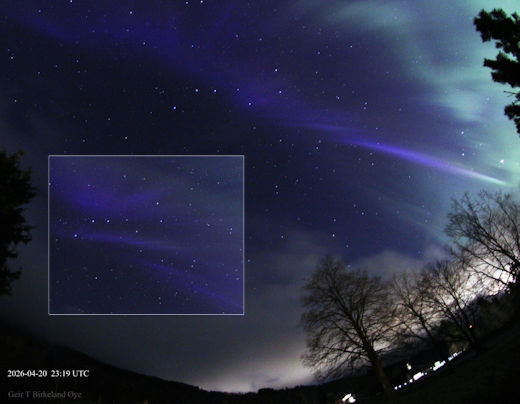
Auroras are almost always red or green--colors produced by oxygen during solar storms. Blue, on the other hand, is a sign of nitrogen. The color is produced by ionized nitrogen molecules (N2+) at the top of Earth's atmosphere. The problem is, there are very few N2+ ions up there. The feeble blue they emit is practically invisible.
For blue auroras to reach naked-eye visibility, something must amplify the light. The amplification process is called "resonant scattering," and it was definitely happening on April 21st.
During the display, the Arctic sun was barely below the horizon, perfectly positioned to illuminate the "nitrogen zone." Nitrogen ions floating 200 km above the ground absorbed and re-emitted sunlight, transforming a faint blue (427.8 nm) emission into a visible, brilliant glow.
"At this time of year, astronomical darkness does not occur here; the sun remains higher than about -13°," explains Øye. "This creates a seasonal window where the upper atmosphere remains sunlit while the ground-level sky is still dark enough for auroras to be visible. That combination is ideal for enhancing N2+ emissions through resonant scattering."
Arctic sky watchers: 'Tis the season for blue auroras. If you see them, submit your photos here.
Realtime Aurora Photo Gallery
Free: Spaceweather.com Newsletter
"ALWAYS AND FOREVER" SPACE PENDANT: Are you looking for a far out gift? Consider the 'Always and Forever' Space Pendent. The students of Earth to Sky Calculus launched it to the top of Earth's atmosphere onboard a cosmic ray research balloon:
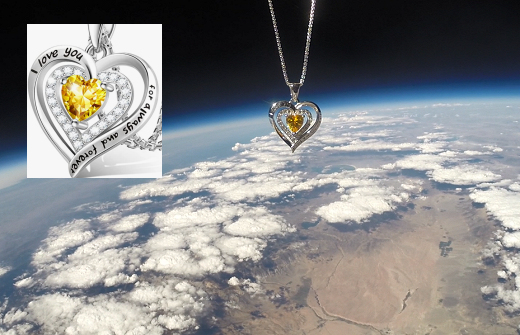
It's yours for $279.95. Engraved with the words "I love you always and forever," this sterling silver pendant features a heart-shaped citrine crystal surrounded by a ring of glittering 5A cubic zirconia nuggets. It comes with a greeting card showing the jewelry in flight and telling the story of its journey to space.
The students of Earth to Sky Calculus are selling space pendants to support their high-altitude balloon program. Each pendant has flown above 99.7% of Earth's atmosphere, experiencing space-like blasts of cosmic rays, extreme cold, and a wild ride parachuting back to Earth after the balloon explodes. All sales support student science projects and STEM education.
Far Out Gifts: Earth to Sky Store
All sales support hands-on STEM education
"DIAMOND RING" SUN HALO: Yesterday in Nattages, France, photographer Christian Viladrich looked up and did a double take. "I saw this strange solar halo offset from the sun," he says. It looked like a diamond ring:
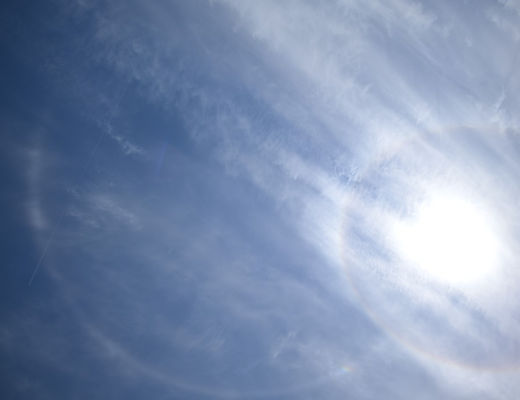
The ring of light passing through the sun is a "full parhelic circle." It is among the rarest of ice halos. Full parhelic circles require as many as five internal reflections from millions of individual ice crystals, all catching sunbeams simultaneously.
For such a display to occur, the sky must fill with a rare mixture of gem-like ice crystals in wispy cirrus clouds. Viladrich looked up at just the right moment!
Realtime Space Weather Photo Gallery
Free: Spaceweather.com Newsletter
Realtime Comet Photo Gallery
Free: Spaceweather.com Newsletter