INCREASING CHANCE OF FLARES: NOAA forecasters have increased the chance of X-flares today to 25%. The sunspot most likely to explode is AR4425, which has an unstable delta-class magnetic field almost directly facing Earth. Solar flare alerts: SMS Text
A GIANT ATMOSPHERIC CHEMISTRY EXPERIMENT: Every 16 hours, more or less, a Starlink satellite falls out of the sky. It's part of the SpaceX business model: Old obsolete satellites re-enter to make way for newer models.
It sounds like a good way to keep Earth orbit from becoming too cluttered, but it comes with a cost. Every Starlink that burns up dumps about 30 kg of aluminum oxide into the upper atmosphere. That aluminum is not supposed to be there.
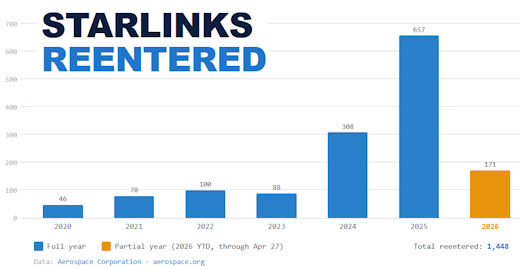
This histogram of Starlink re-entires is updated daily on Spaceweather.com
So far this year, 171 Starlinks have reentered, adding more than 5 metric tons of aluminum oxide to the stratosphere and mesosphere. How does this compare to natural sources?
The primary natural source is meteoroids -- the same "shooting stars" that streak across the night sky. As they burn up between roughly 75 and 110 km, they release a faint dusting of metals. Recent studies suggest that meteoroids disperse between 40,000 kg and 58,000 kg of Al₂O₃ into the atmosphere each year. Starlink in 2026 is on track to add between 26% and 39% of that natural total.
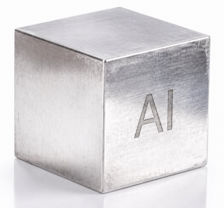 39% may not sound too bad, but consider the following: The size of the Starlink constellation is rapidly increasing, and SpaceX's competitors are racing to catch up. A full buildout of planned megaconstellations with corresponding re-entries could inject more than 360,000 kg of Al₂O₃ per year -- a 640% excess above natural meteoroids (Ferreira et al. 2024).
It all adds up to a giant uncontrolled experiment in atmospheric chemistry. Researchers already know that aluminum oxides can destroy ozone in a complex series of steps involving Al₂O₃, HCl, AlCl₃, sunlight, Cl, and O₃. Other side-effects may reveal themselves in time.
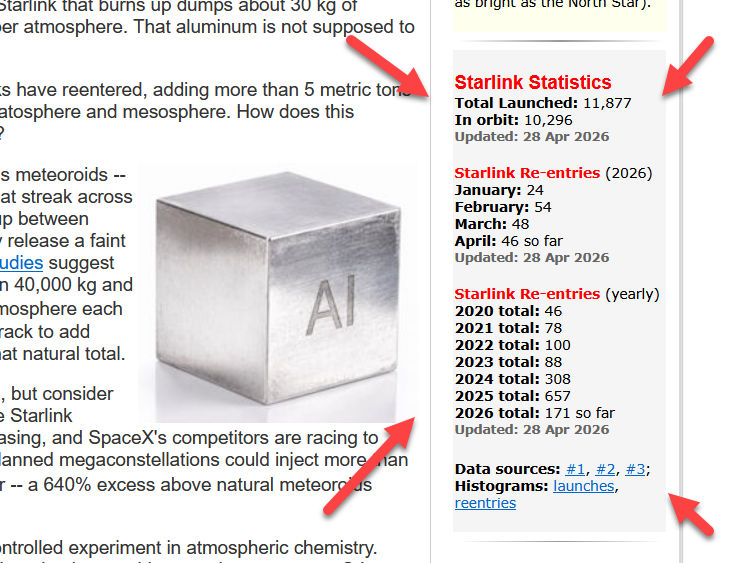
Stay informed: Daily updated totals of Starlink launches and reentries are posted here on Spaceweather.com.
Realtime Space Weather Photo Gallery
Free: Spaceweather.com Newsletter
THE ANTIGRAVITY MOTHER'S DAY BRONZE SCULPTURE: Mother’s Day is coming. Do you need a far-out gift? Consider the Antigravity Mother’s Day Sculpture. On Jan. 7, 2026, it flew to the stratosphere onbord a cosmic ray research balloon:
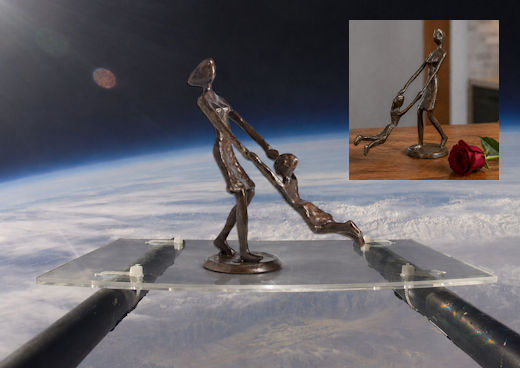
You can have it for $225.95. Made of bronze, the statue celebrates the special uplift only a mom can provide. It makes a great Mother's Day gift, especially when paired with a space rose.
With your purchase, you'll also receive a greeting card showing the sculpture in flight. Printed inside the card, a paragraph of text tells the story of its trip to the stratosphere and back again.
Far Out Gifts: Earth to Sky Store
All sales support hands-on STEM education
Realtime Aurora Photo Gallery
Free: Spaceweather.com Newsletter