ANTARCTIC TONGUES OF IONIZATION: "Tongues of ionization" sound like alien anatomy, but they come from Earth. They're plasma rivers in our planet's ionosphere. During the great geomagnetic storm of May 2024, a dense tongue swept over Antarctica, scrambling GPS with position errors as large as 28 meters. The remarkable event is described in a new paper just published in the research journal Space Weather. Free: Space Weather Newsletter
A GIANT ATMOSPHERIC CHEMISTRY EXPERIMENT: Every 16 hours, a Starlink satellite falls out of the sky. It's part of the SpaceX business model: Old obsolete satellites re-enter to make way for newer models. This may sound like a good way to keep Earth orbit from becoming too cluttered, but it comes with a cost. Every Starlink that burns up dumps about 30 kg of aluminum oxide into the upper atmosphere.
That aluminum is not supposed to be there.
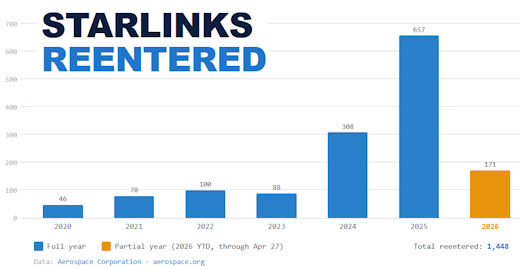
This histogram of Starlink re-entries is updated daily on Spaceweather.com
So far this year (April 28, 2026), 171 Starlinks have reentered, adding more than 5 metric tons (5,000 kg) of aluminum oxide to the stratosphere and mesosphere. How does this compare to natural sources?
The primary natural source is meteoroids -- the same "shooting stars" that streak across the night sky. As they burn up between roughly 75 and 110 km, they release a faint dusting of metals. Recent studies suggest that meteoroids disperse between 40,000 kg and 58,000 kg of Al₂O₃ into the atmosphere each year. Starlink in 2026 is on track to add between 26% and 39% of that natural total.
 39% may not sound too bad, but consider the following: The size of the Starlink constellation is rapidly increasing, and SpaceX's competitors are racing to catch up. A full buildout of planned megaconstellations with corresponding re-entries could inject more than 360,000 kg of Al₂O₃ per year -- a 640% excess above natural meteoroids (Ferreira et al. 2024).
It all adds up to a giant uncontrolled experiment in atmospheric chemistry. Researchers already know that aluminum oxides can destroy ozone in a complex series of steps involving Al₂O₃, HCl, AlCl₃, sunlight, Cl, and O₃. Other side-effects may reveal themselves in time.
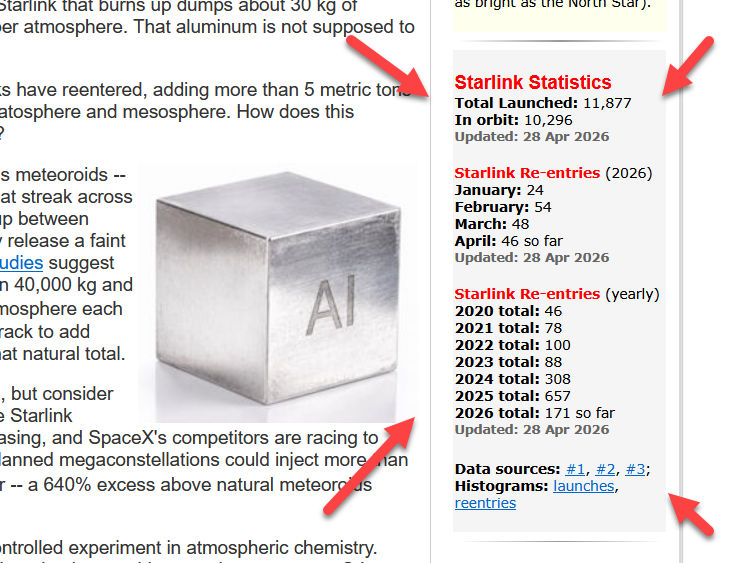
Stay informed: Daily updated totals of Starlink launches and reentries are posted here on Spaceweather.com.
Realtime Space Weather Photo Gallery
Free: Spaceweather.com Newsletter
THE WROUGHT IRON SPACE ROSE: This rose is genuine "star stuff." It is hand crafted from iron, the element formed in supernova explosions, and it has touched the edge of space. The students of Earth to Sky Calculus launched it to the stratosphere onboard a cosmic ray research balloon:
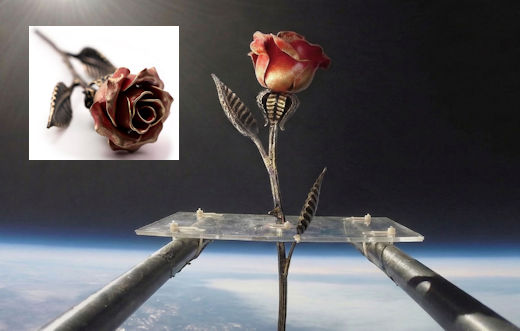
You can have it for $197.95. The metal bloom makes a great gift for Mother's Day (coming soon!), a romantic birthday or anniversary. With your purchase, you will also receive a greeting card showing the bloom in flight and telling the story of its journey to the stratosphere and back again.
Far Out Gifts: Earth to Sky Store
All sales support hands-on STEM education
Realtime Aurora Photo Gallery
Free: Spaceweather.com Newsletter