LOW CHANCE OF FLARES TODAY: Warning: This kind of forecast sometimes provokes an X-flare. Solar activity is quieting as sunspots on the solar disk lose their magnetic complexity. Sunspot 4425, in particular, has almost completely stopped flaring in the past 48 hours. Strong explosions are therefore unlikely on April 30th. Free: Space Weather Newsletter
NOW, AMAZON IS MAKING ITS OWN AURORAS: Et tu, Amazon? The April 27th launch of 29 new satellites for Amazon's Leo internet constellation did something originally made famous by SpaceX. It turned the upper atmosphere red. James Perez-Rogers photographed the phenomenon from the Ashokan Reservoir in New York:
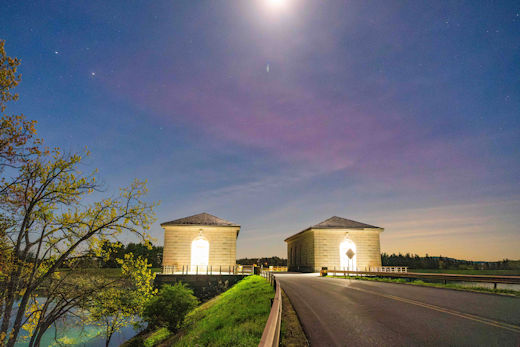
He took this picture shortly after an Atlas 5 rocket lifted off from Cape Canaveral carrying Amazon's satellites. The rocket's second stage separated almost directly above New York with engines burning through the ionosphere. Perez-Rogers' timelapse movie captured both the separation and the 'red bloom.'
"I saw the red, and it distinctly followed the exhaust plume of the rocket," he says.
We're reported this red color before--sometimes calling it a "SpaceX aurora." It appears when rocket engines spray water (H2O) and carbon dioxide (CO2) into the ionosphere. A complicated series of charge exchange reactions between these molecules and oxygen ions (O+) produce photons at a wavelength of 6300 Å–the same color as red auroras.
The red glow is only temporary and seems to cause no harm. But with more rockets launching, more of these artificial red auroras will appear--maybe in a sky near you. Meanwhile, the Amazon Leo constellation now contains 239 satellites. It has some catching up to do.
Realtime Space Weather Photo Gallery
Free: Spaceweather.com Newsletter
THE WROUGHT IRON SPACE ROSE: This rose is genuine "star stuff." It is hand crafted from iron, the element formed in supernova explosions, and it has touched the edge of space. The students of Earth to Sky Calculus launched it to the stratosphere onboard a cosmic ray research balloon:
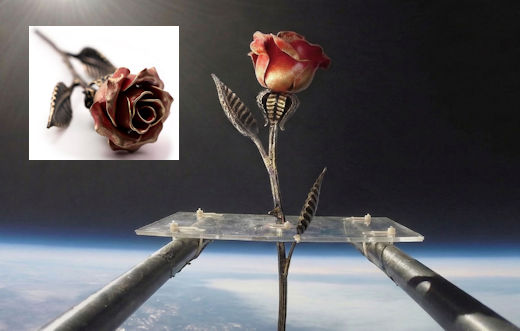
You can have it for $197.95. The metal bloom makes a great gift for Mother's Day (coming soon!), a romantic birthday or anniversary. With your purchase, you will also receive a greeting card showing the bloom in flight and telling the story of its journey to the stratosphere and back again.
Far Out Gifts: Earth to Sky Store
All sales support hands-on STEM education
Realtime Aurora Photo Gallery
Free: Spaceweather.com Newsletter