QUIET WEEKEND: The solar disk is peppered with sunspot groups--at least nine. All of them have stable magnetic fields unlikely to explode. Solar flare activity should remain low this weekend. Free: Space Weather Newsletter
COMET PANSTARRS IS THRIVING: Following its late April close encounter with the sun, Comet PanSTARRS (C/2025 R3) is emerging from the glare in the evening twilight sky. The sun-heated comet is thriving:
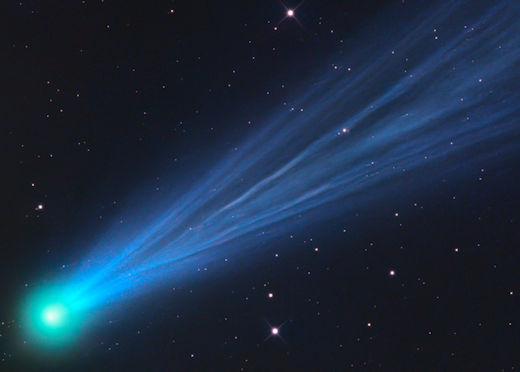
Gerald Rhemann and Michael Jäger took the picture on May 1st using a remote-controlled telescope in Farm Tivoli, Namibia. "This is an LRGB exposure of 240/140/140/140 sec. through a 12.5-inch Astrograph," they explain.
The comet is currently shining like a 5th-to-6th magnitude star in the constellation Eridanus, best seen from the southern hemisphere. Point your optics here.
Realtime Space Weather Photo Gallery
Free: Spaceweather.com Newsletter
BLUE FLASHES ARE REAL: You've heard of the green flash, the emerald light that sometimes glints above the setting sun. It was once thought to be a fable, although we now know it is real.
And what about the blue flash? Turns out, that's real too. Ronny Tertnes photographed one from Bergen, Norway, on April 26th:
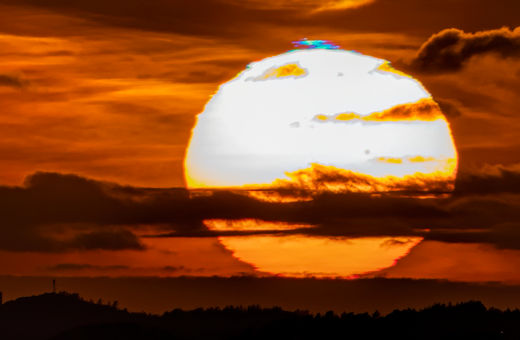
"I haven't seen this before," says Tertnes.
Blue flashes are formed in the same way as green flashes. A mirage magnifies tiny differences in the atmospheric refraction of red, green and blue light. Blue flashes are harder to see than green flashes because blue flashes blend into the surrounding blue sky. When the air is exceptionally clear, however, the blue flash emerges.
Jules Verne popularized the green flash in his 1882 novel "Le Rayon Vert" (The Green Ray). "If there is a green in Paradise, it cannot be but of this shade, which most surely is the true green of Hope," he wrote.
Ditto the blue.
Realtime Blue Flash Photo Gallery
Free: Spaceweather.com Newsletter
FORGET-ME-NOT PHOTO LOCKET: It's a great gift for Mother's Day: The Forget-Me-Not Photo Locket. The students of Earth to sky Calculus launched it to the stratosphere onboard a cosmic ray research balloon:
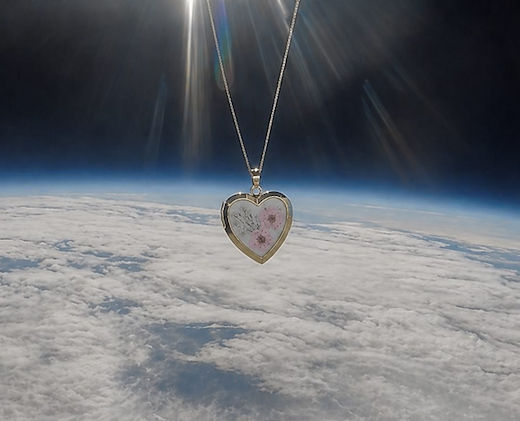
You can have it for $169.95. Filled with real pressed forget-me-not and white lace flowers, the locket opens to hold a small photo close to your heart. You will also receive a greeting card showing the locket in flight and telling the story of its journey to the stratosphere and back again.
The students of Earth to Sky Calculus are selling Mother's Day Gifts from space to pay the helium bill for their cosmic ray ballooning program. Shop now!
Far Out Gifts: Earth to Sky Store
All sales support hands-on STEM education
Realtime Aurora Photo Gallery
Free: Spaceweather.com Newsletter