METEORS FROM HALLEY'S COMET: Earth is entering a stream of debris from Halley's Comet, source of the annual eta Aquarid meteor shower. Forecasters expect the shower to peak on May 5th and 6th. Rates could be as high as 30 meteors per hour in the southern hemisphere, but only half that in the northern hemisphere. The best time to look is just before local sunrise when the constellation Aquarius is high in the sky. Free: Space Weather Newsletter
ARE WE OVERDUE FOR A SUPERFLARE? We've all heard of X-class solar flares--powerful explosions on the sun that pepper satellites with energetic particles and trigger great geomagnetic storms. They can be scary. But not as scary as a new category of solar flare being discussed by researchers: the "S-flare"--a solar superflare stronger than X10.
A new paper published in the Journal of Geophysical Research suggests we may be overdue for one.
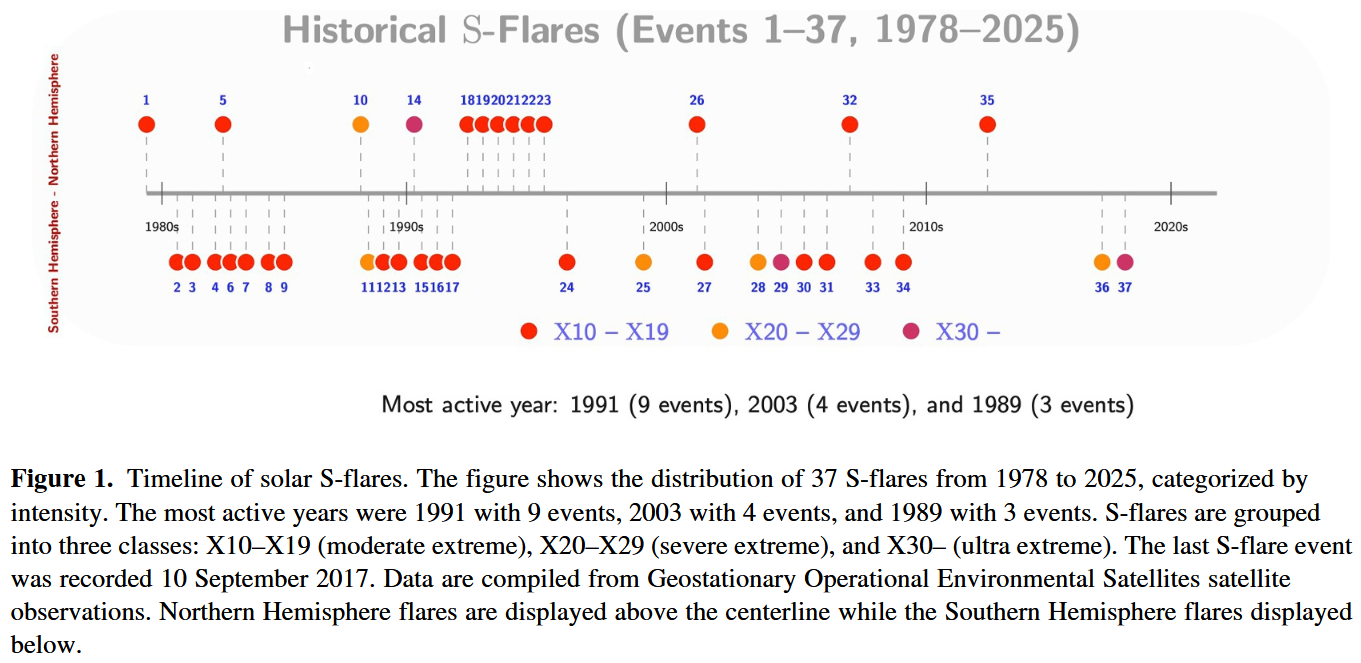
During the current solar cycle, Solar Cycle 25, Earth has not yet experienced an S-flare. That's a little unusual, according to researchers led by V.M. Velasco Herrera of the National Autonomous University of Mexico. The team looked at 50 years of data from Earth-orbiting satellites. Among 95,627 solar flares, they found 37 Earth-directed S-flares. Every solar cycle since the 1970s has produced one--except Solar Cycle 25.
There are some clues to when the next S-flare might happen. In the 50-year dataset, the researchers found two underlying rhythms: 1.7 years and 7 years, both linked to magneto-Rossby waves inside the sun. When both rhythms swing into their positive phase at the same time, the probability of an S-flare spikes.
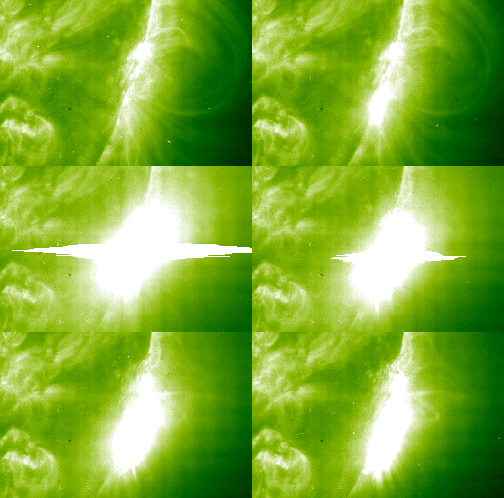 Right: An S-class solar flare (X45) on Nov. 4, 2003. [more]
According to those rhythms, we're exiting a high-risk S-flare window now: mid-2025 through mid-2026. The next high-risk window opens in early 2027 and lasts about 6 months.
In May 2024, Europe's Solar Orbiter detected two possible S-flares on the farside of the sun. Their intensity (with significant error bars) was X11.1 and X16.5. The sun fired the gun; we just happened to be standing behind the target.
Maybe next time. Stay tuned for updates as the 2027 window approaches.
Realtime Space Weather Photo Gallery
Free: Spaceweather.com Newsletter
MOTHER'S DAY IS THIS SUNDAY: Are you looking for an out-of-this world Mother's Day gift? Consider this: Every time the students of Earth to Sky Calculus launch a cosmic ray balloon, they include something extra in the payload--something Mom will love:
Every item in the Earth to Sky Store has flown to the edge of space and comes with a greeting card showing the item in flight. The interior of the card tells the story of the gift's journey from launch to landing. Mom-satisfaction guaranteed!
Far Out Gifts: Earth to Sky Store
All sales support hands-on STEM education
AIRGLOW DUNES (UPDATED): You may have heard of "aurora dunes" -- a recently identified form of Northern Lights named after their resemblence to ripples in desert sand. Researchers led by Minna Palmroth (University of Helsinki) first explained them in a paper published only a few years ago.
Now, let us introduce you to "airglow dunes":
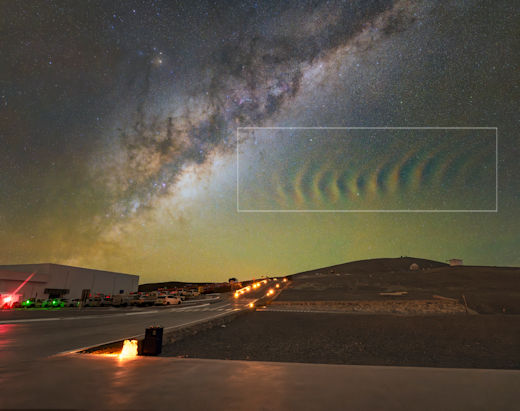
Zdenek Bardon took this picture from the European Southern Observatory in Paranal, Chile, on April 17th. "I was photographing the Milky Way and caught some rippling green airglow at the same time."
The dunes are a "mesospheric bore," a type of atmospheric gravity wave that springs up from Earth's surface and gets caught in a thermal waveguide ~100 km high. Although auroras and airglow are formed in completely different ways (solar activity vs. terrestrial photochemistry) mesospheric bores can modulate them both.
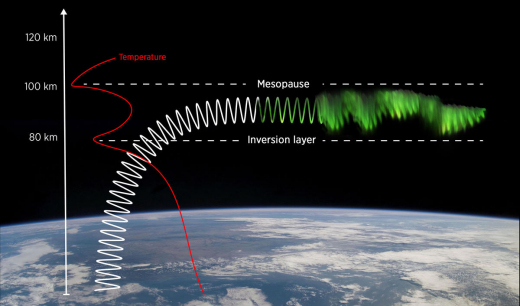
Update: Space scientist Steven M. Smith of Boston University has a different interpretation of these dunes. "They are more likely to be ripples due to a Kelvin-Helmholtz instability," he believes. "This kind of instability is caused by vertical shears in wind speed, which are common in the mesosphere. The effect is also seen on the bottom of sandy streams - the wave-like undulations in the sand on the bottom is due to the rapid change in velocity of the water."
Smith prefers Kelvin-Helmholtz over bores in part because "a bore is much more extensive with the wave-fronts extending across the entire sky."
Realtime Airglow Photo Gallery
Free: Spaceweather.com Newsletter
Realtime Aurora Photo Gallery
Free: Spaceweather.com Newsletter