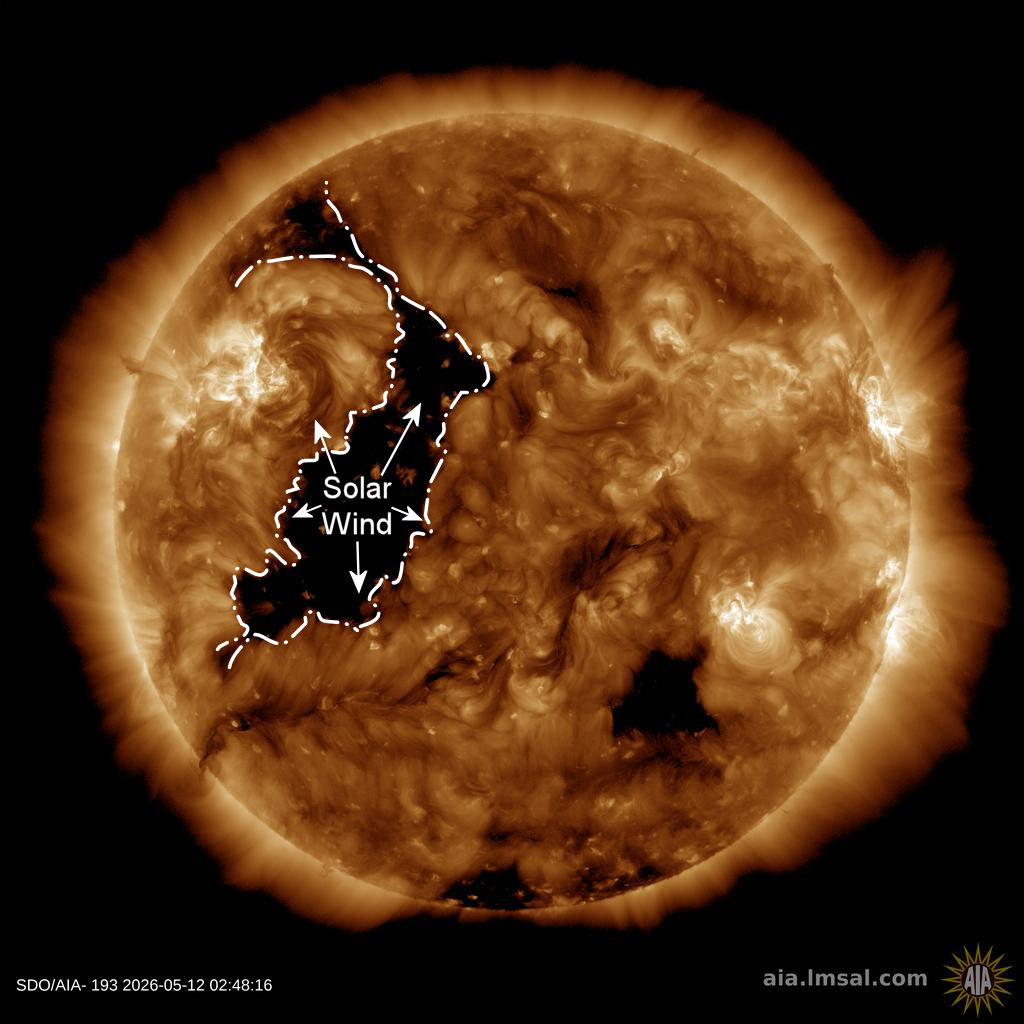
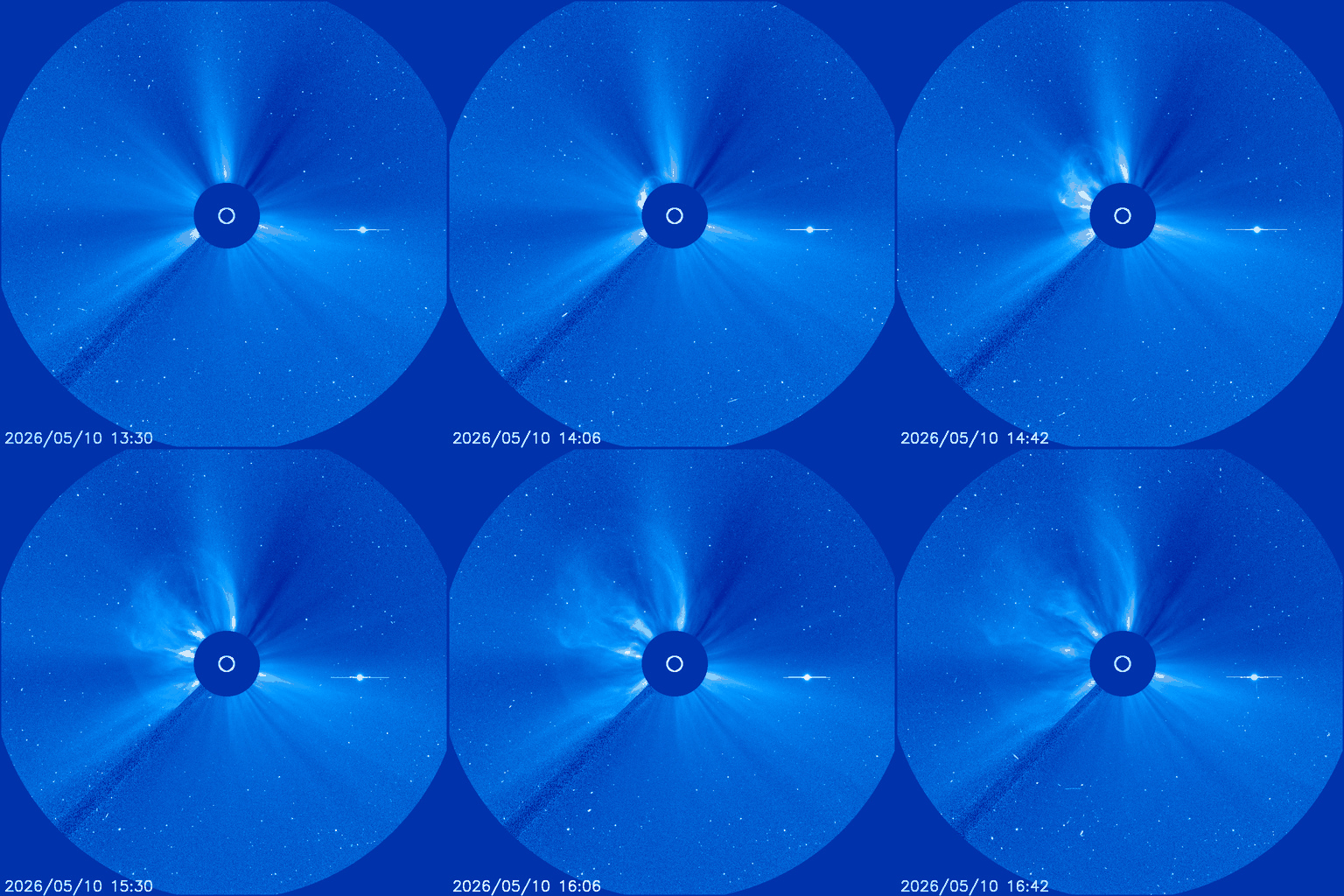
GEOMAGNETIC STORM WATCH--UPGRADED: NOAA forecasters have upgraded the May 15th geomagnetic storm watch to category G2 (Moderate). The new forecast takes into account not only an incoming stream of solar wind but also the possibility of a glancing blow from a CME. The New Moon will provide dark skies for high-latitude auroras. Free: Space Weather Newsletter.

A 'METHALOX COMET' OVER THE USA: Last night, a glowing comet-like apparition swept across the skies of the central United States--but it wasn't a comet. It was a Chinese rocket.
"We just had another satellite fuel dump event here in the Midwest," reports Dan Bush of Albany, Missouri, who photographed the display:
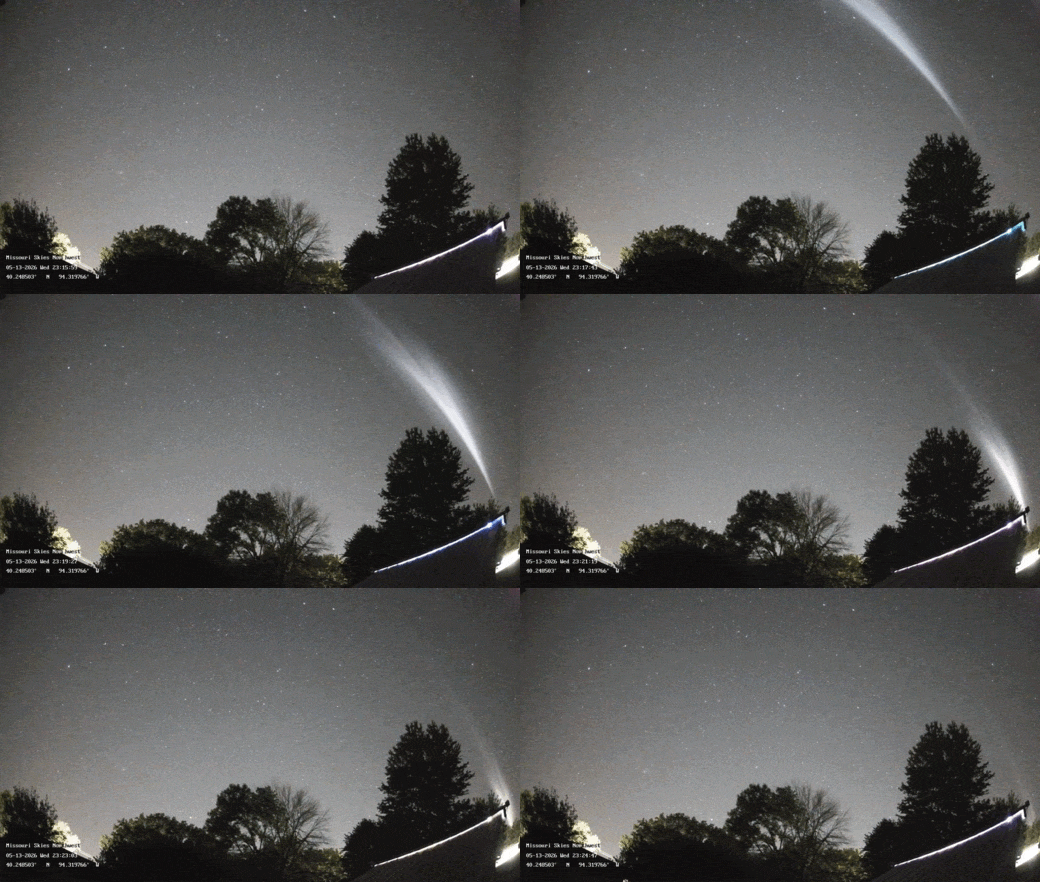
"This one was much larger than previous dumps I have seen," he says. "It began around 4:16 UT (May 14th) and lasted for about 10 minutes."
The source was China's Zhuque-2E Y5 rocket, which lifted off about an hour earlier carrying a 2.8-ton payload to a 900-km polar orbit. What sets this rocket apart is its fuel: liquid methane and liquid oxygen, or "methalox." When a methalox upper stage vents its fuel, the cryogenic propellants flash-freeze into a distinctive comet-like cloud of tiny ice crystals.
Methalox is a new and increasingly popular rocket fuel, offering several advantages over traditional fuels. Methane is easier to store than hydrogen, burns cleaner than kerosene, and can be produced on Mars. Methalox can now be found in the tanks of SpaceX's Starship, Blue Origin's New Glenn, and a growing fleet of Chinese commercial rockets.
The first widely-observed methalox comet appeared only one year ago over Colorado. Get ready for more. The era of methalox is just getting started.
more images: from Brandon Flores of Sauk County, Wisconsin; from Jeffrey Louwagie near Minneapolis, Minnesota; from Barry Simon near Clinton, Louisiana; from Allen Hwang at Lake Superior, Michigan; from Michelle Pearson of Cushing, Wisconsin;
Realtime Space Weather Photo Gallery
Free: Spaceweather.com Newsletter
BREWER'S YEAST FROM SPACE: Father's Day is coming soon. Dad might appreciate some far-out home brew! On Oct. 4, 2025, we flew six test tubes of brewer's yeast to the stratosphere onboard a cosmic ray research balloon:
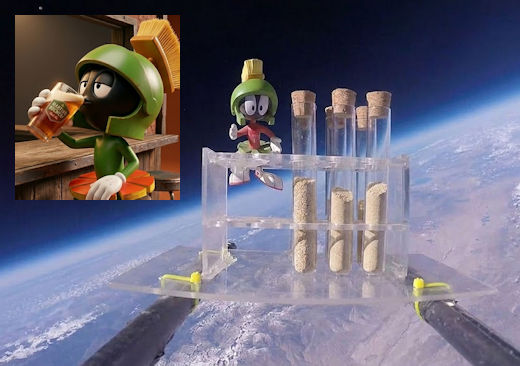
You can have an entire tube for $99.95. These high-flying microbes are the perfect gift for any home brewer who wants a far-out Ale or Lager. Choose from one of three varieties (American Ale, English Ale and Smooth Lager). Your order comes with a greeting card showing the yeast in flight and telling the story of its trip to the stratosphere and back again. Bottoms up!
Far Out Gifts: Earth to Sky Store
All sales support hands-on STEM education
HOW RAINBOWS SUCK LIGHT OUT OF THE SKY: Last week in Palencia, Spain, Alexis Kwasinski saw a beautiful double rainbow. The arcing colors, however, were not what attracted his attention. "The impressive thing was the dark band between them," he says.
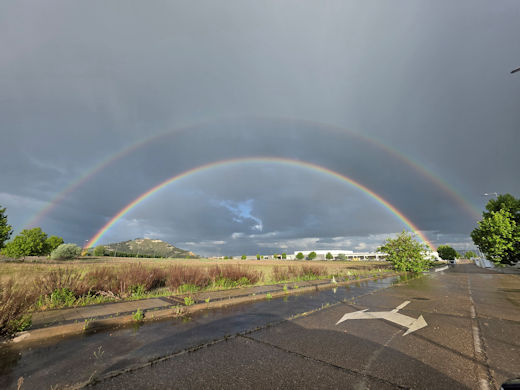
"The image shows quite accurately what I could see with my eyes," he says. "I did no processing."
The dark arch is called "Alexander's dark band" after Alexander of Aphrodisias who first described the effect in 200 AD. All double rainbows are separated by such a band.
The bright primary bow (bottom) is formed by light reflected once inside raindrops. The less-bright secondary bow (top) is formed by light reflected twice inside raindrops. These reflections, single vs. double, scatter light in opposite directions. In between the two rainbows, light is simply not bent toward the observer, so it looks dark.
And that's how rainbows can suck light out of the sky. Find more examples in the Realtime Rainbow Photo Gallery.
Realtime Space Weather Photo Gallery
Free: Spaceweather.com Newsletter
Realtime Aurora Photo Gallery
Free: Spaceweather.com Newsletter