GEOMAGNETIC STORM IN PROGRESS: Earlier today, a CIR (co-rotating interaction region) hit Earth and sparked a minor G1-class geomagnetic storm. NOAA forecasters say the storm could escalate to category G2 (Moderate) as high-speed solar wind blows in on the heels of the CIR. Aurora alerts: SMS Text.


SUPER EL NIÑO, IS THE TERMINATOR TO BLAME? Headlines are buzzing with news that a super El Niño is forming in the Pacific Ocean. A solar physicist saw it coming 3 years ago.
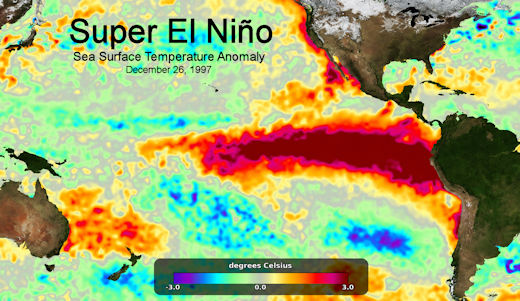
A super El Niño like this one in 1997 is now forming in the Pacific Ocean.
In a 2023 paper, Robert Leamon of NASA and the University of Maryland (Baltimore County) made a striking prediction: The next El Niño would arrive in 2026. He based it on the Terminator, a magnetic event on the sun that ends one solar cycle and ignites the next.
Averaging the past five solar cycles into a "standard cycle" and projecting it forward, Leamon found that El Niños follow about five years after a Terminator. The most recent termination event happened in December 2021, putting the next El Niño squarely in 2026. His model says nothing about the strength of this El Niño, but the timing is spot-on.
Leamon and his colleague Scott McIntosh had previously shown that every Terminator since the 1960s coincided with a flip from El Niño to La Niña. Their work correctly predicted the onset of a triple-dip La Niña in 2020 and revealed an unexpected connection between the sun and the ENSO (El Niño-Southern Oscillation).
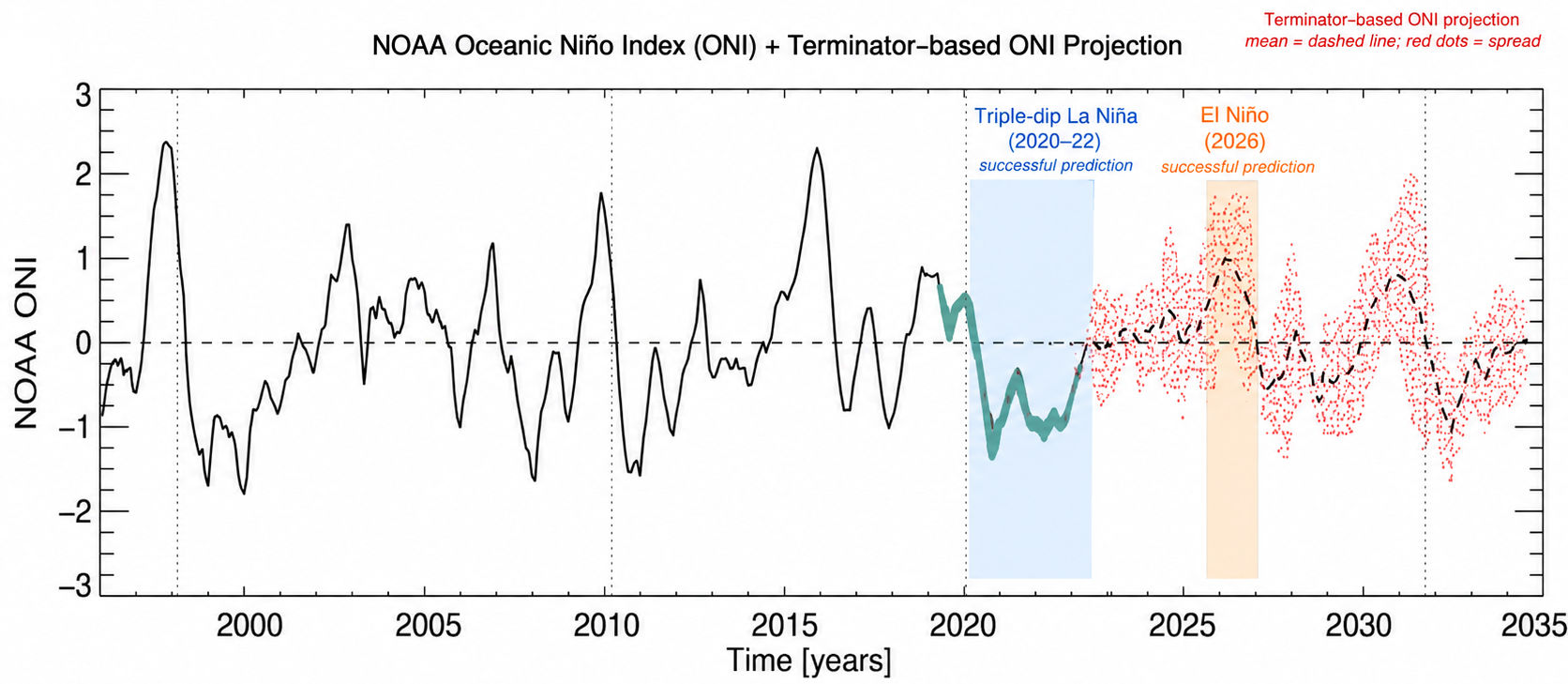
Adapted from Fig. 5 of Leamon (2023), this chart highlights two apparently successful predictions based on the Terminator
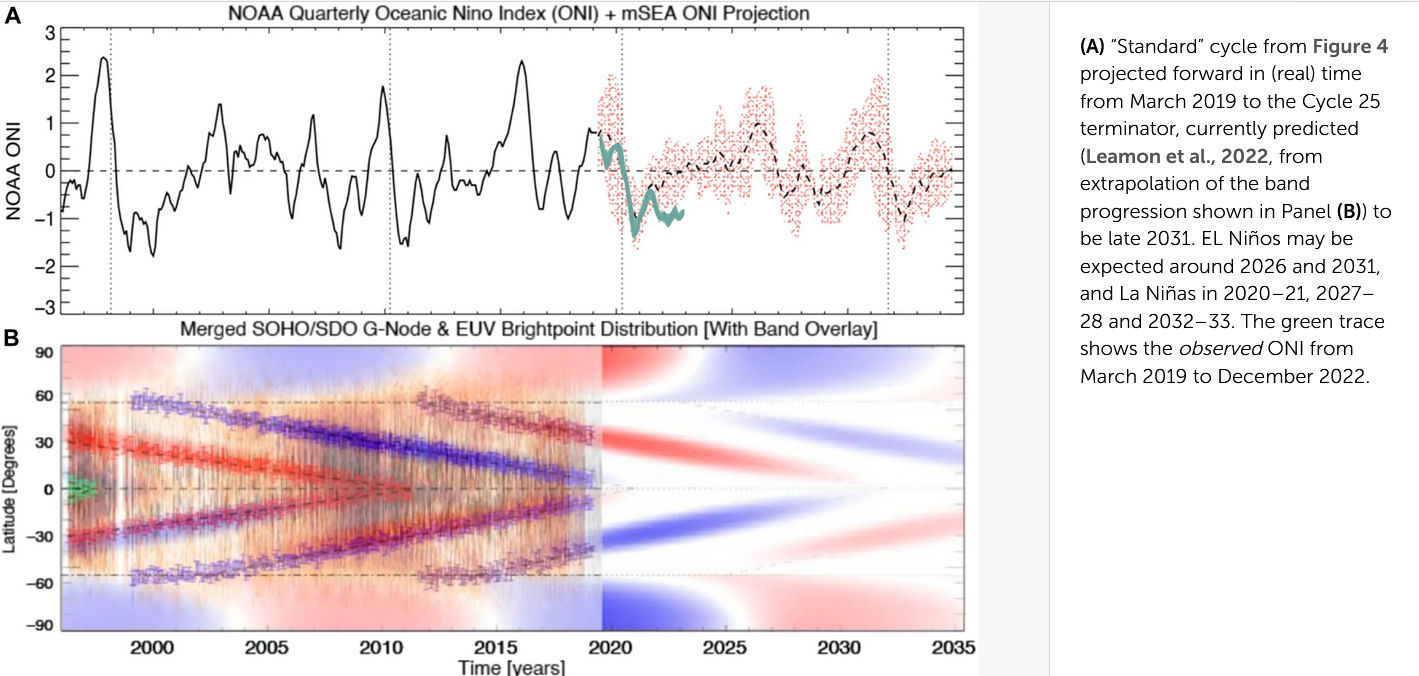
No one knows how the sun exerts control over the ENSO. Most researchers favor "top-down" models: Solar activity alters the top of Earth's atmosphere, making changes that percolate down to affect the weather we experience near Earth's surface. But the actual mechanism is unknown.
At first (2021), Leamon and McIntosh thought cosmic rays were responsible. Galactic cosmic rays vary with the solar cycle, and they influence the ionization of Earth's atmosphere. But later (2023) Leamon himself weighed in against cosmic rays, noting that the timing didn't work. He currently favors a correlation with geomagnetic activity.
The search for a sun-El Niño connection is as old as El Niño itself. Sir Gilbert Walker, who discovered the "Southern Oscillation" (the SO in ENSO) in the early 1900s, tried and failed to find a link to sunspots. Throughout the 20th century, other researchers likewise struggled to make the connection. The Terminator, however, is a new concept articulated by McIntosh and Leamon in a series of papers starting 10 years ago. It seems to do a good job of predicting solar cycles and may be successful with ENSO as well.
It will take more than 1 or 2 successful predictions to build confidence in this model, but it's a good start. Let the El Niño begin.
Realtime Space Weather Photo Gallery
Free: Spaceweather.com Newsletter
"MAKE SOMETHING WONDERFUL" STEVE JOBS DOLLAR COINS: This is real money. The US Mint just released a new $1 coin to honor one of America's greatest innovators: Steve Jobs. On May 14, 2026, the students of Earth to Sky Calculus launched the coins to the stratosphere onboard a cosmic ray research balloon:
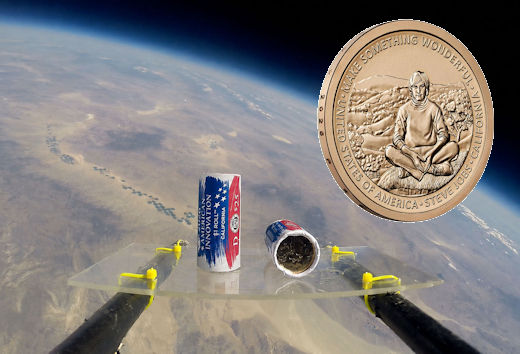
You can have a single coin for $49.95 or an entire unbroken roll for $299.95. No longer available from the US Mint, these rare coins flew 111,113 feet above the Sierra Nevada. One side shows Steve Jobs in a meditative pose; the other side features the Statue of Liberty in profile. The coin is inscribed with the words "MAKE SOMETHING WONDERFUL."
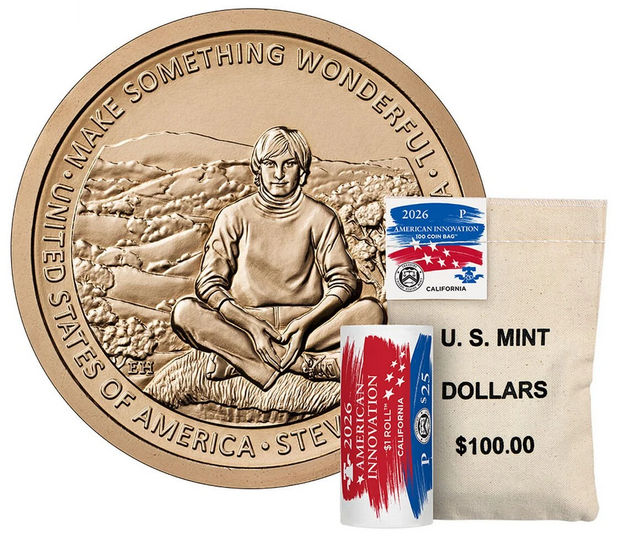
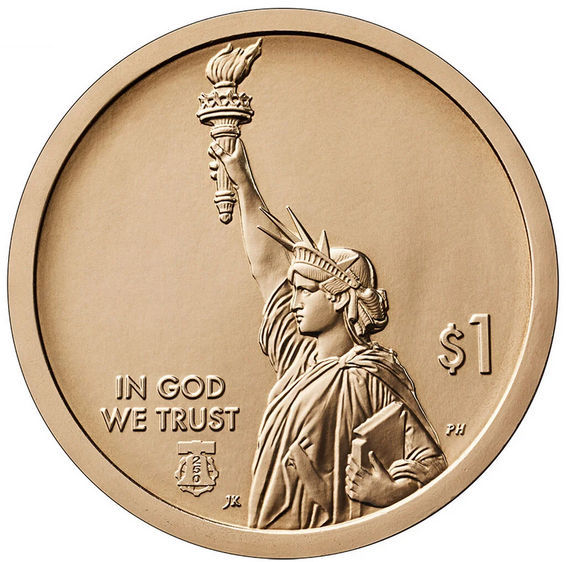
Bonus: If you need to, you can spend these coins. They're legal tender.
The students are selling space coins to support to support their cosmic ray research program. (Helium is expensive!) Each order comes with a greeting card showing the coins in flight and telling the story of their journey to the stratosphere and back again.
Far Out Gifts: Earth to Sky Store
All sales support hands-on STEM education
Realtime Aurora Photo Gallery
Free: Spaceweather.com Newsletter