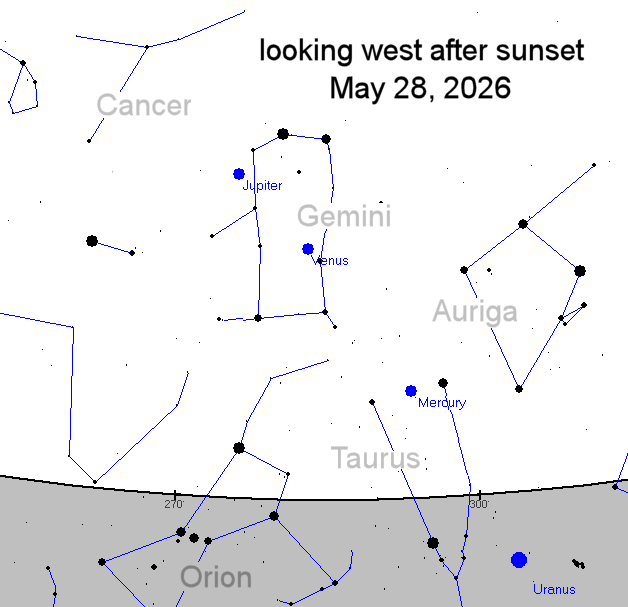
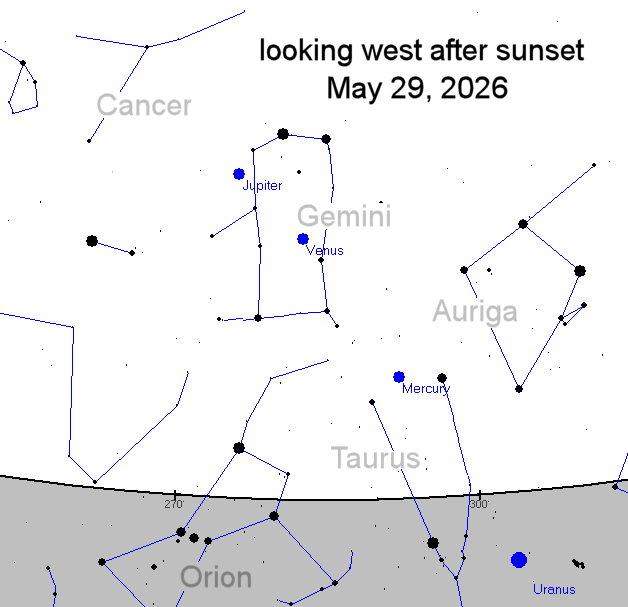
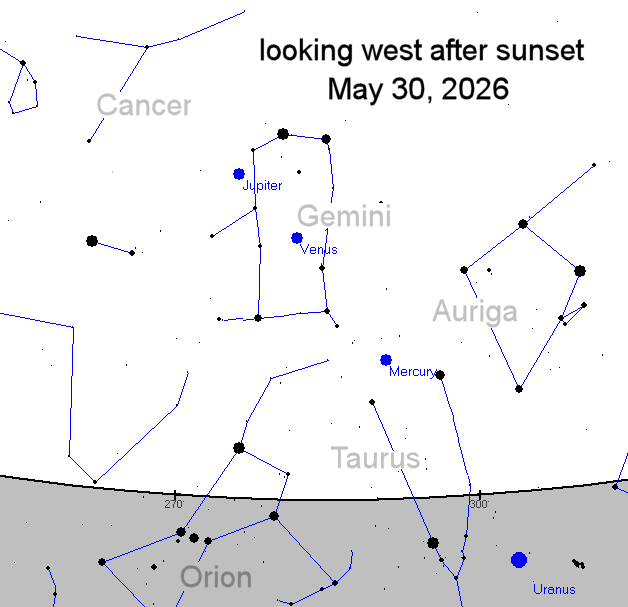
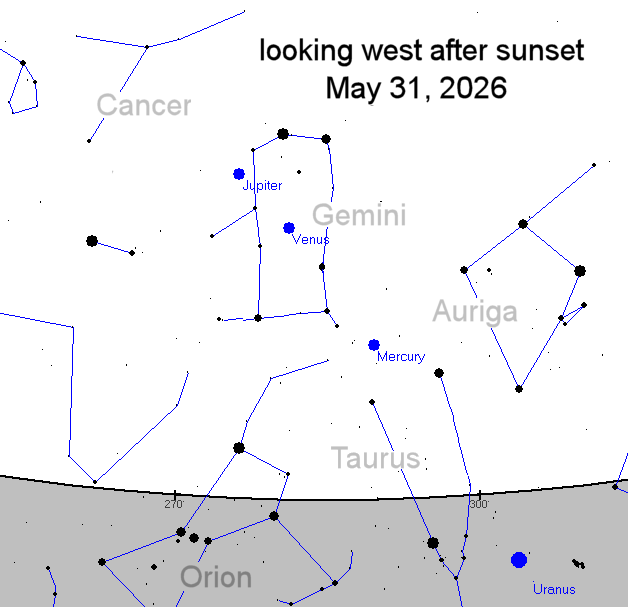
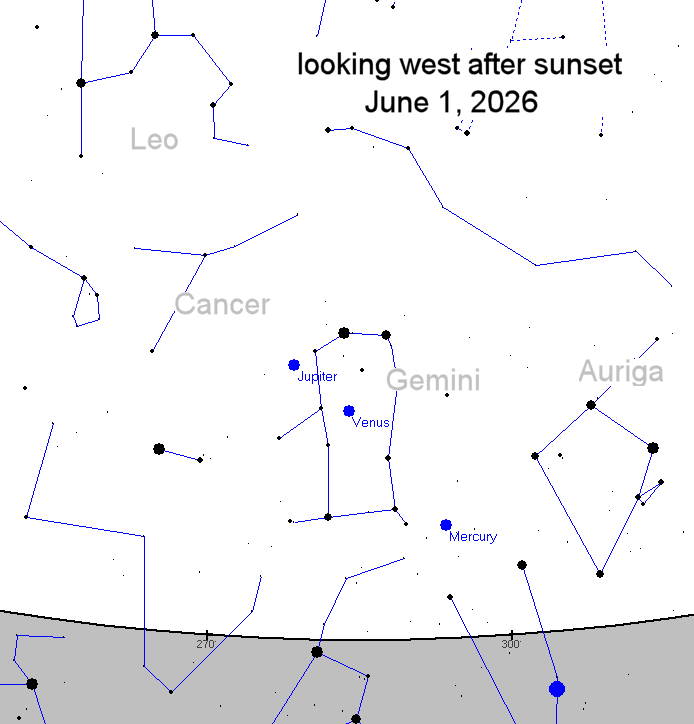
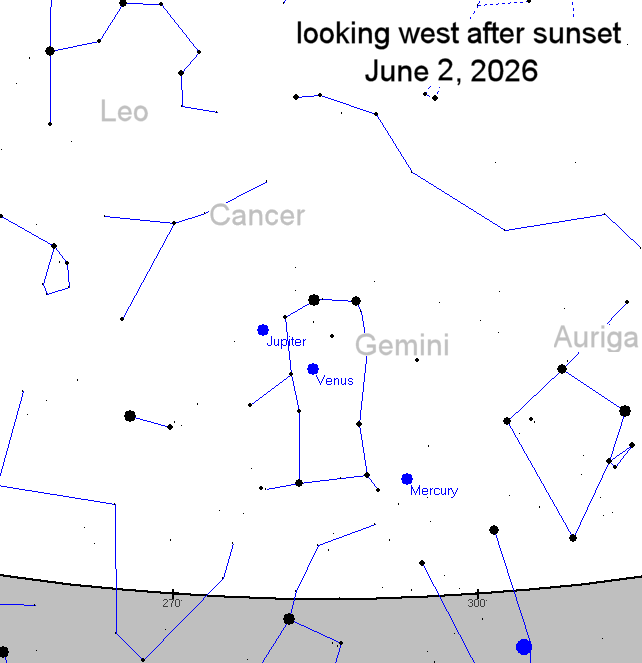
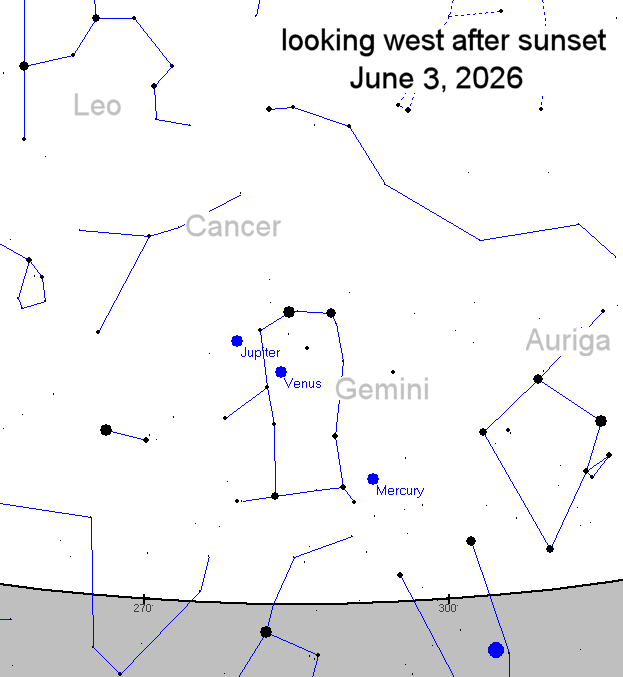
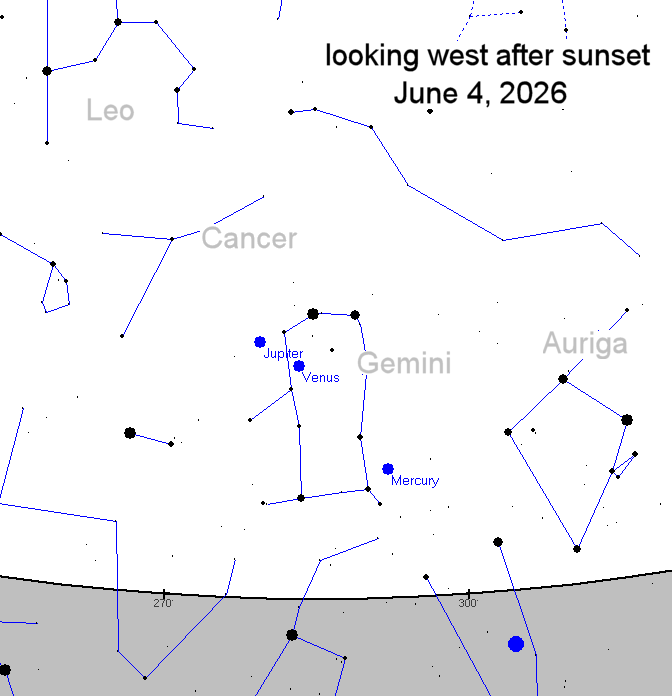
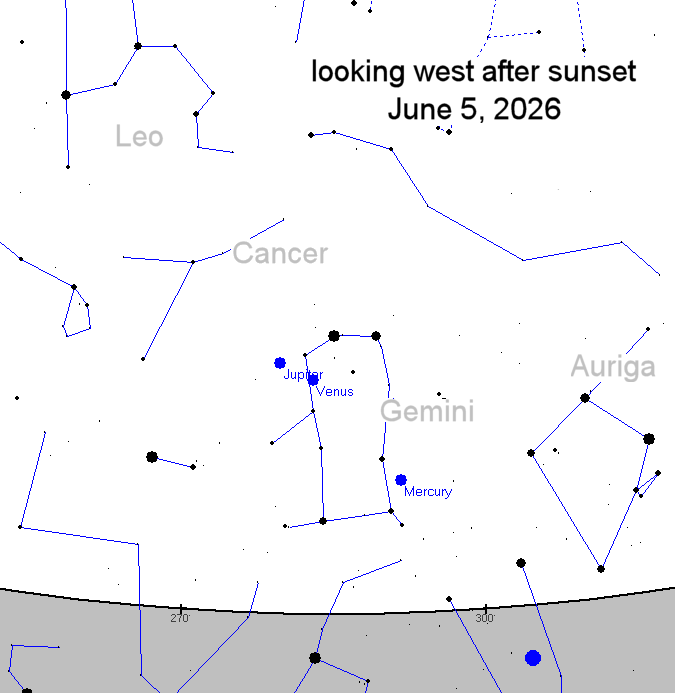
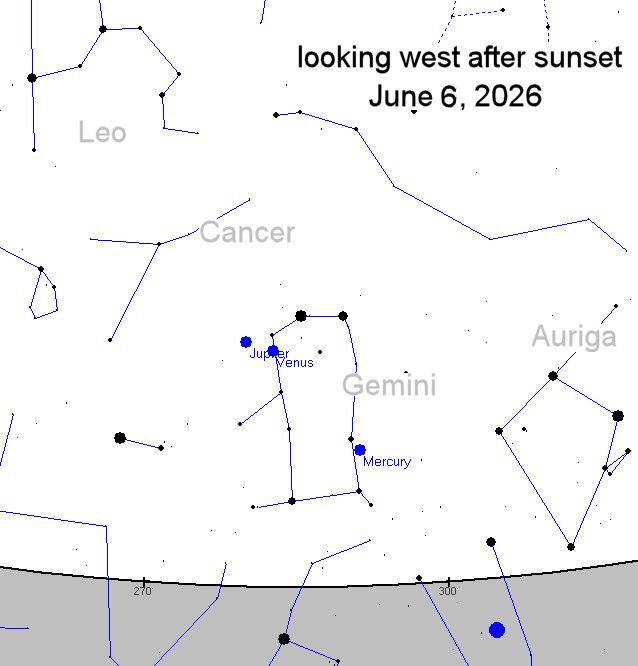
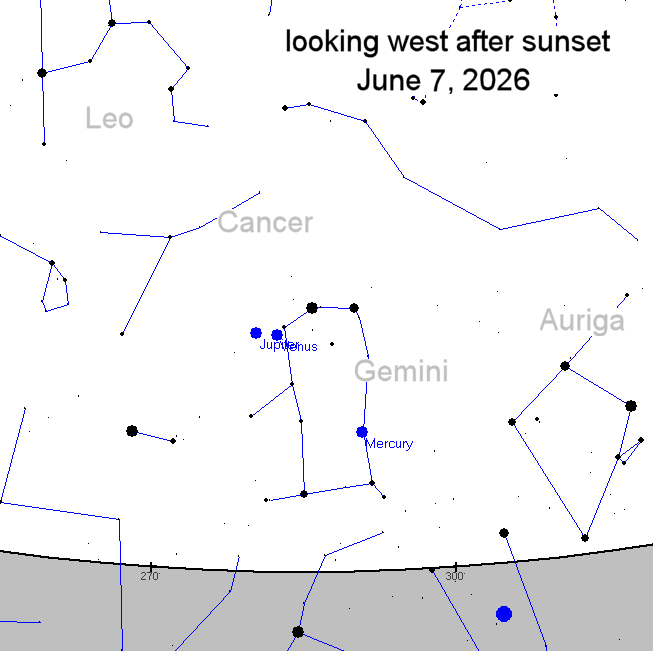
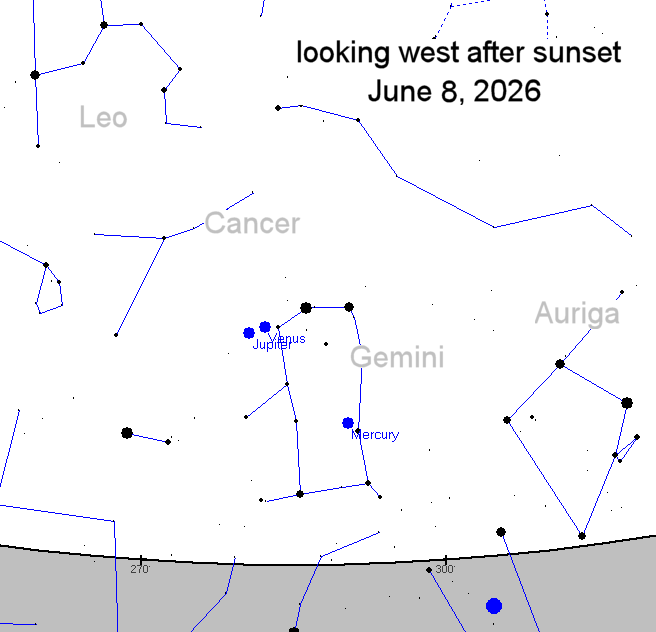
THREE PLANETS IN THE SUNSET SKY: When the sun goes down tonight, step outside and look west. Venus and Jupiter are converging in the twilight sky -- noticably closer together every night as they head for a tight conjunction on June 8-9. Soon, Mercury will join the show, too, forming a trio. Browse the sky maps for coming attractions: May 28, 29, 30, 31, June 1, 2, 3, 4, 5, 6, 7, 8. Free: Space Weather Newsletter
PUTTING THE "MEGA" IN MEGACONSTELLATION: Two months ago, headlines announced a Space Age milestone: SpaceX now has more than 10,000 active Starlink satellites circling Earth--two-thirds of all the working satellites in the sky. Analysts were gobsmacked by the pace of change.
Turns out, that's nothing. Back in January, SpaceX had already filed paperwork asking the FCC for permission to launch a million. The proposed megaconstellation would become a solar-powered AI data center, requiring hourly rocket launches carrying a million tons of satellites per year.
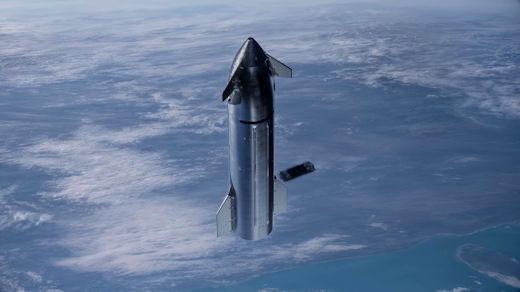
Above: Starship, the launch vehicle for the proposed AI data center
Condemnation was swift. Critics pointed out that the new satellites could outnumber visible stars, altering the appearance of the night sky. Moreover, the traffic jam could bring Earth orbit to the doorstep of "the Kessler Syndrome" -- a dangerous cascade of satellite collisions.
"The industrial scale of this is staggering," satellite expert Jonathan McDowell (recently retired from the Harvard-Smithsonian Center for Astrophysics) told Sky&Telescope, adding that it might even be a publicity stunt.
While much criticism has focused on night-sky light pollution and orbital safety, there's an even bigger issue: The effect on Earth's atmosphere. Satellites change the atmosphere twice: On the way up (via rocket exhaust) and again on the way down (via reentry debris). Researchers are only beginning to understand what happens at scale.
 The "black carbon problem" is a good example. Almost every rocket deposits black carbon (residue left over when carbon-based fuels do not burn completely) into the upper atmosphere. It's like the black soot inside a chimney. Black carbon can be tricky. By absorbing sunlight, it heats the atmosphere. By shading sunlight, it cools the atmosphere. So, while researchers are sure that black carbon will tip the atmosphere's thermal balance--they don't know which way (Maloney et al. 2022; Barker et al. 2026).
Reentries are just as bad. Consider this: For millions of years, natural meteoroids have been adding about 10,000 to 20,000 tons/year of material into Earth's atmosphere. Humanity is about to match that total. No later than 2040, disintegrating satellites will put as much material into the atmosphere as meteoroids do (Maloney et al. 2025; Sharma 2024). Unlike meteoroids, however, satellites are rich in industrial alloys. A million years of meteor bombardment doesn't tell us what a million satellite reentries might do.
NOAA has already detected the first signs of change. About 10% of sulfuric-acid droplets in the stratosphere contain metals from disintegrating spacecraft (Murphy et al. 2023). Aluminum oxides found in these droplets are a concern because they help destroy ozone, our planet's sunscreen.
Studies attempting to predict the effects of megaconstellations have proliferated since the Starlink program began in 2019. The catch is that nearly all of the forecasts assume Starlink-sized swarms of a few tens of thousands of satellites. A million satellites is another problem entirely.
Let the launches begin. But, first, could we do a little research?
Realtime Space Weather Photo Gallery
Free: Spaceweather.com Newsletter
THE MANDALORIAN AND GROGU: No collection of Star Wars bobbleheads is complete without the Mandalorian and Grogu. On May 20th, this Funko Pop! collector's item flew to the stratosphere onboard an Earth to Sky Calculus cosmic ray research balloon:
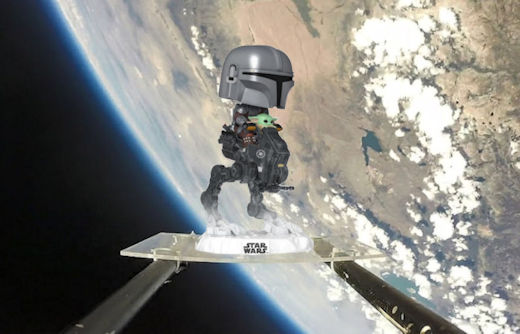
You can have it for $99.95. The nodding figurine shows the bounty hunters riding an Imperial Remnant AT-RT. Made from durable vinyl, this collectible is built to last. It has already survived a trip to the edge of space with cosmic rays 100x Earth normal and temperatures as low as -62 C.
The students are selling Star Wars bobbleheads to support their cosmic ray ballooning program. The Mandalorian and Baby Yoda are also available as separate items. Each one comes with a greeting card showing the bobblehead in flight and telling the story of its journey to the edge of space and back again.
Far Out Gifts: Earth to Sky Store
All sales support hands-on STEM education
Realtime Aurora Photo Gallery
Free: Spaceweather.com Newsletter