NOCTILUCENT CLOUD SEASON STARTS NOW: High above the Arctic Circle, water vapor is crystallizing around meteor smoke, kickstarting the 2026 season for natural noctilucent clouds (NLCs). First sightings have just been reported from Finland and Northern Ireland. We say "natural" noctilucent clouds to distinguish them from manmade noctilucent clouds, which are now seeded year-round by rocket exhaust. The NLCs forming now are the original kind, and they will spread to lower latitudes in June and July. Free: Space Weather Newsletter
BLUE MOON ALERT: Tonight's full Moon is no ordinary full Moon. It's a Blue Moon. To see it, step outside at sunset and spin round to face east. Just don't be surprised if it is orange:
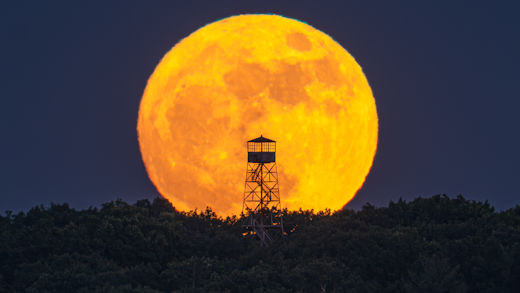
Above: The Blue Moon over Kingston, NY. Credit: James Perez-Rogers
This is a "calendar Blue Moon," the second full Moon within a single calendar month. May 2026 opened with a full Moon at the start of the month, and now closes with another. According to tradition, the second full Moon is "Blue."
Two full Moons squeeze into a single month once every two to three years. The phenomenon does not alter the Moon's natural colors. Low-hanging Blue Moons are typically orange (because of scattering in the atmosphere) while overhead Blue Moons are the gray shades of moonrock.
But here's the twist: Moons CAN actually turn blue. It's rare, but real.
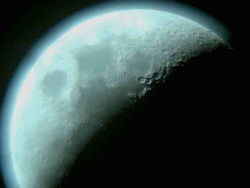 True blue Moons require unusual atmospheric conditions caused by forest fires and volcanoes. When the air is loaded with smokey particles slightly wider than the wavelength of red light (about 1 micron across) those particles preferentially scatter red wavelengths while letting blue light pass through. The result: a Moon tinged genuinely blue.
Following the 1883 eruption of Krakatoa, observers reported blue Moons for nearly two years. The 1980 eruption of Mt. St. Helens produced them, as did the 1991 eruption of Mt. Pinatubo. Smoke from wildfires in western Canada in September 1950 turned Moons blue across North America and Europe for weeks.
This Sunday, step outside and look up. The Moon will be full, bright, and, barring a volcanic calamity or forest fire, stubbornly silver. Enjoy the "Blue" moonlight anyway!
Realtime Space Weather Photo Gallery
Free: Spaceweather.com Newsletter
SOLAR SYSTEM STUD EARRINGS: These earrings have flown to the edge of space--and all eight planets are included. On May 21st, the students of Earth to Sky Calculus launched the Solar System Stud Earrings to the stratosphere onboard a cosmic ray research balloon. At the apex of the flight, they floated 104,655 feet high:

You can have the complete set for $129.95. Only Pluto is omitted from the collection; the dwarf planet was too small for human earlobes. The earrings come with a greeting card showing the studs in flight and telling the story of their journey to the stratosphere and back again.
Far Out Gifts: Earth to Sky Store
All sales support hands-on STEM education
Realtime Aurora Photo Gallery
Free: Spaceweather.com Newsletter