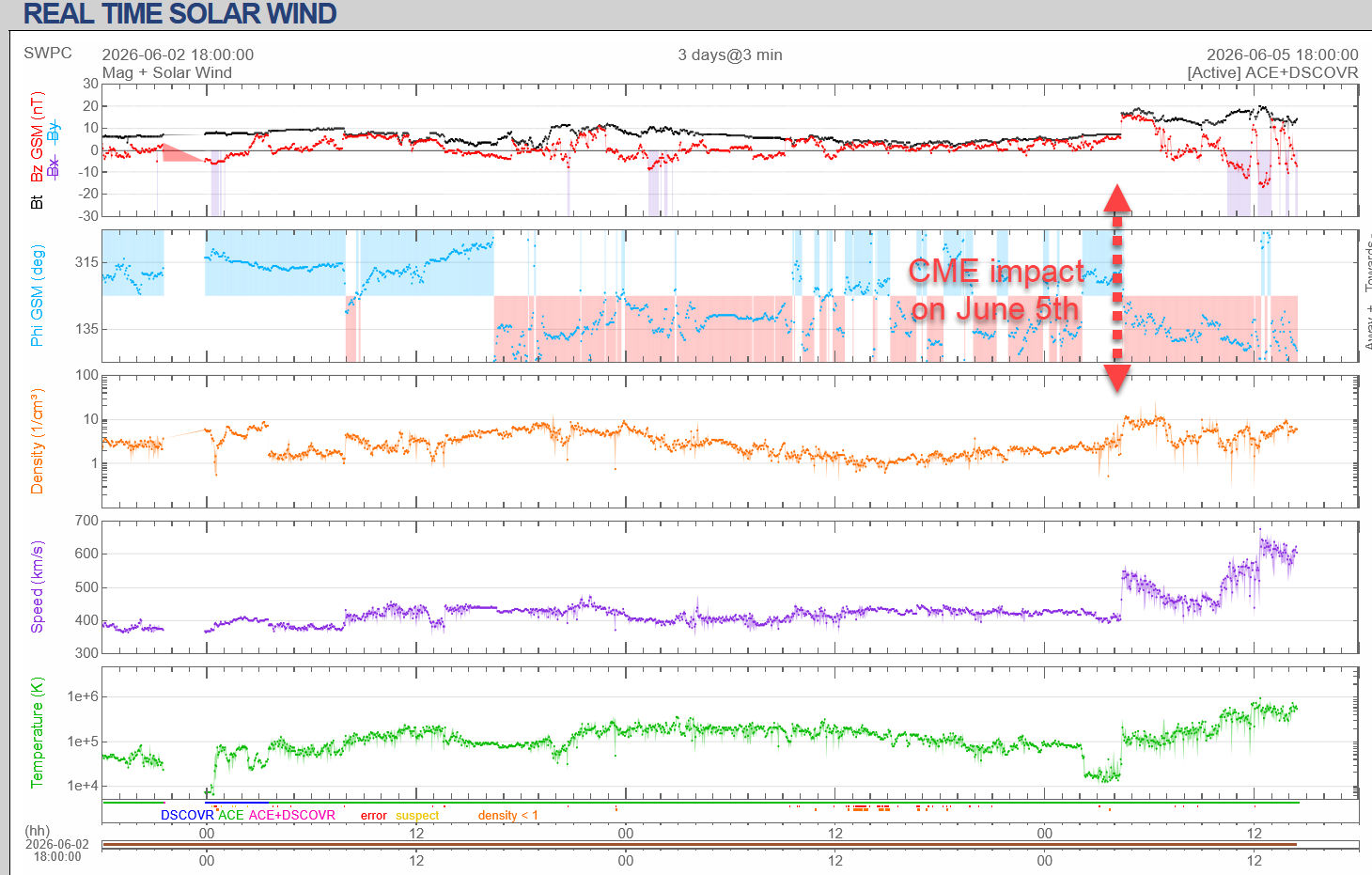
GEOMAGNETIC STORM UNDERWAY: A G2-class (Moderate) geomagnetic storm is underway on June 5th as Earth moves through the wake of a CME that struck earlier today. There is a slight chance that the storm could intensify to category G3 (Strong) with mid-latitude auroras. Overall, though, this event is less intense than forecast models predicted, and aurora sightings will probably be restricted to high latitudes. Aurora Alerts: SMS Text


THIS COMET JUST EXPLODED IN BRIGHTNESS: Little-known Comet 220P/McNaught caught astronomers off guard on June 1st with a dramatic outburst. In a matter of hours, the comet's brightness soared by a factor of almost 1,000--and kept going. By June 3rd, when Gerald Rhemann and Michael Jäger took this picture, the increase was nearly 10,000-fold:
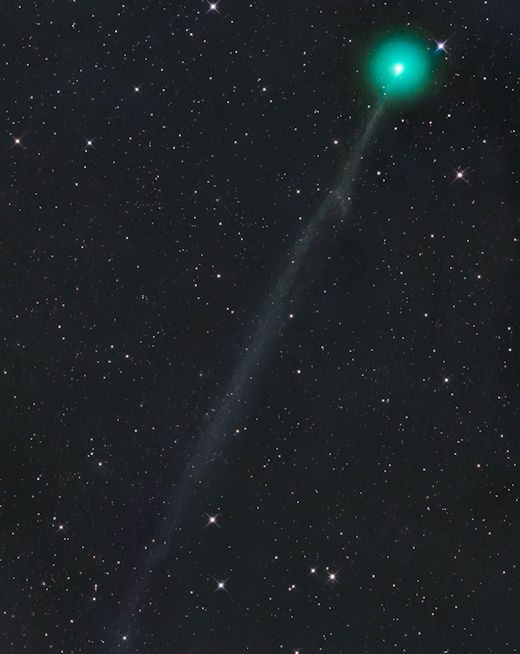
"We took the picture using a remote-controlled telescope in Namibia," says Rhemann. "The comet was so bright we could detect it despite interference from the Moon."
No one knows what caused the outburst--but we have a good idea: The comet is approaching perihelion (its closest approach to the sun, 1.56 AU) on June 14th. Increasing solar heat may have opened a fissure in the comet's core, allowing plumes of gas and dust to explode into space.
While this is a big outburst, it is not a record-breaker. The all-time leader is Comet 17P/Holmes, which in October 2007 brightened by an astonishing 14 magnitudes--a factor of nearly half a million. During the outburst, Comet Holmes briefly grew larger than the sun. 220P's 10,000-fold surge falls short of that historic event.
To see Comet 220P, set your alarm for 3 o'clock in the morning. Look low in the eastern sky before dawn not far from Saturn in the constellation Pisces. At 8th magnitude, the comet is too faint for the naked eye, but a 6-inch or larger telescope should reveal it as a small fuzzy glow. Point your optics here.
Realtime Space Weather Photo Gallery
Free: Space Weather Newsletter
STERLING SILVER RAINBOW DRAGONFLY: Are you looking for a far-out gift? Consider the Rainbow Dragonfly Space Pendant. The students of Earth to Sky Calculus launched it to the stratosphere onboard a cosmic ray research balloon:
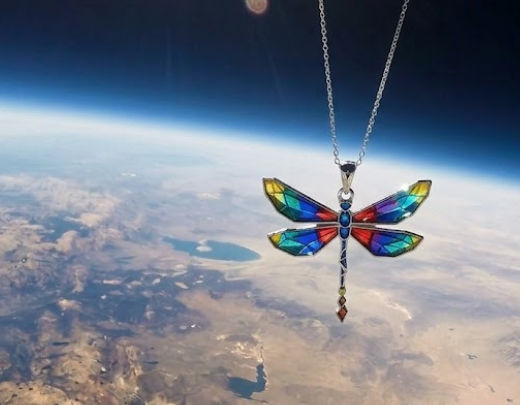
You can have it for $179.95. Made of stained glass with a sterling silver exoskeleton, the pendant has a wingspan of 1.1-inches and comes with a matching 18-inch sterling silver chain.
The students are selling space pendants to pay the helium bill for their cosmic ray ballooning program. Each one comes with a greeting card showing the jewelry in flight and telling the story of its trip to the stratosphere and back again.
Far Out Gifts: Earth to Sky Store
All sales support hands-on STEM education
Realtime Aurora Photo Gallery
Free: Spaceweather.com Newsletter