NEW! BACKYARD ASTRONOMY ALERTS: We're proud to announce a new service from Spaceweather.com: Backyard Astronomy Alerts. We love this product. Subscribers receive real-time alerts about space station flybys, aurora outbursts, planetary conjunctions, meteor showers and more -- all easy to see with the naked eye. SMS text messages tell you to go outside right now while the event is happening, and companion emails include sky maps and detailed observing tips. Check out the Father's Day Special, 50% off!
HOW TO DEFEAT A SOLAR STORM: Is it bonkers? Or brilliant? You decide: A new paper published in the June issue of Space Weather describes how a small fleet of spacecraft could be used to partially neutralize approaching CMEs--even Carrington-class monsters--by releasing clouds of gas in the CME's path. The editors of Science magazine called it an "orbital airbag" for solar storms.
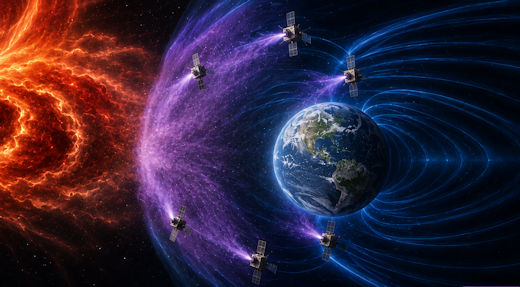
Above: An artist's concept of the "air bag" solar storm defense--not to scale!
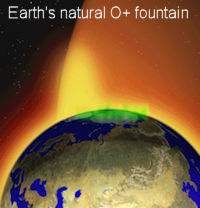
The researchers, led by Brian Walsh of Boston University, got their inspiration from Earth itself. During major geomagnetic storms, Earth's upper atmosphere naturally releases a fountain of oxygen ions into space. These ions "mass-load" the magnetic field, reducing magnetic reconnection and, in effect, making Earth's magnetic field harder to push around.
The new study asks a simple question: What if we amplified this natural defense using spacecraft?
 Walsh's team simulated the great geomagnetic storm of May 2024 and found they could cut some of its effects by as much as 84% using six spacecraft releasing 384 tons of a barium-like gas.
That might sound like a lot of gas, but consider this: A typical CME weighs about a billion tons. The proposed shield contains less than one millionth as much mass, yet still weakens the storm's impact. Their scheme punches far above its weight.
Now for the problems: Once the spacecraft deploy their defenses, their tanks would quickly empty. A refill requires launching about six Starship-class tankers. Also, the environmental effects are unknown. Injecting hundreds of tons of ionized gas into Earth's magnetosphere could alter the radiation belts, interfere with satellites, and create an artificial plasma environment unlike anything near Earth today. Researchers still need to understand these risks.
Indeed, the paper is best seen not as a concrete proposal but rather as a provocative thought experiment. Defeating solar storms is within our reach. We just don't know if it's a good idea. Let the conversation begin.
Realtime Space Weather Photo Gallery
Free: Space Weather Newsletter
GIVE THE GIFT OF THE STARS FOR FATHER'S DAY: Father's Day is this Sunday. Do you need a last-minute gift? Consider our new Backyard Astronomy Alert Service. Subscribers receive real-time alerts about space station flybys, aurora outbursts, planetary conjunctions, meteor showers and more -- all easy to see with the naked eye.
How it works: SMS text messages tell Dad to go outside right now while the event is happening, and companion emails include sky maps and detailed observing tips.
For Father's Day, it's 50% off. You can give an entire year of stargazing for $49.95 (regularly $99.95). We'll send Dad a gift card and activation code immediately or on Father's Day itself, whichever you prefer.
Bonus: You can buy this gift for yourself at the same half-off price.
Give the Gift of the Stars at backyardalerts.com/gifts.
Far Out Gifts: Earth to Sky Store
All sales support hands-on STEM education
Realtime Aurora Photo Gallery
Free: Spaceweather.com Newsletter
Realtime Space Weather Photo Gallery
Free: Space Weather Newsletter