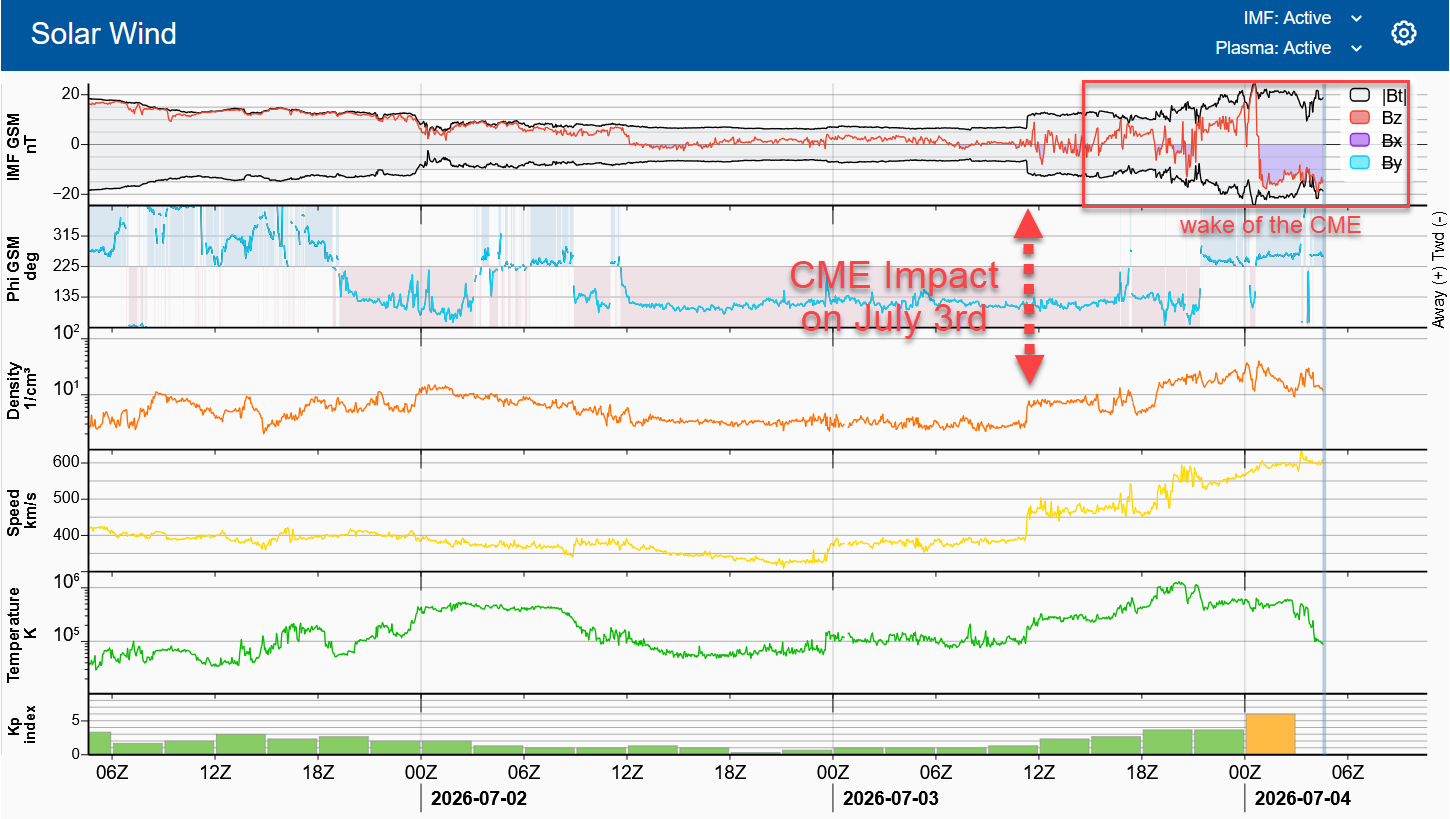
WEEKEND AURORA WATCH--CONTINUED: Last night's strong geomagnetic storm is over, but another storm could be in the offing. NOAA models suggest that a second CME will graze Earth during the late hours of July 4th. If it makes contact, this CME could cause a G2-class (Moderate) geomagnetic storm. The auroras would not be as bright as last night, but fireworks photos might capture an unusually colorful background. Aurora Alerts: SMS Text

MIDSUMMER GEOMAGNETIC STORM: Midsummer auroras are rare, but last night (July 3/4) they blanketed the USA during a strong G3-class geomagnetic storm. The display was caused by a CME strike on July 3rd, which was hurled in our direction by an X1-class solar flare three days earlier. After the impact, observers in more than 30 US states reported seeing auroras.

"Holy smokes!" says Roger Hill, who photographed the geomagnetic glow through an electrical storm over Bennett, Colorado (+39.8N latitude):
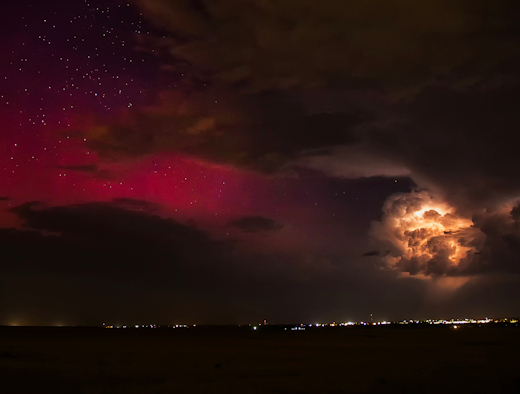
"The geomagnetic storm became strong just as a cluster of severe thunderstorms formed east of our house," says Hill. "The result? A *really cool* photo-op."
We've also received reports from New Mexico, Kentucky, Utah, Colorado, Washington, Pennsylvania, New York, Idaho, Virginia, Wyoming, Ohio, Oregon, Nevada, California, Arizona--and almost every northern-tier state near the US-Canadian border.
It is unusual to have such a strong display so close to the summer solstice. Two reasons: (1) Short summer nights narrow the observing window. Persistent twilight can make even the strongest auroras impossible to see. (2) Auroras dislike solstices. The same Russell-McPherron Effect that boosts auroras around equinoxes also suppresses auroras around solstices. It took an "X-class CME" to overcome these obstacles.
Did you miss the show? Next time get a heads-up from our new Backyard Astronomy Alert Service.
Realtime Aurora Photo Gallery
Free: Spaceweather.com Newsletter
NEW! BACKYARD ASTRONOMY ALERTS: We're proud to announce a new service from Spaceweather.com: Backyard Astronomy Alerts. We love this product. Subscribers receive real-time alerts about space station flybys, significant aurora outbursts, planetary conjunctions, meteor showers and more -- all easy to see with the naked eye.
SMS text messages tell you to go outside right now while the event is happening, and companion emails include sky maps and detailed observing tips. Give it a try! Introductory offer: 1 year for 50% off
Far Out Gifts: Earth to Sky Store
All sales support hands-on STEM education
Realtime Aurora Photo Gallery
Free: Spaceweather.com Newsletter
Realtime Space Weather Photo Gallery
Free: Space Weather Newsletter