A GRAND DISPLAY OF NOCTILUCENT CLOUDS: Observers in Europe and Canada are reporting a significant outbreak of noctilucent clouds (NLCs). "It is most extensive and brightest display so far in the 2026 season," says Alan Dyer from southern Alberta. NLCs are made of frosted meteor smoke. They form naturally in summer months, and now is prime time to see them. [photo gallery]

CHINA HAS REACHED EARTH'S MINI-MOON: Everyone knows that Earth has a Moon. But did you know that it also has a mini-Moon? This week, a spacecraft from China pulled up alongside it.
On July 6th, the China National Space Administration (CNSA) announced that its Tianwen-2 probe has arrived at asteroid 469219 Kamoʻoalewa, a space rock that loops around our planet about once per year.
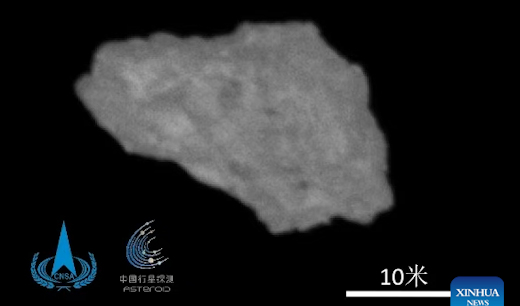
Snapped from about 20 km away, this 'first contact' photo reveals a house-sized body tumbling once every 28 minutes. That means it's probably a solid object, not a rubble pile that would easily spin apart.
Kamoʻoalewa is not a true moon. It is a "quasi-satellite," tracing lazy corkscrews around Earth while actually orbiting the sun in near-lockstep with our planet. Discovered by the Pan-STARRS telescope in Hawaii in 2016, its name comes from a Hawaiian chant and means, roughly, "oscillating celestial fragment."
This isn't Earth's only mini-Moon; there are at least 7 others. However, Kamoʻoalewa stands out as the most stable. It is expected to remain a quasi-satellite for centuries. That stability made it an attractive target for China's growing space program.
In this movie, NASA uses an earlier designation (2016 HO3) for Kamoʻoalewa
Kamoʻoalewa looks like a chip off of something bigger. But what?
Some researchers believe it is a piece of the Moon, blasted into space by the impact that dug lunar crater Giordano Bruno. Others argue it wandered in from the asteroid belt. Tianwen-2 could settle the debate by bringing a piece of the mini-Moon home.
In the months ahead, the spacecraft will scout sampling sites using cameras and radar. Then comes the hard part: Grabbing material from a rapidly-spinning space rock. Tianwen-2 will try three different techniques: a touch-and-go tag like NASA's OSIRIS-REx, a hover-and-scoop with a robotic arm, and an "anchor and attach" maneuver that would fasten the probe directly to the rock's surface. Mission planners hope one of them will work.
If all goes well, Tianwen-2 will leave Kamoʻoalewa on April 24, 2027--China's National Space Day--and drop its sample capsule into Earth's atmosphere in late November 2027. The spacecraft itself won't stop: it will sling past Earth toward Comet 311P/PANSTARRS.
Stay tuned for updates from Kamoʻoalewa.
Realtime Space Weather Photo Gallery
Free: Space Weather Newsletter
THE 18K GOLD 'METEOR CRATER' PENDANT: Have you heard of Moissanite? It's a very rare mineral discovered by 19th-century chemist Henri Moissan in Arizona's Meteor Crater. At first, he thought it was diamond, but later realized it was even more rare. It's a diamond mimic that, until the 1950s, was found naturally only in meteorites.
On May. 29, 2025, the students of Earth to Sky Calculus launched this Moissanite pendant to the stratosphere onboard a cosmic ray research balloon:
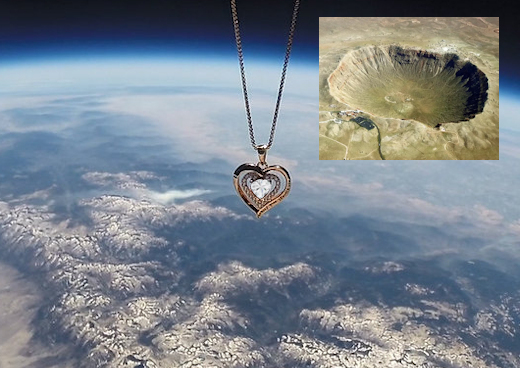
You can have it for $199.95. Engraved with the words "I love you always and forever", this 18K gold-plated sterling silver pendant has a heart-shaped ruby crystal in the middle surrounded by a heart-shaped ring of glittering 5A cubic zirconia nuggets..
The students are selling space pendants to pay the helium bill for their cosmic ray ballooning program. Each one comes with a greeting card showing the jewelry in flight and telling the story of its trip to the stratosphere and back again.
Far Out Gifts: Earth to Sky Store
All sales support hands-on STEM education
Realtime Aurora Photo Gallery
Free: Spaceweather.com Newsletter
Realtime Space Weather Photo Gallery
Free: Space Weather Newsletter