GEOMAGNETIC STORM WATCH (G1): NOAA forecasters say that minor G1-class geomanetic storms are possible on July 12th when a CME might graze Earth's magnetic field. NASA models suggest a more direct hit, but G1 is probably still the correct forecast for this lightweight CME. CME Impact Alerts: SMS Text

SUNRISE JELLYFISH AND PAYLOAD FAIRINGS: Just before daybreak on Thursday, July 9th, SpaceX launched a Falcon 9 rocket from Cape Canaveral. Minutes later, the second stage passed over Raleigh, North Carolina, where Jeremy Gilchrist photographed a lovely "sunrise jellyfish":
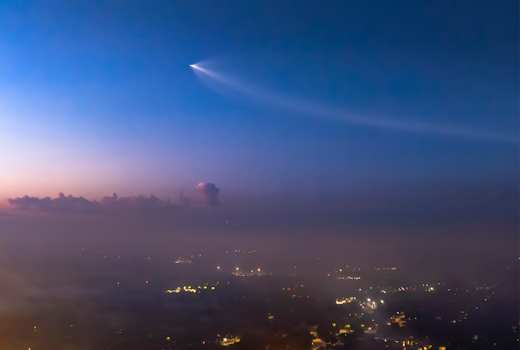
Gilchrist photographed the display from a drone hovering above the morning fog. At the time, the rocket engines were spewing water vapor into near-space 143 to 152 km high. Water molecules rapidly crystalized into an expanding cloud of ice--the "jellyfish"--illuminated by the rays of the high-altitude sun.
"The jellyfish in the dawn sky was quite a sight in North Carolina!" he says.
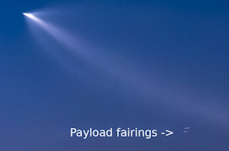 He also caught something very rare--the rocket's payload fairings. Take a look.
Payload fairings are the two clamshell halves of the rocket's nose cone. They shield the payload (in this case, 29 Starlink satellites) from onrushing air during the climb through the atmosphere. They split away once the air is too thin to matter, at roughly T+3 minutes and 110 km up.
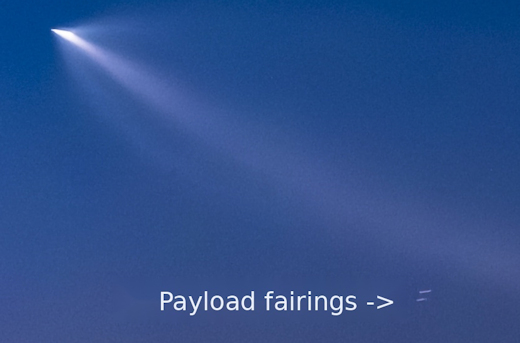
Catching them in a photograph from the ground, as Jeremy did, is remarkable. They're only about 13 meters long, unlit, and hundreds of kilometers away. Well done, Jeremy!
Realtime Space Weather Photo Gallery
Free: Space Weather Newsletter
THE 18K GOLD 'METEOR CRATER' PENDANT: Have you heard of Moissanite? It's a very rare mineral discovered by 19th-century chemist Henri Moissan in Arizona's Meteor Crater. At first, he thought it was diamond, but later realized it was even more rare. It's a diamond mimic that, until the 1950s, was found naturally only in meteorites.
On May. 29, 2025, the students of Earth to Sky Calculus launched this Moissanite pendant to the stratosphere onboard a cosmic ray research balloon:
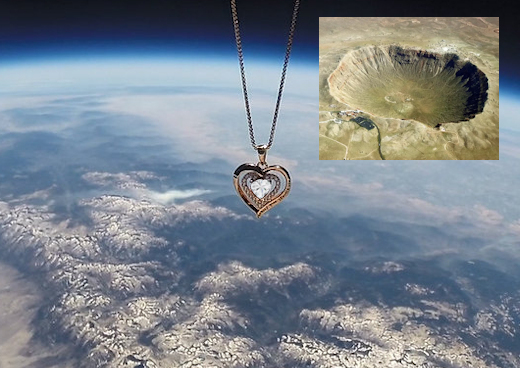
You can have it for $199.95. Engraved with the words "I love you always and forever", this 18K gold-plated sterling silver pendant has a heart-shaped ruby crystal in the middle surrounded by a heart-shaped ring of glittering 5A cubic zirconia nuggets..
The students are selling space pendants to pay the helium bill for their cosmic ray ballooning program. Each one comes with a greeting card showing the jewelry in flight and telling the story of its trip to the stratosphere and back again.
Far Out Gifts: Earth to Sky Store
All sales support hands-on STEM education
Realtime Aurora Photo Gallery
Free: Spaceweather.com Newsletter
Realtime Space Weather Photo Gallery
Free: Space Weather Newsletter