NEAR-MISS CME SPARKS SOUTHERN LIGHTS: As predicted, a CME passed close to Earth today. It did not deliver a direct hit. Instead, ripples in the solar wind from the CME's near miss ignited auroras in the southern hemisphere. Taichi Nakamura sends this picture from Dunedin, New Zealand:
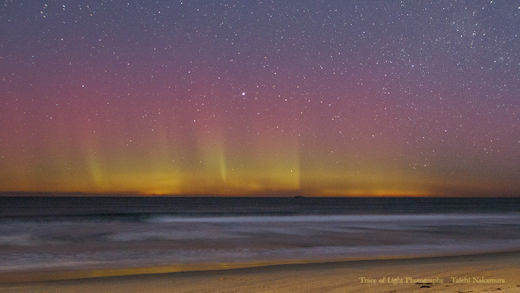
"It was very nice to see these auroras raising above the horizon while I was having a walk at the beach," says Nakamura.
A similar display would have appeared in the northern hemisphere but Northern Lights were mostly overwhelmed by summer twilight. This is the time of year that favors aurora australis. CME Impact Alerts: SMS Text
Realtime Aurora Photo Gallery
Free: Spaceweather.com Newsletter
GALILEO'S OPTICAL ILLUSION: Last month, sky watchers around the world observed a magnificent conjunction between Venus and Jupiter in the evening sky. Little did they know, it was part illusion: Galileo's Illusion. Paolo Palma of Roma, Italy, photographed the effect:
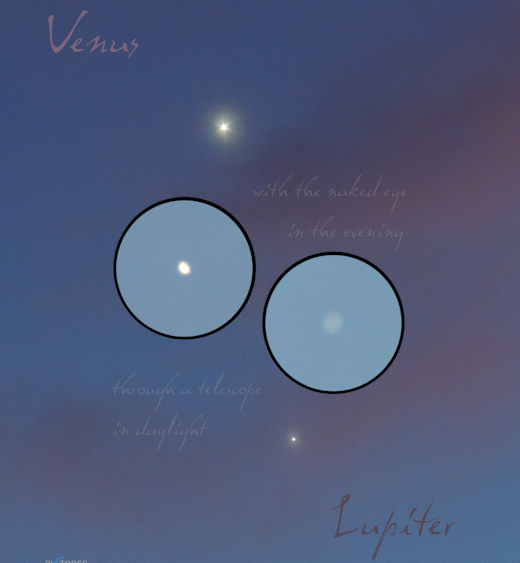
"The conjunction on June 11th was visible to the naked eye, but only those who observed them through a telescope would have noticed a most peculiar detail," says Palma. "Whilst to the naked eye Venus appeared many times LARGER than Jupiter, through a telescope its apparent diameter turned out to be significantly SMALLER than that of the gas giant!"
"So who is lying: the telescope or our eyes?" he asks.
The liar turns out to be the human eye, as Galileo discovered 400 years ago: "I have often seen Jupiter and Venus together […] and Venus appeared to be as much as eight or even ten times larger than Jupiter when viewed with the naked eye; but when observed through the telescope, Jupiter’s disc was actually four or more times larger than that of Venus."
Galileo himself figured out why: Bright objects against a dark background sprout luminous halos in the human eye, making them appear bigger than they really are. Venus was much brighter than Jupiter, so its false halo was much larger. This is why it is sometimes called the "Irradiation Illusion."
Realtime Space Weather Photo Gallery
Free: Space Weather Newsletter
STERLING SILVER RAINBOW DRAGONFLY: Are you looking for a far-out gift? Consider the Rainbow Dragonfly Space Pendant. The students of Earth to Sky Calculus launched it to the stratosphere onboard a cosmic ray research balloon:
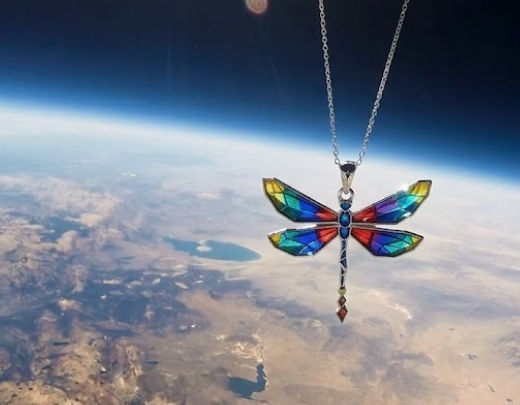
You can have it for $179.95. Made of stained glass with a sterling silver exoskeleton, the pendant has a wingspan of 1.1-inches and comes with a matching 18-inch sterling silver chain.
The students are selling space pendants to pay the helium bill for their cosmic ray ballooning program. Each one comes with a greeting card showing the jewelry in flight and telling the story of its trip to the stratosphere and back again.
Far Out Gifts: Earth to Sky Store
All sales support hands-on STEM education
Realtime Aurora Photo Gallery
Free: Spaceweather.com Newsletter
Realtime Space Weather Photo Gallery
Free: Space Weather Newsletter