CHINA'S SPACE STATION IS FLYING OVER THE USA: This is a great week to see China's Tiangong space station. It is making a series of bright nighttime flybys over the USA--easy to see even from urban areas. All you need to know is when to look. Sign up for our new Backyard Astronomy Alert Service to receive realtime Tiangong flyby alerts. The space station is inhabited by three taikonauts (Chinese astronauts) and sometimes glows with a red hue akin to Mars: photo gallery.
THIS SOUNDS LIKE A BAD IDEA: Since SpaceX began launching Starlink satellites in 2019, astronomers have grown increasingly concerned. It's almost impossible now to take a deep-sky image without satellite streaks in the background. The megaconstellation numbers nearly 11,000 functioning satellites, and SpaceX launched another 1,589 during the first half of 2026 alone.
Soon, Starlink may be the least of their worries.
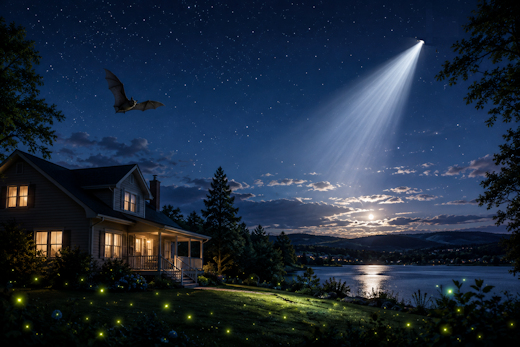
An artist's concept of sunlight beamed down from orbit. Bats, fireflies, and other creatures of the night could find their darkness interrupted by roving spots of artificial sunlight
Last week, the FCC authorized Reflect Orbital Inc. to launch a huge space mirror named “Eärendil-1.” From an orbit about 625 km high, it will cast a moving, 5-km-wide patch of light onto the Earth about as bright as a full Moon. Later, the company could combine beams from multiple satellites to create much brighter spotlights. Reflect Orbital wants to launch 50,000 more by 2035, selling sunlight-on-demand to solar farms, construction sites and search-and-rescue teams.
If Reflect Orbital's plan is realized, it could be calamitous not only for astronomy but also for the natural world as a whole. Nocturnal animals and night-blooming plants, tuned by evolution to the rhythm of day and night, would suddenly find their darkness interrupted by moving pools of redirected sunlight. Small favors? Reflect Orbital says the light will not be bright enough to start fires.
 The FCC itself acknowledged some of these concerns, but noted in its order that optical astronomy and the environment lie largely outside its jurisdiction. They can only regulate the project's use of radio signals. For now, no US agency regulates how bright a satellite may shine.
The company's FCC application attracted more than 1,800 public comments, most of them sharply critical. Nevertheless, the launch of Eärendil-1 is now expected before the end of the year.
Stay tuned for too much sunlight.
Realtime Space Weather Photo Gallery
Free: Space Weather Newsletter
STERLING SILVER RAINBOW DRAGONFLY: Are you looking for a far-out gift? Consider the Rainbow Dragonfly Space Pendant. The students of Earth to Sky Calculus launched it to the stratosphere onboard a cosmic ray research balloon:
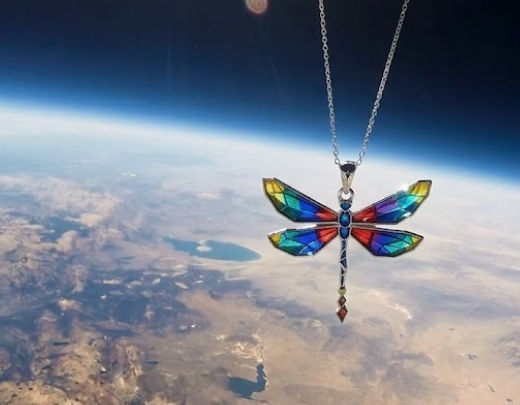
You can have it for $179.95. Made of stained glass with a sterling silver exoskeleton, the pendant has a wingspan of 1.1-inches and comes with a matching 18-inch sterling silver chain.
The students are selling space pendants to pay the helium bill for their cosmic ray ballooning program. Each one comes with a greeting card showing the jewelry in flight and telling the story of its trip to the stratosphere and back again.
Far Out Gifts: Earth to Sky Store
All sales support hands-on STEM education
Realtime Aurora Photo Gallery
Free: Spaceweather.com Newsletter
Realtime Space Weather Photo Gallery
Free: Space Weather Newsletter