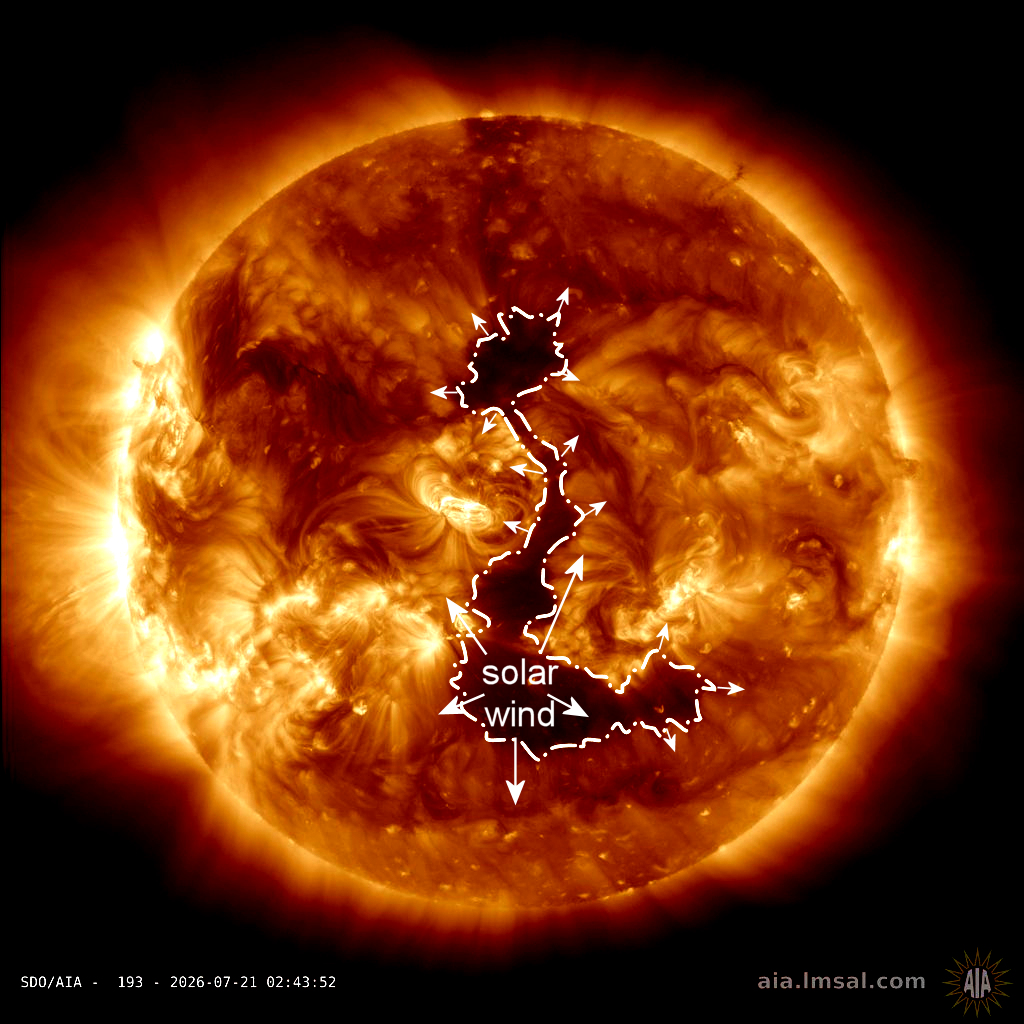
MINOR GEOMAGNETIC STORM IN PROGRESS: A minor G1-class geomagnetic storm is in progress on July 23rd as Earth moves through a high-speed (650 km/s) stream of solar wind. The gaseous material is flowing from a canyon-shaped hole in the sun's atmosphere. High-latitude sky watchers might see auroras, especially in the southern hemisphere where winter darkness favors visibility. Aurora alerts: SMS Text.

STARSHIP 13 LAUNCH--RESCHEDULED AGAIN: SpaceX is about to conduct a significant new test of its Starship megarocket. Starship 13 is poised for launch on Friday, July 24th at 5:45 pm CDT (originally scheduled for July 20th and July 23rd):
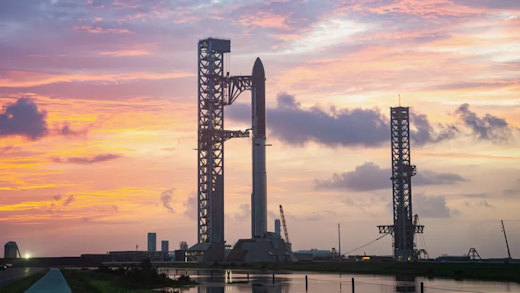
Blasting off from the Texas Starbase, Starship will deploy 20 production Starlink V3 satellites for the first time. These are super-Starlink satellites 10x more capable than previous models.They are so massive that they need Starship to launch them. Ironically, the satellites will disintegrate ~40 minutes after the launch of this suborbital flight. It's just a test.
The main purpose of the flight is to prove Starship can actually deploy operational Starlink V3 satellites, but that's not all. A second goal involves the heat shield and controlled reentry. After deploying the satellites, the ship is meant to survive atmospheric reentry and perform a soft splashdown in the Indian Ocean. Watch the launch here.
CHRISTMAS IN JULY: Are you looking for a far-out gift? Check out the Earth to Sky Store. It's filled with unique items that have flown to the edge of space onboard cosmic ray research balloons.

Carried aloft by giant helium balloons, these unique gifts have flown above 99.7% of Earth's atmosphere, experiencing space-like blasts of cosmic rays, extreme cold, and a wild ride parachuting back to Earth after the balloon explodes. Even Amazon doesn't carry items this far out.
Enter coupon code "JULY" at checkout for a 10% Christmas-in-July discount.
Far Out Gifts: Earth to Sky Store
All sales support hands-on STEM education
APOPHIS IS COMING--A FRIDAY THE 13TH COUNTDOWN: When astronomers discovered asteroid Apophis in 2004, they felt a jolt of fear. Early calculations gave it a 1-in-37 chance of hitting Earth on April 13, 2029--then the highest impact probability ever for a sizable asteroid. Naturally, it would arrive on Friday the 13th.
Years and thousands of observations later, we know that Apophis will miss, but by so little that watching it will feel like a close call. The 340-meter space rock will slice through Earth's shell of geosynchronous satellites so close that 2 billion people will be able to see it with their naked eyes.
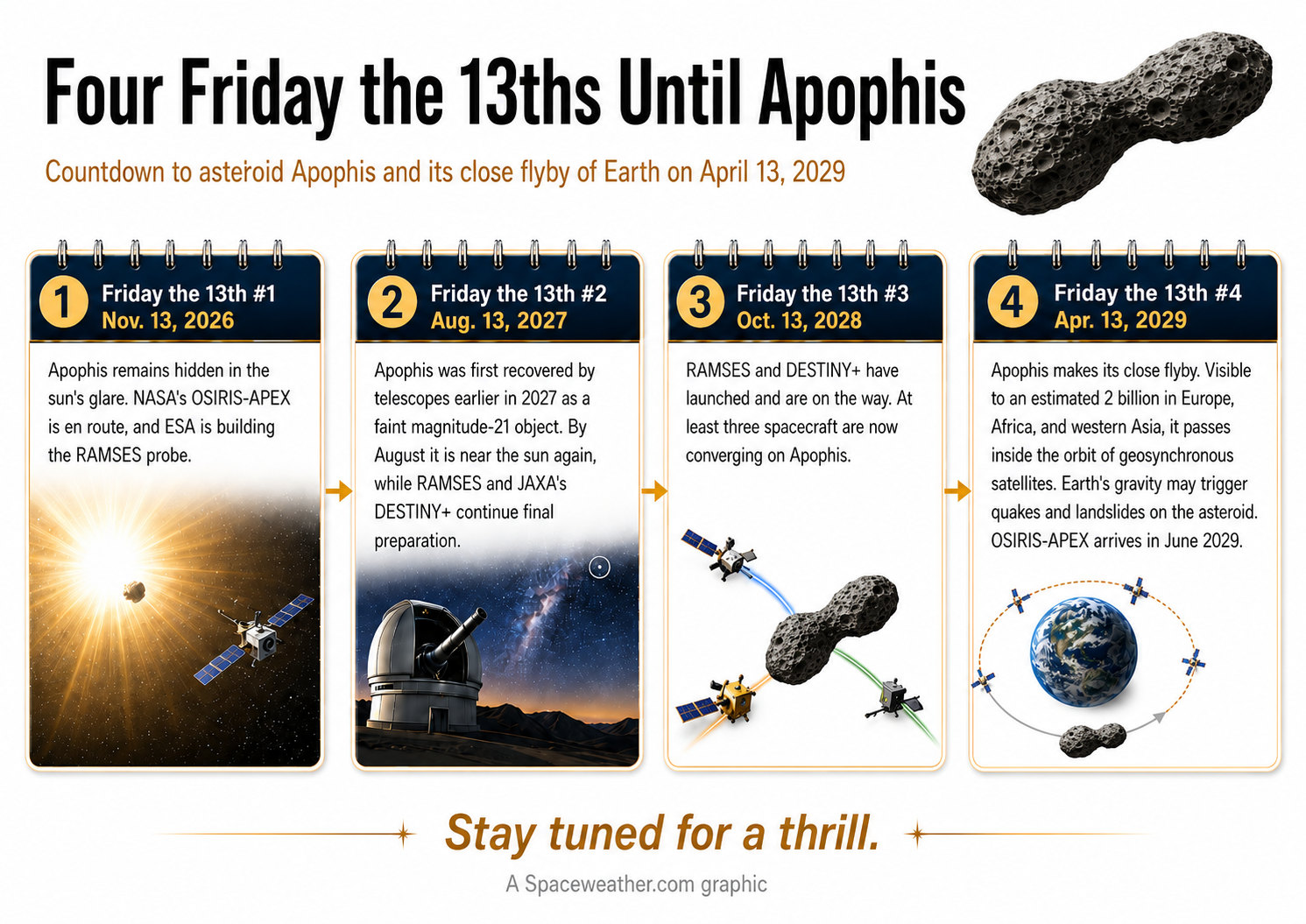
Days may not be the best unit for this kind of countdown. Instead, let us count the Friday the 13ths. There are only four left--and the last one is the flyby itself.
Friday the 13th #1 (Nov. 13, 2026): Nobody can see Apophis. The asteroid has been hiding in the sun's glare since 2021. NASA's OSIRIS-APEX spacecraft is chasing the asteroid, and the European Space Agency is building a probe of its own, named Ramses.
Friday the 13th #2 (Aug. 13, 2027): Telescopes on Earth have just found Apophis again--a faint magnitude-21 speck. Ramses and Japan's DESTINY+ probe are in final testing.
 Friday the 13th #3 (Oct. 13, 2028): The chase is on! Ramses and DESTINY+ launched together on a Japanese H3 rocket in April 2028. At least three spacecraft are now converging on Apophis.
Friday the 13th #4 (April 13, 2029): Apophis arrives. Cruising alongside the asteroid, Ramses will release two CubeSats--one will try to land--while DESTINY+ may zip past for a close-up of its own. Earth's gravity will have a powerful effect on Apophis, bending its orbit and possibly causing quakes and landslides on the asteroid's surface. OSIRIS-APEX arrives two months later to survey the aftermath.
During the flyby, sky watchers on the nightside of Earth (Europe, Africa, and western Asia) will be able to look up and see Apophis shining like a star of magnitude 3.1. That's about as bright as stars in the Big Dipper. Moving 42 degrees per hour (the width of a full Moon every minute), Apophis will visibly drift against the background stars, a sight no human has ever seen without a telescope.
Stay tuned for a close call.
Realtime Aurora Photo Gallery
Free: Spaceweather.com Newsletter
Realtime Space Weather Photo Gallery
Free: Space Weather Newsletter