NEW! STARLINK TRAIN ALERTS: You've probably heard about Starlink's "string of pearls" -- a bright train that forms in the night sky for a few days after the launch of each new batch of satellites. Now you can see one. Our Backyard Astronomy Alert Service now includes Starlink Train Alerts. You'll receive a text and email whenever a string of pearls is about to fly over your backyard. Sign up now.
NOCTILUCENT COUDS FROM 32,000 FT: Noctilucent cloud (NLC) season is still underway. Steve Friend was flying 32,000 ft over the Gulf of Alaska on July 24th when he looked out the window and saw the electric-blue glow:
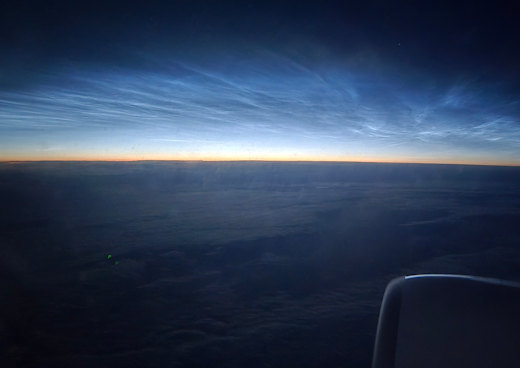
"It was a great show!" says Friend.
Noctilucent clouds are made of frosted meteor smoke. Every year in June through August, summertime wisps of water vapor rise up from Earth to the edge of space. Water molecules stick to specks of meteor debris to form the icy clouds. There are still 3 or 4 weeks left in the 2026 NLC season. Here's how to see them.

Realtime Noctilucent Cloud Photo Gallery
Free: Spaceweather.com Newsletter
A NEW CATEGORY OF SATELLITE REENTRY EVENT: SpaceX's Starship 13 megarocket blasted off from Texas on Friday, July 24th. En route to space, it created a new category of satellite reentry event -- rapid-fire, deliberate, and massive.
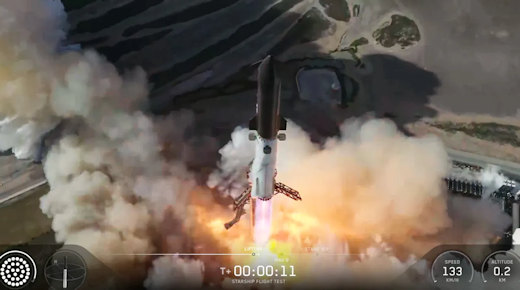
Satellites reenter Earth's atmosphere all the time -- a few per day, typically. It's a slow drizzle of human tech raining back onto our planet. Most are old first-generation Starlinks.
Starship 13 did something different. It deployed 20 V3 Starlinks. These are "super Starlinks," ten times more capable and roughly seven times the mass of the first-generation models. You might think that these 20 behemoths would form the basis of a new internet megaconstellation. Instead, they rapidly deorbited over the Indian Ocean.
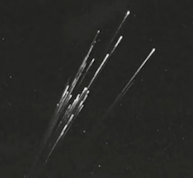 Why would SpaceX do this? It's a test. The new satellites are so massive they need a megarocket like Starship to reach orbit, and the main purpose of this flight was to prove Starship could deploy the new V3s. But because the test flight was suborbital, the satellites fell back almost immediately.
If you add up the mass of all 20 satellites it comes to ~38,000 kg or about 80 times the normal daily mass of Starlinks reentering the atmosphere. Because V3s are rich in aluminum, their sudden reentry would have created an enormous spike in aluminum oxide deposition-- the very compound that studies show can deplete Earth's ozone layer.
Flight 13 is not the first time Starship has dumped tons of Starlink-mass into the atmosphere in a single day. It is actually the fourth, starting with Flight 10 back in August 2025. However, those previous flights deployed dummy satellites containing much less aluminum. That makes #13 unprecedented.
Starship Launch Alerts: Would you like an instant text message when Starships launch? Sign up for Backyard Alerts, our new real-time alert service that tracks all SpaceX launches.
Realtime Space Weather Photo Gallery
Free: Space Weather Newsletter
STERLING SILVER SPACE CAT PENDANT:Are you looking for a far-out gift? Consider the Sterling Silver Space Cat. On July 22nd, the students of Earth to Sky Calculus launched it to the stratosphere onboard a cosmic ray research balloon:
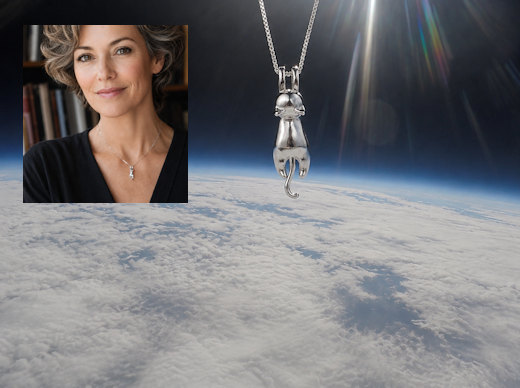
You can have it for $139.95. This feline astronaut is made of genuine sterling silver and hangs from a matching 18-inch sterling silver chain. It is a purrfect birthday, anniversary or belated graduation gift.
The students are selling space pendants to pay the helium bill for their cosmic ray ballooning program. Each one comes with a greeting card showing the jewelry in flight and telling the story of its trip to the stratosphere and back again.
Far Out Gifts: Earth to Sky Store
All sales support hands-on STEM education
Realtime Aurora Photo Gallery
Free: Spaceweather.com Newsletter