MULTIPLE CMEs INCOMING: The sun has produced a number of minor CMEs this week. Emphasis on minor. Nevertheless, almost all of them have an Earth-directed component. A series of glancing blows on July 31st and Aug. 1st could produce a G1-class geomagnetic storm with high-latitude auroras. CME impact alerts: SMS Text.

METEOR ALERT--THREE STREAMS AT ONCE: Don't be surprised if you see a meteor tonight. Three streams of comet debris are intersecting Earth's orbit this week, with a peak in activity expected on July 30-31.
Stream #1 is the most interesting. It's the Alpha Capricornid stream. Parent comet: 169P/NEAT. Here is a typical "alpha Cap" observed by Brad Goldpaint in the Sierra backcountry near Independence, CA:
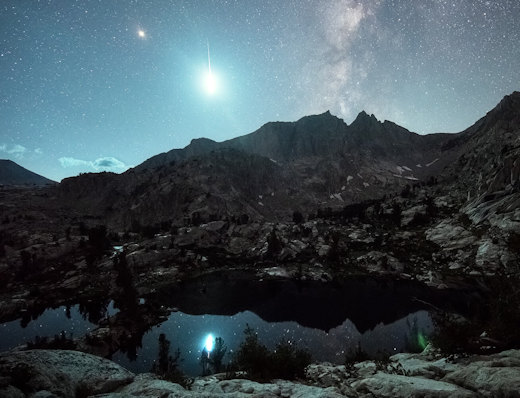
"The explosion was so bright it briefly illuminated the entire landscape," says Goldpaint. "You can see the persistent train in this time-lapse."
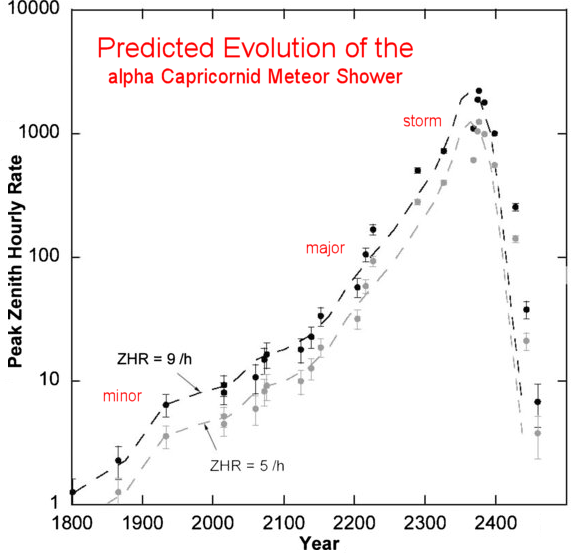
The Alpha Capricornids are famously rich in fireballs. But that's not why they're so interesting. This meteor shower is going to turn into a storm.
Researchers Peter Jenniskens (SETI Institute) and Jeremie Vaubaillon (Paris Observatory) have studied the alpha Cap debris stream. They believe it resulted from a major fragmentation event ~5000 years ago when as much as half of the original comet disintegrated. Since then, the debris has been drifting toward Earth. When it arrives in ~300 years, the Alpha Caps will transform from a 5-per-hour minor shower to a storm of thousands that return year after year.
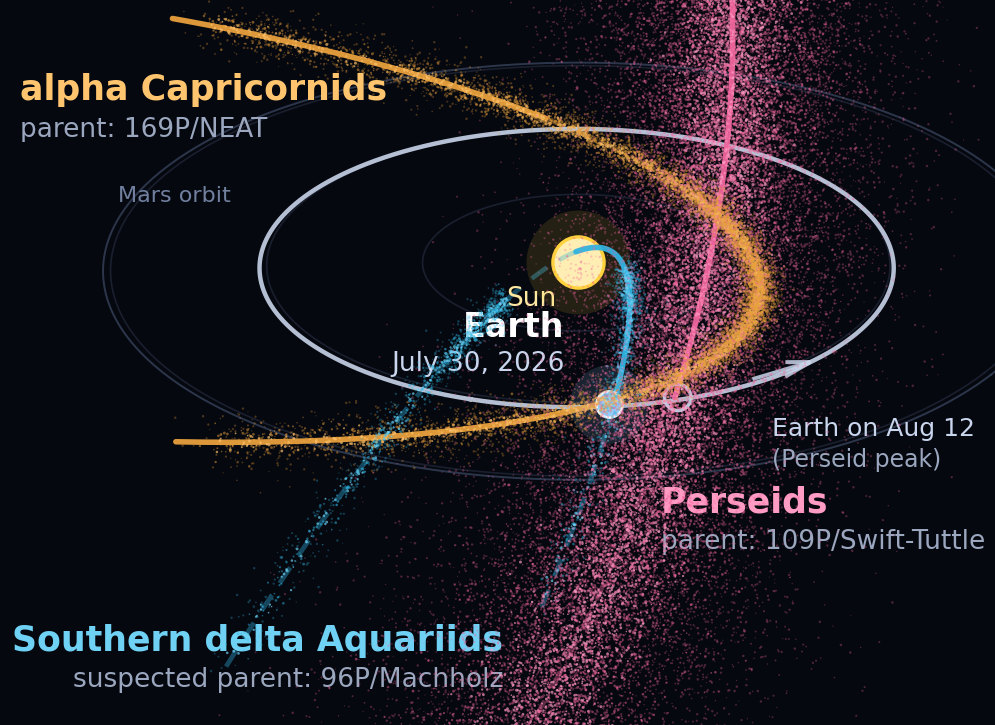 Stream #2 is a mystery. No one knows where it comes from, although 96P/Machholz is a leading suspect. The Southern Delta Aquariids (SDAs) produce as many as 20 meteors per hour every July 30th. Most are faint and swift, radiating from the constellation Aquarius.
Stream #3 is the famous one--the Perseids. The best meteor shower of the year doesn't peak until August 12th, but we are entering the debris stream of parent comet Swift-Tuttle right now. Observers are already seeing a few every night.
The overlap of these three showers means any meteor you spot could belong to a different stream of cosmic debris. There's a ~98% illuminated moon that's up all night so fainter SDAs and Perseids will be washed out. This makes the fireball-rich alpha Caps the stars of this year's 3-stream display.
Observing tips: The hours just before sunrise are best. Find a dark location, let your eyes adapt for 20 minutes, and enjoy the show!
Realtime Space Weather Photo Gallery
Free: Space Weather Newsletter
THE MILKY WAY IN A CRYSTAL BALL: Are you looking for a big gift? How about the entire Milky Way? The students of Earth to Sky Calculus have launched our own galaxy to the stratosphere onboard a cosmic ray research balloon. Here it is 113,517 feet above the Sierra Nevada mountains of central California:
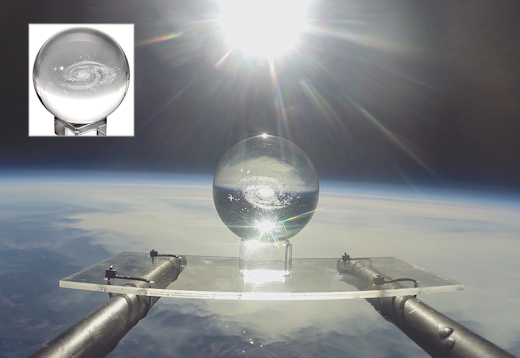
You can have it for $119.95. The galaxy is laser etched inside a 60 mm crystal sphere. You can turn it in your hands, inspecting the spiral star system from any angle. The gift-boxed sphere comes with a greeting card showing the item in flight and telling the story of its journey to the edge of space.
Far Out Gifts: Earth to Sky Store
All sales support hands-on STEM education
Realtime Aurora Photo Gallery
Free: Spaceweather.com Newsletter