REMINDER--A ROCKET HITS THE MOON TONIGHT: We have written about this twice: June 13th and July 28th. A SpaceX rocket will hit the Moon during the night of Aug. 4-5 for observers in the Americas. A new crater will form at 11:35 p.m. PDT on Aug. 4th (2:35 a.m. EDT Aug 5th). If you see it, submit your images here.
TOTAL ECLIPSE OF THE SUN: Mark your calendar. On Wednesday, Aug. 12th, the Moon will pass directly in front of the sun, producing a total solar eclipse. It's the first total eclipse for western Europe since 1999.

A sunset eclipse in the Andes. July 11, 2010. Credit & Copyright: Janne Pyykkö
The show begins in the Arctic where the Moon's cool shadow races across Siberia and Greenland en route to Iceland. Reykjavík gets nearly a minute of darkness.
The main event is in Spain, where the eclipse happens at sunset. Hanging less than 10 degrees above the horizon, the eclipsed sun will be beautifully framed by mountains, trees and urban skylines. Sunset eclipses are extra-beautiful and weird, with an otherworldly lighting that is hard to describe in words. Spanish observers, please check out these maps of terrain shadows in Spain to plan your photoshoot. They were prepared by Michael Zeiler of EclipseAtlas.com.
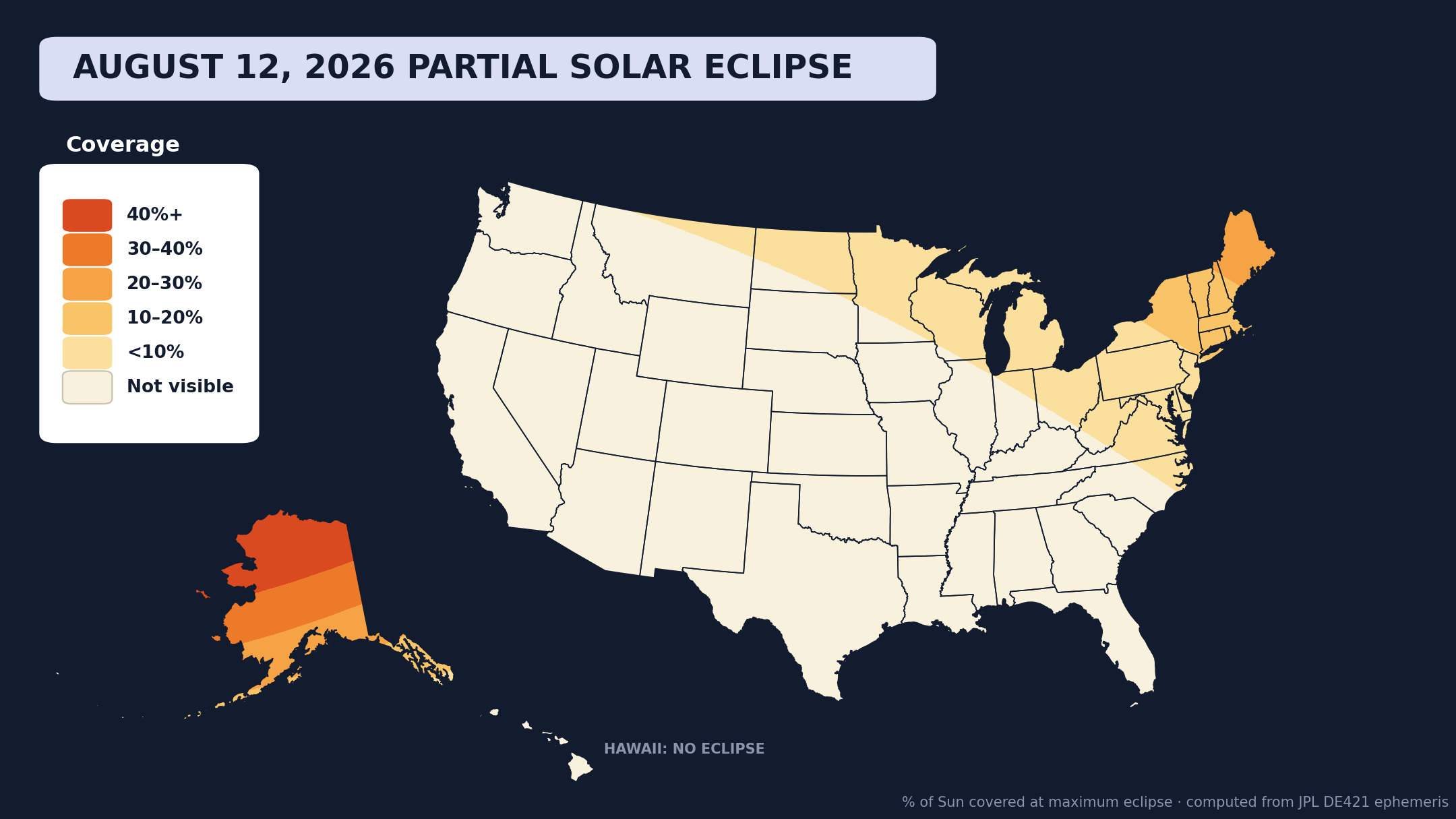 Meanwhile in Canada and the USA, partial phases will be visible from Alaska to the Carolinas, mostly between noon and 3 p.m. local time. Alaskans will see the deepest bite, with as much as 57% of their morning sun covered (37% in Fairbanks, 28% in Anchorage).
Remember: the partial phases are never safe to view with the naked eye. Use certified eclipse glasses or a solar-filtered telescope, and watch for crescent-shaped sunbeams dappling the ground beneath leafy trees.

Would you like an alert when the eclipse is underway? Sign up for Backyard Astronomy Alerts. Our service will send you a text message and email tailored to your precise location minutes before the eclipse begins. You won't miss a thing.
Visibility maps: Detailed Path of Totality (EclipseAtlas); USA (Spaceweather.com); Global (Time and Date); Global+ (NASA)
Realtime Space Weather Photo Gallery
Free: Space Weather Newsletter
TOTAL ECLIPSE TAHITIAN BLACK PEARL: It came from Tahiti, then it flew into the shadow of the Moon. On April 8, 2024, the students of Earth to Sky Calculus launched this black pearl into a total eclipse of the sun over Texas. Riding on a cosmic ray research balloon, the pearl was 86,564 feet high when lunar darkness swallowed it for 3 minutes 45 seconds:

You can have it for $349.95. Measuring 9 mm in diameter, this genuine Tahitian pearl has an 18K rose gold clasp and is suspended from a matching 925 Sterling Silver chain. It comes with a greeting card showing the pearl in flight and telling the story of its journey to the edge of space during the 2024 total eclipse.
Far Out Gifts: Earth to Sky Store
All sales support hands-on STEM education
Realtime Aurora Photo Gallery
Free: Spaceweather.com Newsletter