SOLAR ECLIPSE IMAGES AVAILABLE NOW: Today's solar eclipse is over, and the photos are flooding in to our gallery. Sky watchers in Europe saw a very deep partial eclipse and totality, while some in the USA witnessed a shallow partial eclipse.
On the island of Mallorca, Elias Chasiotis watched a warped crescent sun sink into the Mediterranean:
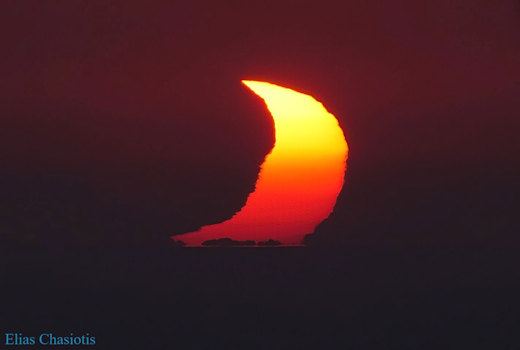
"The setting eclipsed sun was distorted by multiple mirages (Fata Morgana)," says Chasiotis. "It was very rewarding!"
We're still waiting for images of totality with the Spanish landscape in the foreground--the weirdest sunset in many years. Stay tuned!
Realtime Solar Eclipse Photo Gallery
Free: Space Weather Newsletter
GREAT PERSEIDS TONIGHT: Why is this year's Perseid meteor shower so good? Two words: New. Moon. When the shower peaks on the night of Aug. 12-13, there won't be a single photon of moonlight to spoil the show.
The shower is already underway. NASA all-sky cameras have detected more than a dozen fireballs every night this week. This morning, Troy Bryan saw this one with hisown eyes over Scottsbluff, Nebraska:
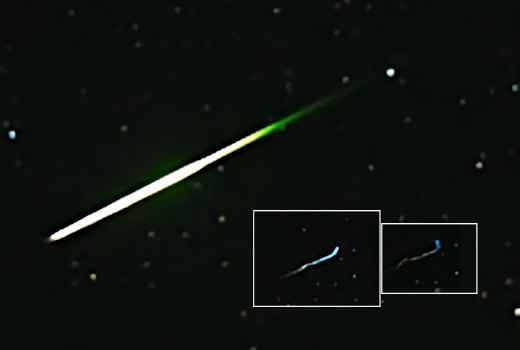
"After the fireball passed by, we could see its debris twisting in the upper atmospheric winds (inset)," says Bryan.
When the shower peaks tonight, meteor rates will surge with as many as 100 sightings every hour ranging from faint streaks to exploding fireballs.
The source of the shower is giant comet 109P/Swift-Tuttle. Its nucleus is 26 km wide--more than twice the size of the object that wiped out the dinosaurs. Every 133 years it swings through the inner solar system, laying down a fresh ribbon of dust for Earth to plow through each August.
Observing tips: Get away from city lights and look up during the hours between local midnight and dawn. That is when the shower's radiant in the constellation Perseus climbs high overhead. Give your eyes 30 minutes to adapt to the darkness, and enjoy the show!
Realtime Space Weather Photo Gallery
Free: Space Weather Newsletter
IRON METEORITE RING: The iron in this meteorite ring has an interesting history. Thousands of years ago it skipped across the top of Earth's atmosphere, creating a field of fragments in China almost 500 km long. This month, we sent it back again:
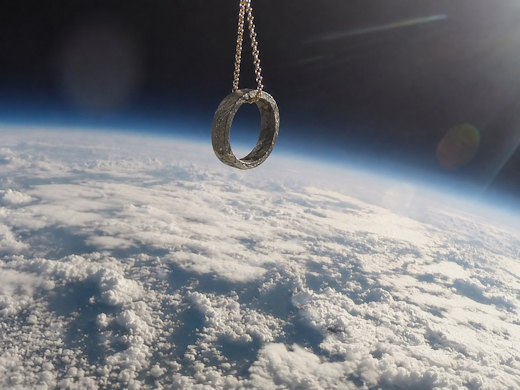
The ring flew to the stratosphere onboard a cosmic ray research balloon, above 99.4% of the atmsphere where it once skipped in a glancing blow to our planet.
You can have it for $219.95. This fragment comes from the Altai Mountains in China, and is known as an "Aletai meteorite." Widmanstätten patterns on the ring confirm its celestial origin, and an accompanying full-color greeting card shows the ring in flight.
Far Out Gifts: Earth to Sky Store
All sales support hands-on STEM education
Realtime Aurora Photo Gallery
Free: Spaceweather.com Newsletter