CO-ROTATING INTERACTION REGION: A corotating interaction region (CIR) hit Earth this morning. CIRs are like mini-CMEs. They are sandwiches of dense solar wind with strong magnetic fields inside. If an actual CME hits later today, as expected, the one-two punch will almost certainly cause G1-G2 geomagnetic storming. CME Impact Alerts: SMS Text.


ALMOST TOTAL LUNAR ECLIPSE: Last night's lunar eclipse was only 96%. That was enough. "Our cactus loved it," reports Bill Williams who sends this picture from Jupiter, Florida:
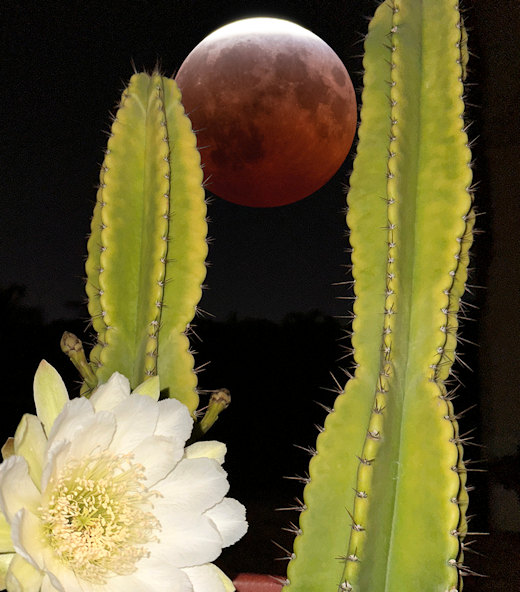
"Whenever I witness an eclipse, I like to be acutely aware of my surroundings such as how animals react during a solar eclipse," says Williams. "While enjoying this partial lunar eclipse, I noticed that my Night-Blooming Cactus (Cereus peruvianus) was displaying a spectacular huge white flower! I rarely see this cactus bloom, so I wondered if this is coincidence or somehow related to the Full Moon."
The answer is yes. He explains: "Turns out that the creatures that pollinate this species of cactus such as sphinx moths, bats and nocturnal insects are more active during the Full Moon because the bright moonlight reflects off the white flowers making the cactus more likely to be pollinated. Who knew??!!"
The eclipse was widely visible from coast to coast in the USA and throughout the Americas, while Europeans caught it setting at dawn. Browse the eclipse gallery for the latest photos.
Realtime Space Weather Photo Gallery
Free: Space Weather Newsletter
THE MARTIAN GEMSTONE PENDANT (PERIDOT): In Nov. 2021, NASA's Perseverance rover found tiny green crystals in the frozen magma of Mars. Here on Earth, we call them Peridot. The students of Earth to Sky Calculus just flew some of the gemstones to the stratosphere in the Martian Gemstone Pendant:
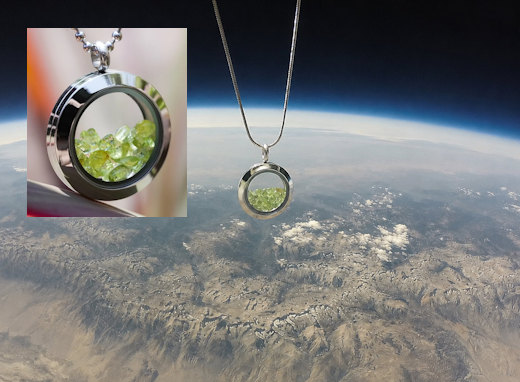
You can have it for $169.95. These pieces of natural terrestrial peridot were launched onboard a cosmic ray research balloon, flying 111,543 feet above the Sierra Nevada of central California. They have touched the edge of space--closer to Mars than any other peridot on Earth.
The unique 'window pendant' is milled from solid stainless steel with inset sapphire coated quartz glass lenses. The two halves screw together to form an airtight seal, preserving the gemstones inside.
The students are selling space pendants to pay the helium bill for their cosmic ray ballooning program. Each one comes with a greeting card showing the jewelry in flight and telling the story of its trip to the stratosphere and back again.
Far Out Gifts: Earth to Sky Store
All sales support hands-on STEM education
Realtime Aurora Photo Gallery
Free: Spaceweather.com Newsletter