SOLAR SECTOR BOUNDARY CROSSING: Earth is about to cross a fold in the heliospheric current sheet--a vast wavy structure in interplanetary space separating regions of opposite magnetic polarity. The crossing, called a "solar sector boundary crossing," is expected on May 11th and could trigger geomagnetic activity around Earth's poles. Aurora alerts: SMS Text.
NOCTILUCENT CLOUD FORECAST: Last summer, sky watchers in the northern hemisphere witnessed the finest outbreak of noctilucent clouds (NLCs) ever. Normally confined to polar regions, the rippling blue clouds spread as far south as Las Vegas, Nevada, and Los Angeles, California, smashing old records for low-latitude visibility. One of the brightest displays occurred over Paris, France:

"On June 21, 2019, the day of the summer solstice, these rare noctilucent clouds were visible over Paris," says photographer Kulik Bertrand. "It was amazing!"
NLCs are Earth's highest clouds. Seeded by meteoroids, they float at the edge of space more than 80 km above the ground. The clouds form when summertime wisps of water vapor rise up to the mesosphere, allowing water to crystallize around specks of meteor smoke. In the northern hemisphere, noctilucent cloud season typically ranges from mid-May through mid-August.
Given that 2019 was such a record-breaker, researchers are naturally wondering what will happen in 2020. Could NLCs spread even farther south? To try to answer that question, Lynn Harvey of the University of Colorado's Laboratory for Atmospheric and Space Physics has taken a look at data from NASA's Microwave Limb Sounder (MLS). She prepared the following plots, which show moisture and temperature in the mesosphere for the past 14 years--including 2020:

Moisture and temperature are key ingredients of NLCs. The clouds flourish when the mesosphere is extra cold and wet. Harvey's plots show 2020 (red) splitting right down the middle of other recent years--not too cold and not too wet.
"So far, 2020 is shaping up to be fairly average," says Harvey. In other words, 2020 does not look a repeat of 2019. This summer's clouds might be confined to higher latitudes again.
No one will know for sure, however, until NLC season actually begins. Daily images of NLCs from NASA's AIM spacecraft are posted right here on Spaceweather.com. "Based on the MLS data, I would guess that the first NLCs will be spotted in two weeks or so," she says. Stay tuned to see if the forecast is correct!

Realtime Noctilucent Cloud Photo Gallery
Free: Spaceweather.com Newsletter
CRYSTAL MOON BALL IN THE STRATOSPHERE: On Star Wars Day ("May the 4th be with you"), the students of Earth to Sky Calculus launched an array of cosmic ray sensors to the stratosphere. They do this every week or so to monitor increasing levels of atmospheric radiation. This crystal Moon ball went along for the ride:
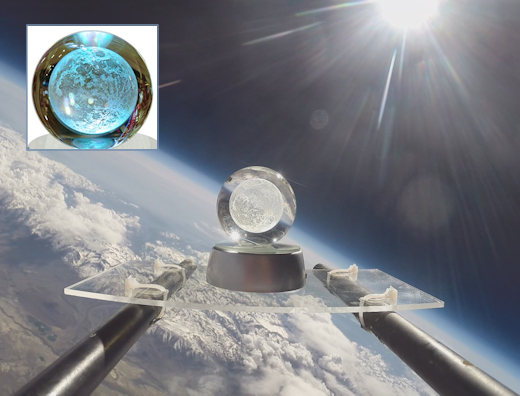
You can have it for $129.95. The students are selling these far-out balls to support their cosmic ray ballooning program.
Each one comes with an LED base that turns the laser-etched crystaline Moon a beautiful shade of purple, blue, green or yellow. It makes a great night light. Also included is a greeting card showing the crystal ball in flight and telling the story of its journey to the edge of space and back again.
Far Out Gifts: Earth to Sky Store
All sales support hands-on STEM education
Realtime Aurora Photo Gallery
Free: Spaceweather.com Newsletter
Realtime Space Weather Photo Gallery
Free: Spaceweather.com Newsletter