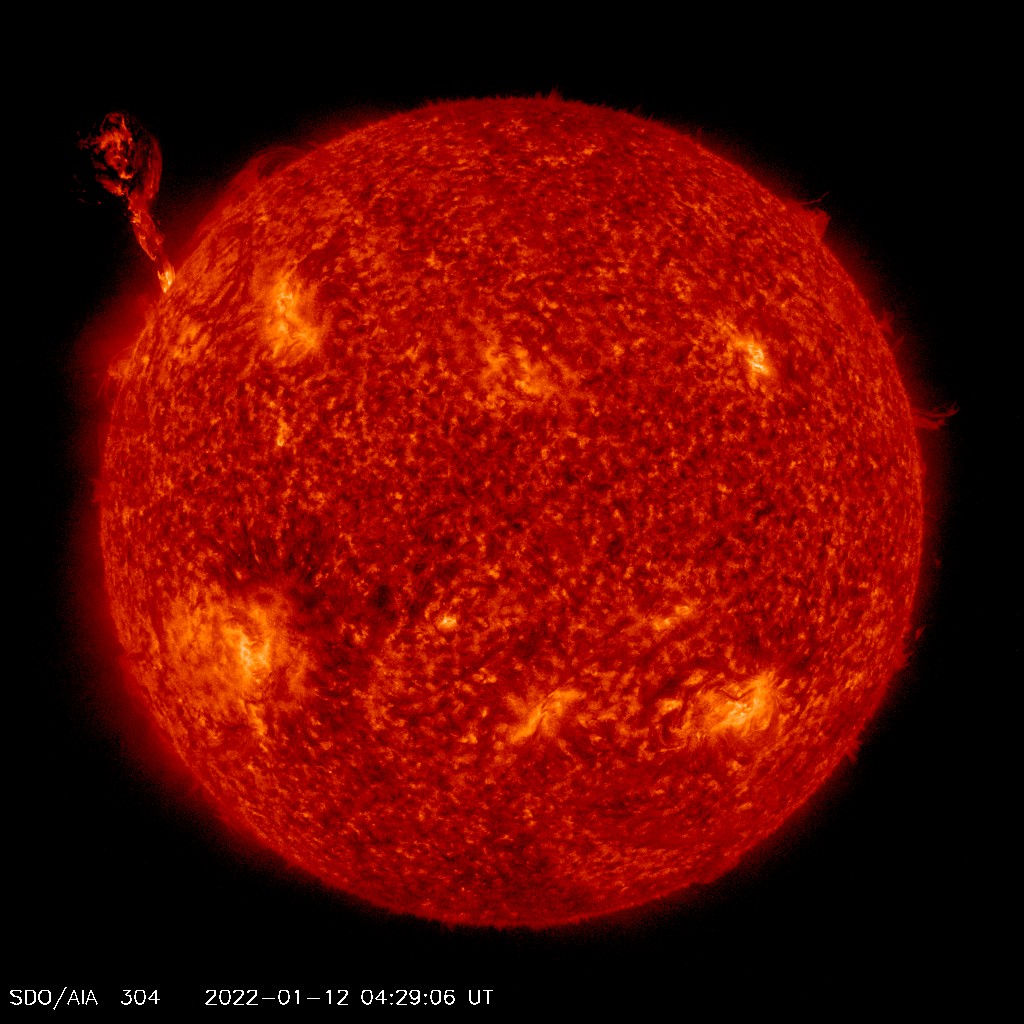
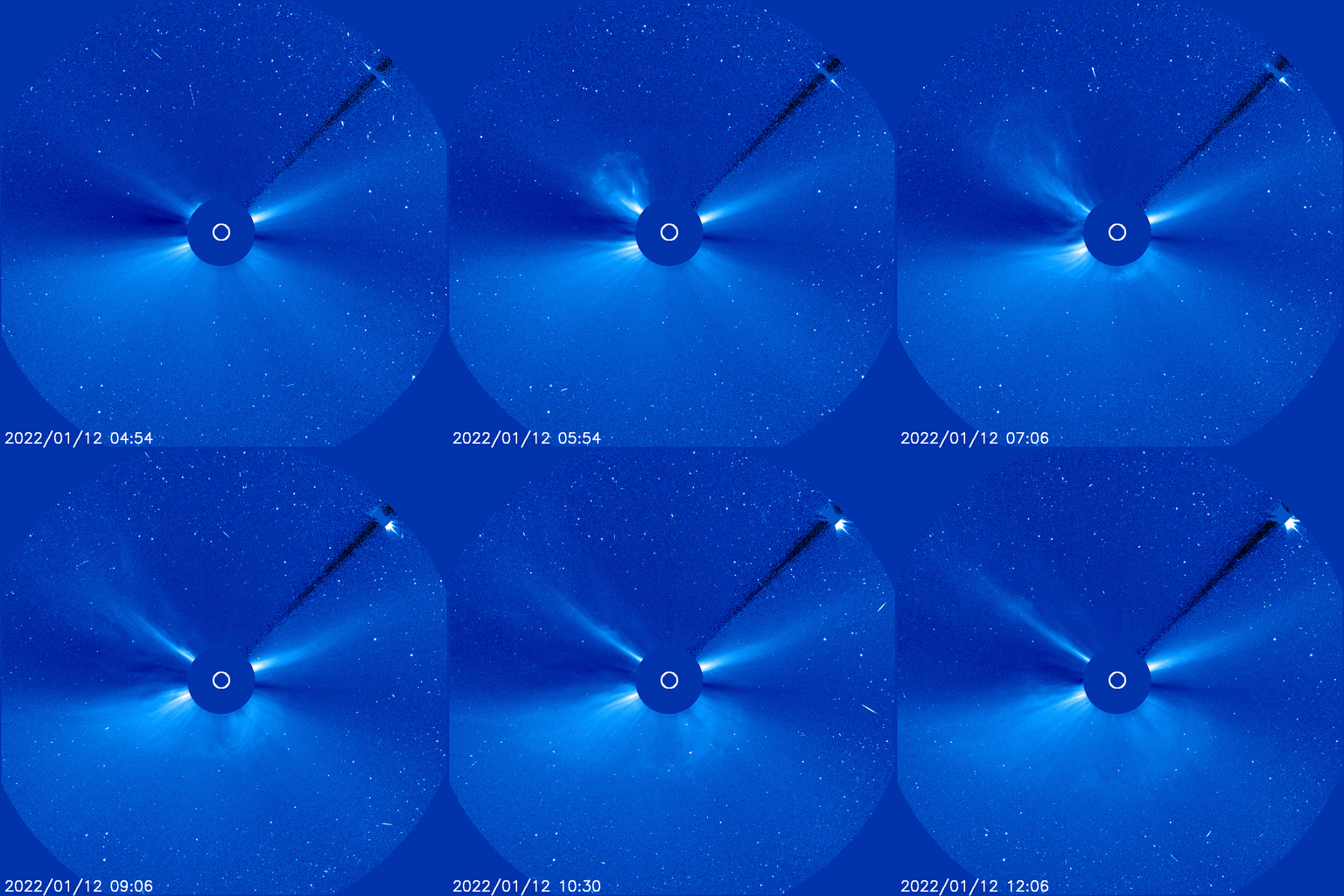
SIGNIFICANT FARSIDE EXPLOSION (UPDATED): A significant explosion has occured on the farside of the sun. During the early hours of Jan. 12th a huge plume of hot plasma leaped over the sun's northeastern limb. Soon after, a full halo CME emerged from the same location. This was probably an X-class event eclipsed by the edge of the sun. The blast site will turn to face Earth later this week, possibly during the weekend. Solar flare alerts: SMS Text.
SOLAR CYCLE UPDATE: Solar Cycle 25 is heating up. New sunspot counts from NOAA confirm that the young solar cycle is outperforming the official forecast. You are here:

See the complete labeled plot or play with an interactive version from NOAA.
Sunspot counts have exceeded predictions for 15 straight months. The monthly value at the end of December 2021 was more than twice the forecast, and the highest in more than 5 years.
The "official forecast" comes from the Solar Cycle Prediction Panel representing NOAA, NASA and International Space Environmental Services (ISES). Using a variety of leading indicators, the Panel predicted that Solar Cycle 25 would peak in July 2025 as a relatively weak cycle, similar in magnitude to its predecessor Solar Cycle 24. Instead, Solar Cycle 25 is shaping up to be stronger.
Sky watchers have already noticed the change. "We are definitely seeing the effects on the ground in the Arctic!" reports Chad Blakley of the Swedish tour guide service Lights over Lapland. "Auroras now are the best in years."
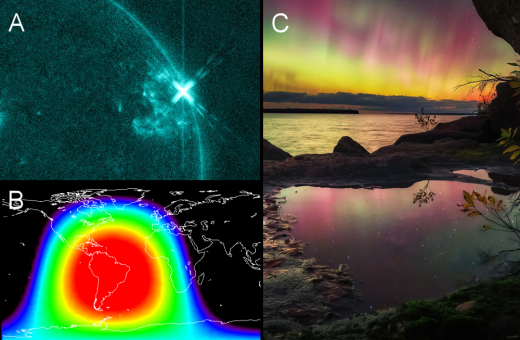
(A) The first X-flare of Solar Cycle 25 on July 3, 2021; (B) A radio blackout caused by an X-flare on Oct. 28, 2021; (C) Auroras over Wisconsin photographed by Marybeth Kiczenski on Nov. 4, 2021.
Indeed, geomagnetic activity has nearly tripled since the new solar cycle began. In 2020, the first full year of Solar Cycle 25, there were 9 days with at least minor (G1-class) geomagnetic storms. That number skyrocketed to 25 days in 2021. One of those "storm days" (Nov. 4, 2021) was a borderline G4-class (severe) event with auroras sighted as far south as California and New Mexico.


Another sign of increasing solar activity is the X-flare. X-flares are the most powerful type of solar flare. They can cause strong radio blackouts, pepper Earth's atmosphere with energetic particles, and herald intense geomagnetic storms. The sun produced zero of these flares from late 2017 until mid-2021. Solar Cycle 25 busted the drought on July 3, 2021, with an X1.6 category explosion, followed by an X1-flare on Oct. 28, 2021.
Two down, 98 to go? Typical 11-year solar cycles produce more than 100 X-flares during the years around Solar Max. Stay tuned for updates as Solar Cycle 25 intensifies.
Realtime Space Weather Photo Gallery
Free: Spaceweather.com Newsletter
"I LOVE YOU MORE" MOONSTONE PENDANT: Valentine's Day is coming! Nothing says "I love you" like a moonstone from space. This one hitched a ride on an Earth to Sky Calculus cosmic ray research balloon, floating 112,201 feet above the Sierra Nevada mountains of central California:
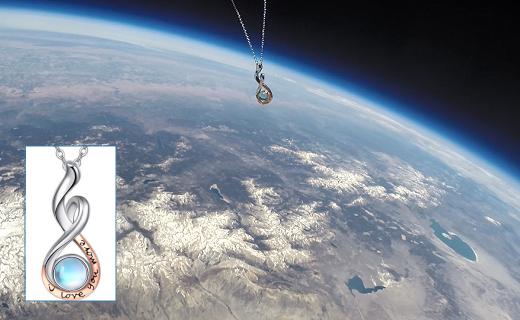
You can have it for $142.95. The students are selling these sterling silver infinity-wrapped moonstone pendants to support their ballooning program. Engraved with "I Love You More," it makes a romantic Valentine's gift. Each one comes with a greeting card showing the moonstone in flight and telling the story of its trip to the stratosphere and back again.
Far Out Gifts: Earth to Sky Store
All sales support hands-on STEM education
Realtime Aurora Photo Gallery
Free: Spaceweather.com Newsletter
Realtime Venus Photo Gallery
Free: Spaceweather.com Newsletter