SOMETHING FLARE-Y THIS WAY COMES: A new and apparently large sunspot is emerging over the sun's southeastern limb, right here. This could be the same sunspot that produced a near-X-flare on May 16th. The event, decribed below, could herald a period of renewed solar activity as the sunspot turns toward Earth. Solar flare alerts: SMS Text.

PARTIALLY ECLIPSED X-FLARE: Today, Earth-orbiting satellites detected an M9.6-class solar flare from a sunspot group hiding behind the sun's southeastern limb. It was only percentage points away from being an X-flare. In fact, it probably was an X-flare partially eclipsed by the edge of the sun.

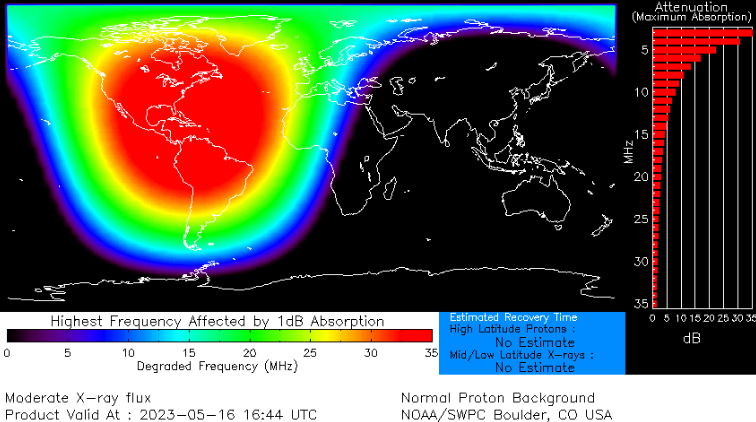
Although the underlying sunspot group was hidden from view, it nevertheless managed to touch Earth. Radiation ionized the top of our planet's atmosphere, causing a deep shortwave radio blackout over North America: map.
"I knew something significant was happening on the sun today when all the normal radio stations I monitor suddenly faded," reports amateur radio astronomer Thomas Ashcraft of New Mexico. His shortwave radio telescope recorded the broadband event:

Horizontal lines in this dynamic spectrum are terrestrial radio stations. All of them sharply faded immediately after the flare. Loss of signal lasted 10 minutes at the top of the band (27 MHz) and more than 20 min at the bottom (16 MHz). This is typical of solar radio blackouts-- the lowest frequencies are hit hardest.
The source of this explosion may be the same farside sunspot we discussed on May 12th. If so, it could emerge over the eastern limb later today, with solar rotation turning it almost directly toward Earth this weekend. Solar flare alerts: SMS Text.
Realtime Aurora Photo Gallery
Free: Spaceweather.com Newsletter
SATURN'S CAT PENDANT: It's a far-out gift for the cat-lover in your life: Saturn's Cat. The sterling silver pendant touched space on April 29, 2023, when it hitched a ride onboard an Earth to Sky Calculus cosmic ray research balloon.
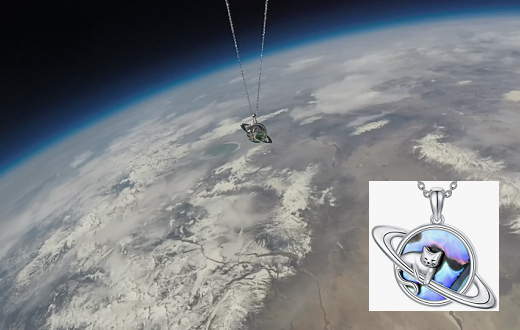
You can have it for $142.95. The students of Earth to Sky Calculus are selling space pendants to support their cosmic ray ballooning program. Each one comes with a greeting card showing the pendant in flight and telling the story of its journey to the stratosphere and back again.
Far Out Gifts: Earth to Sky Store
All sales support hands-on STEM education
SOLAR FILAMENTS OUTNUMBER SUNSPOTS: If there is an explosion on the sun today, it might not come from a sunspot. Unstable magnetic filaments pose the greater threat. This photo from Michael Borman of Evansville, Indiana, shows at least 20 dark filaments scattered around the solar disk:
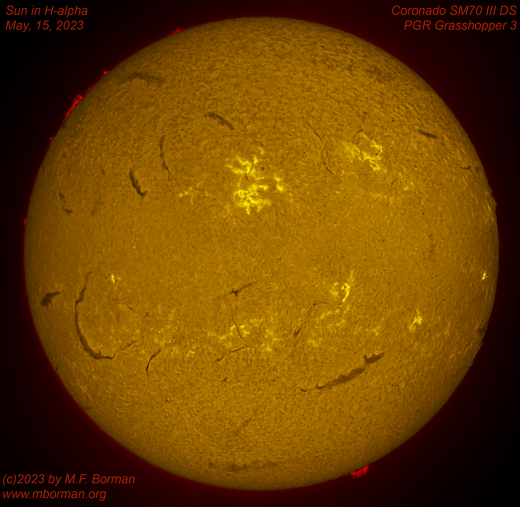
This means there are about three times more filaments than sunspot groups, with half-a-dozen directly facing Earth.
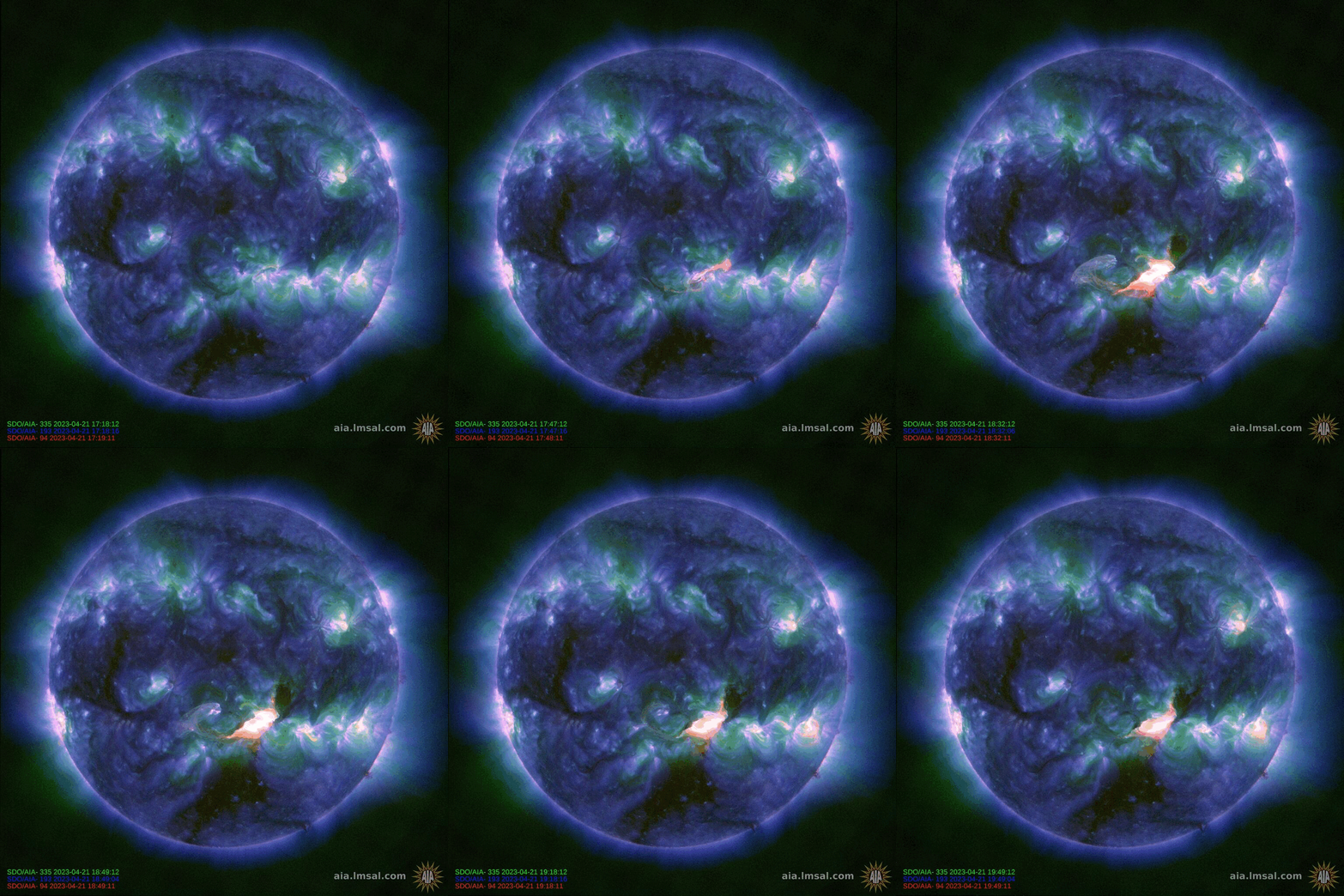
Famously unstable, solar filaments are twisted tubes of magnetism filled with dense plasma. Their eruptions can hurl massive CMEs into space. Sometimes the debris falls back to the surface of the sun, triggering a Hyder Flare; two explosions for the price of one. To illustrate the potency of these structures, the severe geomagnetic storm of April 23-24, 2023, was caused by a filament eruption, not a sunspot. Stay tuned. Solar flare alerts: SMS Text.
Realtime Space Weather Photo Gallery
Free: Spaceweather.com Newsletter